Review
. 2021 Sep 10;22(18):9821.
doi: 10.3390/ijms22189821.

Reactive Oxygen Species and Endothelial Ca2+ Signaling: Brothers in Arms or Partners in Crime?

Affiliations
Review

Reactive Oxygen Species and Endothelial Ca2+ Signaling: Brothers in Arms or Partners in Crime?

Sharon Negri et al. Int J Mol Sci. .

Abstract

An increase in intracellular Ca2+ concentration ([Ca2+]i) controls virtually all endothelial cell functions and is, therefore, crucial to maintain cardiovascular homeostasis. An aberrant elevation in endothelial can indeed lead to severe cardiovascular disorders. Likewise, moderate amounts of reactive oxygen species (ROS) induce intracellular Ca2+ signals to regulate vascular functions, while excessive ROS production may exploit dysregulated Ca2+ dynamics to induce endothelial injury. Herein, we survey how ROS induce endothelial Ca2+ signals to regulate vascular functions and, vice versa, how aberrant ROS generation may exploit the Ca2+ handling machinery to promote endothelial dysfunction. ROS elicit endothelial Ca2+ signals by regulating inositol-1,4,5-trisphosphate receptors, sarco-endoplasmic reticulum Ca2+-ATPase 2B, two-pore channels, store-operated Ca2+ entry (SOCE), and multiple isoforms of transient receptor potential (TRP) channels. ROS-induced endothelial Ca2+ signals regulate endothelial permeability, angiogenesis, and generation of vasorelaxing mediators and can be exploited to induce therapeutic angiogenesis, rescue neurovascular coupling, and induce cancer regression. However, an increase in endothelial [Ca2+]i induced by aberrant ROS formation may result in endothelial dysfunction, inflammatory diseases, metabolic disorders, and pulmonary artery hypertension. This information could pave the way to design alternative treatments to interfere with the life-threatening interconnection between endothelial ROS and Ca2+ signaling under multiple pathological conditions.

Keywords: Ca2+ signaling; InsP3 receptors; Orai; STIM; endothelial cells; glutathione; hydrogen peroxide; reactive oxygen species; superoxide anion; transient receptor potential channel.


Conflict of interest statement

The authors declare no conflict of interest.

Figures
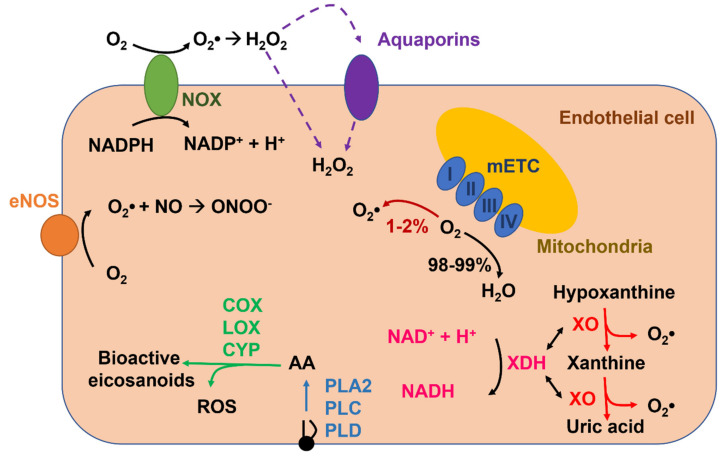
Figure 1
Figure 1
Major mechanisms of ROS production in vascular endothelial cells. The enzyme NADPH oxidase (NOX; green) catalyzes the transfer of an electron from NADPH to O2, generating O2 in the extracellular space. O2 is rapidly dismutated into H2O2, which may freely diffuse across the plasma membrane or enter the cytosol through aquaporins (purple). O2 is continuously generated in the mitochondria (right) by members (blue) of the electron transport chain machinery (mETC; blue) in the inner mitochondrial membrane. 1%-2% of the O2 consumed is estimated to be converted into O2 and not into H2O2. A fraction of this O2 can then leak to the cytoplasm through the VDACs in the outer mitochondrial membrane. During the oxidation of hypoxanthine to xanthine and xanthine to uric acid, XDH catalyzes the reduction of NAD+ to NADH, whereas XO catalyzes the reduction of O2 to O2 and not into H2O2. Arachidonic acid, which may be produced upon cleavage of glycerophospholipids on the plasma membrane by PLD, PLC, and PLA2, may generate ROS as secondary byproducts during its conversion into an array of bioactive eicosanoids by COXs, LOXs, and CYPs. Finally, eNOS (orange) releases NO in the presence of BH4 (coupled eNOS), while it produces O2 in the absence of BH4 (uncoupled eNOS).
Figure 2
Figure 2
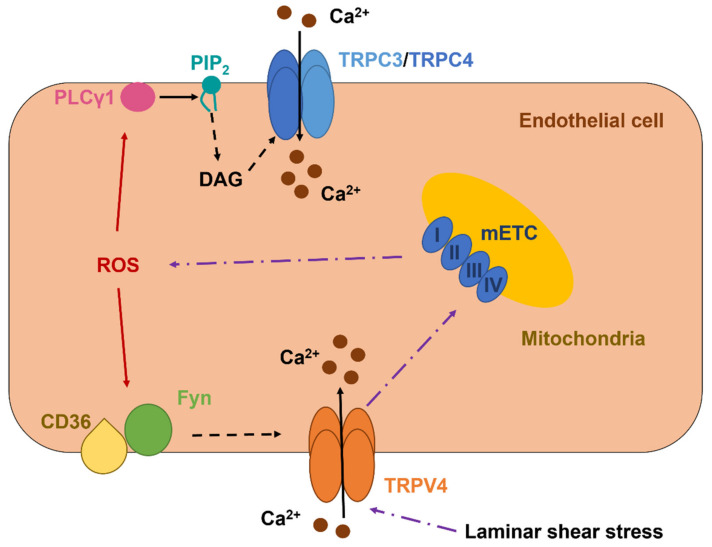
ROS activates TRPC3/TRPC4 heterotetramers and TRPV4 in vascular endothelial cells. ROS may activate endothelial TRPC3/TRPC4 heterotetramers and TRPV4 by exploiting two distinct mechanisms. ROS could stimulate PLCγ1 to cleave DAG from the minor membrane phospholipide, PIP2, thereby gating the TRPC3/TRPC4 heterotetramer. ROS could be detected by Fyn, which is required to activate TRPV4 in a redox-sensitive manner. The physical association between Fyn and TRPV4 is maintained by CD36. Laminar shear stress may boost the mitochondrial production of ROS by stimulating TRPV4-mediated extracellular Ca2+ entry.
Figure 3
Figure 3
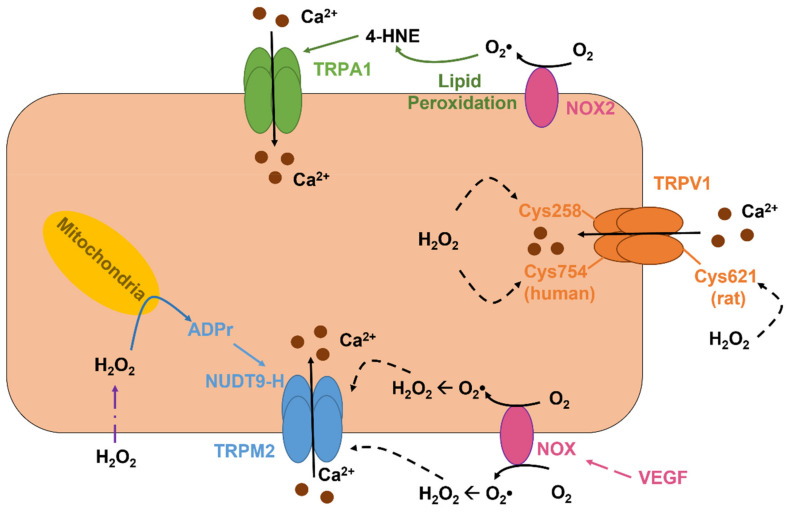
ROS activate endothelial TRPA1, TRPV1, and TRPM2. H2O2 may directly activate TRPV1, although the underlying mechanism may vary depending on the species and involves the cytosolic Cys258 and Cys274 and the extracellular Cys621 in the human and rat proteins, respectively (please see the text for further explanation). H2O2 may indirectly activate TRPM2 by inducing the mitochondrial production of ADPr, which binds to the COOH terminal NUDT9-H motif and gates the channel. VEGF-induced NOX2 activation may lead to TRPM2 activation upon intracellular ROS production. NOX2-derived O2 may induce lipid membrane peroxidation and thereby promote 4-HNE formation through the Fenton reaction. 4-HNE, in turn, stimulates TRPA1 to mediate extracellular Ca2+ entry.

References

    1. McCarron J.G., Wilson C., Heathcote H.R., Zhang X., Buckley C., Lee M.D. Heterogeneity and emergent behaviour in the vascular endothelium. Curr. Opin. Pharmacol. 2019;45:23–32. doi: 10.1016/j.coph.2019.03.008. - DOI - PMC - PubMed
    1. McCarron J.G., Lee M.D., Wilson C. The endothelium solves problems that endothelial cells do not know exist. Trends Pharmacol. Sci. 2017;38:322–338. doi: 10.1016/j.tips.2017.01.008. - DOI - PMC - PubMed
    1. Negri S., Faris P., Rosti V., Antognazza M.R., Lodola F., Moccia F. Endothelial TRPV1 as an emerging molecular target to promote therapeutic angiogenesis. Cells. 2020;9:1341. doi: 10.3390/cells9061341. - DOI - PMC - PubMed
    1. Faris P., Negri S., Perna A., Rosti V., Guerra G., Moccia F. Therapeutic potential of endothelial colony-forming cells in ischemic disease: Strategies to improve their regenerative efficacy. Int. J. Mol. Sci. 2020;21:7406. doi: 10.3390/ijms21197406. - DOI - PMC - PubMed
    1. Negri S., Faris P., Berra-Romani R., Guerra G., Moccia F. Endothelial transient receptor potential channels and vascular remodeling: Extracellular Ca2+ entry for angiogenesis, arteriogenesis and vasculogenesis. Front. Physiol. 2019;10:1618. doi: 10.3389/fphys.2019.01618. - DOI - PMC - PubMed

MeSH terms

LinkOut - more resources