. 2021 Sep 14;22(18):9921.
doi: 10.3390/ijms22189921.

Role of Iron-Containing Alcohol Dehydrogenases in Acinetobacter baumannii ATCC 19606 Stress Resistance and Virulence

Affiliations

Role of Iron-Containing Alcohol Dehydrogenases in Acinetobacter baumannii ATCC 19606 Stress Resistance and Virulence

Guang-Huey Lin et al. Int J Mol Sci. .

Abstract

Most bacteria possess alcohol dehydrogenase (ADH) genes (Adh genes) to mitigate alcohol toxicity, but these genes have functions beyond alcohol degradation. Previous research has shown that ADH can modulate quorum sensing in Acinetobacter baumannii, a rising opportunistic pathogen. However, the number and nature of Adh genes in A. baumannii have not yet been fully characterized. We identified seven alcohol dehydrogenases (NAD+-ADHs) from A. baumannii ATCC 19606, and examined the roles of three iron-containing ADHs, ADH3, ADH4, and ADH6. Marker-less mutation was used to generate Adh3, Adh4, and Adh6 single, double, and triple mutants. Disrupted Adh4 mutants failed to grow in ethanol-, 1-butanol-, or 1-propanol-containing mediums, and recombinant ADH4 exhibited strongest activity against ethanol. Stress resistance assays with inorganic and organic hydroperoxides showed that Adh3 and Adh6 were key to oxidative stress resistance. Virulence assays performed on the Galleria mellonella model organism revealed that Adh4 mutants had comparable virulence to wild-type, while Adh3 and Adh6 mutants had reduced virulence. The results suggest that ADH4 is primarily involved in alcohol metabolism, while ADH3 and ADH6 are key to stress resistance and virulence. Further investigation into the roles of other ADHs in A. baumannii is warranted.

Keywords: alcohol metabolism; iron-containing alcohol dehydrogenase; stress resistance; virulence.


Conflict of interest statement

The authors declare no conflict of interest. The funders had no role in the design of the study; in the collection, analyses, or interpretation of data; in the writing of the manuscript, or in the decision to publish the results.

Figures
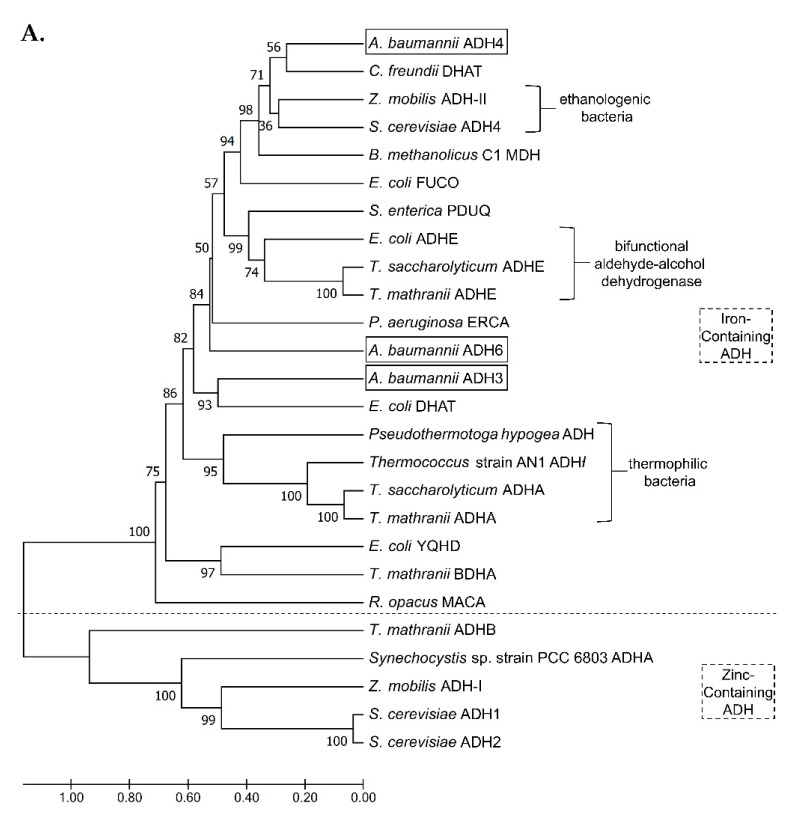
Figure 1
Figure 1
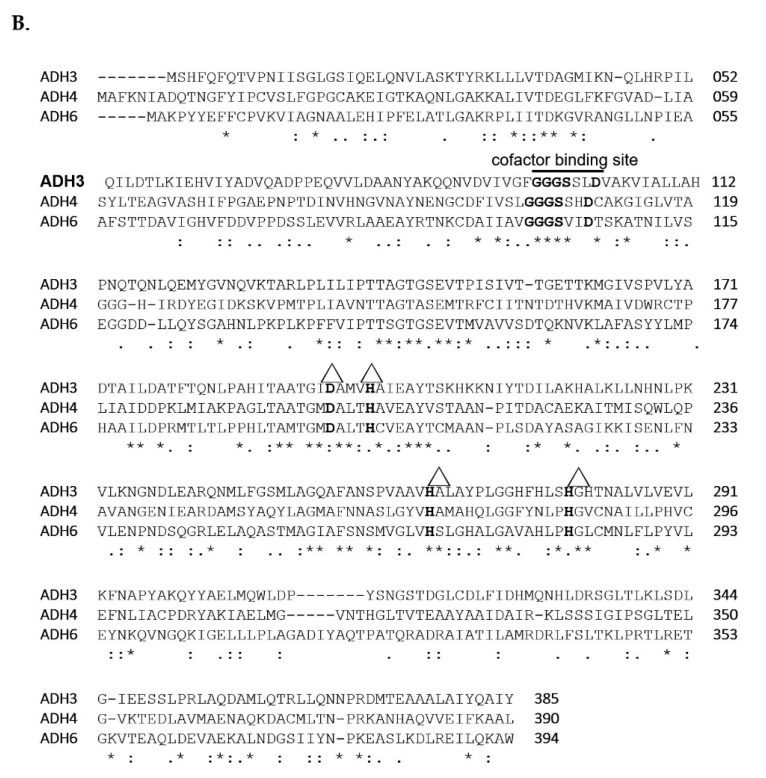
(A) Cladogram of iron-containing Adh genes in A. baumannii compared with 23 other Adh genes from 14 organisms. The scale bar indicates the number of nucleotide substitutions per site. (B) Amino acid alignment of three FeADHs (ADH3, ADH4, ADH6) in A. baumannii. Δ indicates the positions of the four key iron-binding sites (D, H, H, H). Asterisks (*) indicate positions with single fully conserved amino acid residues; colons (:) indicate positions with conservation between residues of strongly similar properties (scoring > 0.5 in the Gonnet point accepted mutation 250 matrix); and periods (.) indicate positions with conservation between groups of weakly similar properties (scoring ≤ 0.5 in the Gonnet point accepted mutation 250 matrix).
Figure 1
Figure 1
(A) Cladogram of iron-containing Adh genes in A. baumannii compared with 23 other Adh genes from 14 organisms. The scale bar indicates the number of nucleotide substitutions per site. (B) Amino acid alignment of three FeADHs (ADH3, ADH4, ADH6) in A. baumannii. Δ indicates the positions of the four key iron-binding sites (D, H, H, H). Asterisks (*) indicate positions with single fully conserved amino acid residues; colons (:) indicate positions with conservation between residues of strongly similar properties (scoring > 0.5 in the Gonnet point accepted mutation 250 matrix); and periods (.) indicate positions with conservation between groups of weakly similar properties (scoring ≤ 0.5 in the Gonnet point accepted mutation 250 matrix).
Figure 2
Figure 2
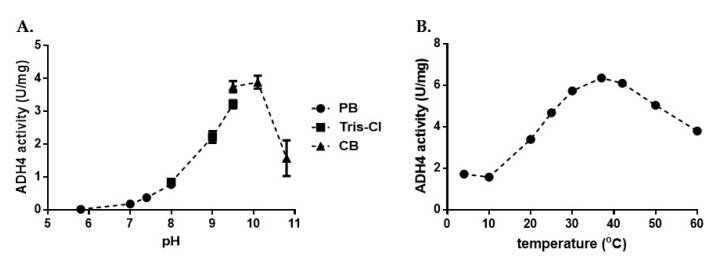
(A) Optimum pH conditions for ADH4 enzymatic activity. ADH4 enzymatic activity was assessed at room temperature under the following pH ranges: Tris-Cl: pH = 5.8–8; PB, phosphate buffer: pH = 8–9.5; CB, carbonate-bicarbonate buffer: pH = 9.5–10.8. The production of 1 µmole of NADH was defined as 1 unit of ADH activity. (B) Optimum temperature of ADH4 enzymatic activity. ADH4 enzymatic activity was assessed for different temperatures at the optimum pH of 10.8 in CB buffer.
Figure 3
Figure 3
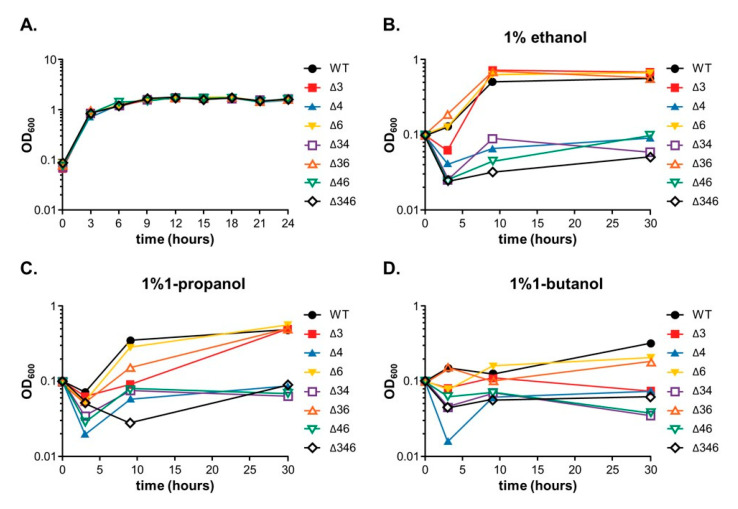
Growth rates of wild-type (WT) or mutant strains in different medium. (A) Growth rates in LB medium. (B) Growth rates in M9 medium containing 1% ethanol. (C) Growth rates in M9 medium containing 1% 1-propanol. (D) Growth rates in M9 medium containing 1% 1-butanol.
Figure 4
Figure 4
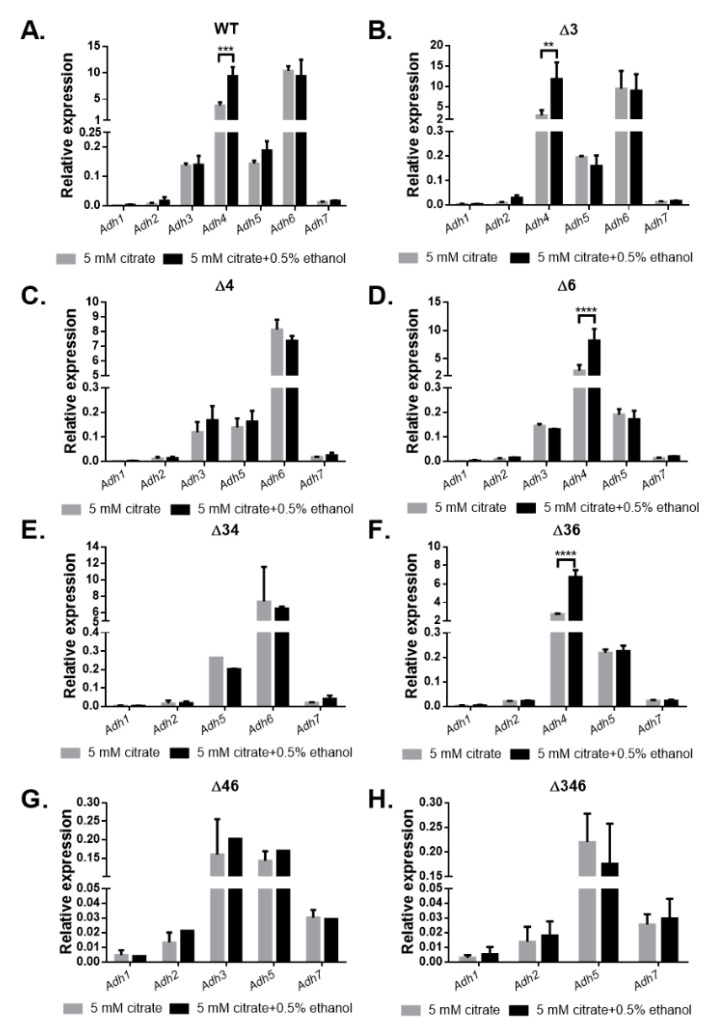
Relative gene expression of Adh genes in wild-type and mutant strains after culturing in medium with or without ethanol. The gyrase gene (A4U85_RS04125) was used as a control to calculate relative expression levels. Comparison of relative gene expression for A. baumannii ATCC 19606 (A) wild-type; (B) Δ3 single mutant; (C) Δ4 single mutant; (D) Δ6 single mutant; (E) Δ34 double mutant; (F) Δ36 double mutant; (G) Δ46 double mutant; and (H) Δ346 triple mutant strains cultured in M9 medium with 5 mM citrate (gray bar) or 5 mM citrate and 0.5% ethanol (black bar). Two-way ANOVA tests were conducted to assess statistical significance. ** p < 0.01; *** p < 0.001; **** p < 0.0001.
Figure 5
Figure 5
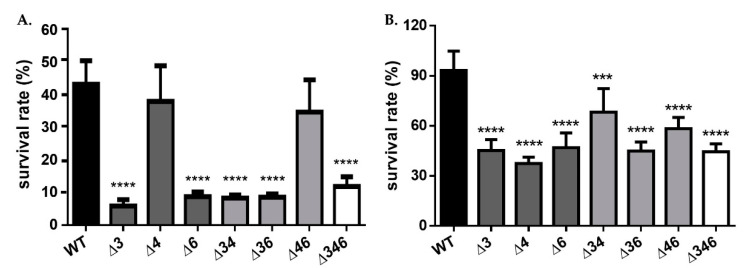
Survival rates of wild-type or mutant strains treated with (A) 5 mM H2O2; or (B) 300 mM tert-BHP for 20 min. Two-way ANOVA tests were conducted to assess statistical significance. *** p < 0.001; **** p < 0.0001.
Figure 6
Figure 6
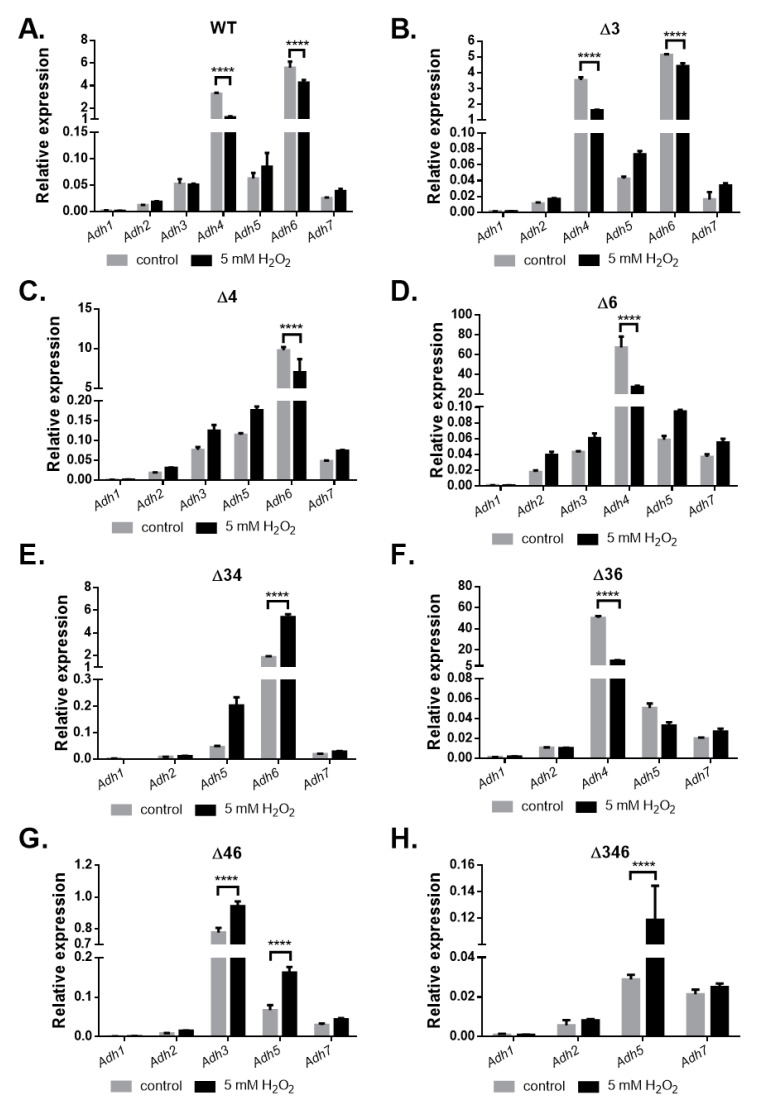
Relative gene expression of Adh genes in wild-type and mutant strains after treatment with H2O2 for 20 min. Comparison of relative gene expression for A. baumannii ATCC 19606 (A) wild-type; (B) Δ3 single mutant; (C) Δ4 single mutant; (D) Δ6 single mutant; (E) Δ34 double mutant; (F) Δ36 double mutant; (G) Δ46 double mutant; and (H) Δ346 triple mutant strains cultured in M9 medium before (gray bar) and after 5 mM H2O2 treatment for 20 min (black bar). Two-way ANOVA tests were conducted to assess statistical significance. **** p < 0.0001.
Figure 7
Figure 7
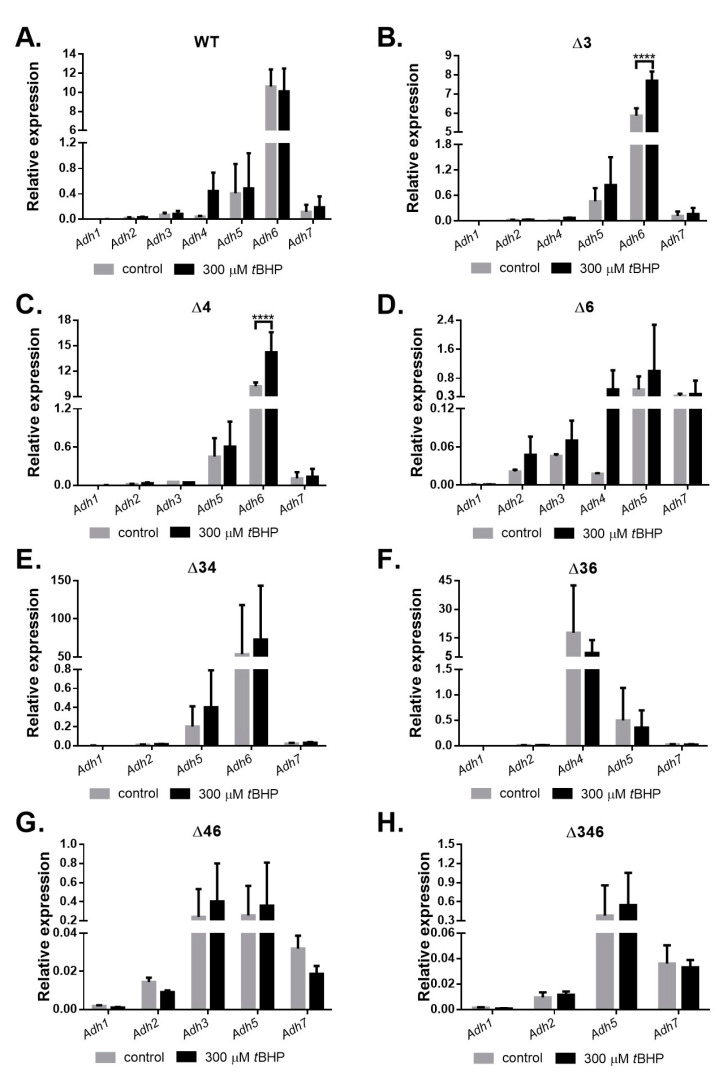
Relative gene expression of Adh genes in wild-type and mutant strains after treatment with tert-BHP for 20 min. Comparison of relative gene expression for A. baumannii ATCC 19606 (A) wild-type; (B) Δ3 single mutant; (C) Δ4 single mutant; (D) Δ6 single mutant; (E) Δ34 double mutant; (F) Δ36 double mutant; (G) Δ46 double mutant; and (H) Δ346 triple mutant strains cultured in M9 medium before (gray bar) and after 300 mM tert-BHP treatment for 20 min (black bar). Two-way ANOVA tests were conducted to assess statistical significance. **** p < 0.0001.
Figure 8
Figure 8
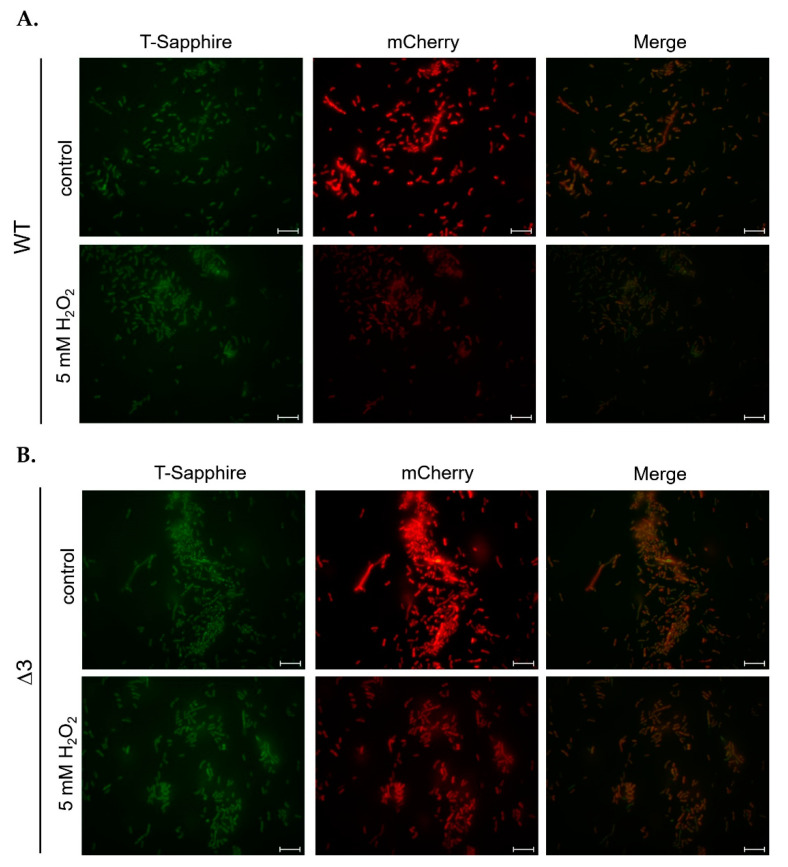
Fluorescence analysis of A. baumannii ATCC 19606 (A) wild-type and (B) Δ3 single mutant with a Peredox plasmid. Here, mCherry fluorescence reflects bacterial viability, while T-Sapphire fluorescence reflects redox changes in bacteria. A total of 5 µL of bacterial culture before (control) and after 5 mM H2O2 treatment for 20 min were added to slides before observation, with mCherry images captured after 4 s of excitation at a wavelength of 587 nm, while T-Sapphire images were captured after 8 s of excitation at a wavelength of 400 nm. Scale bars: 10 µm.
Figure 9
Figure 9
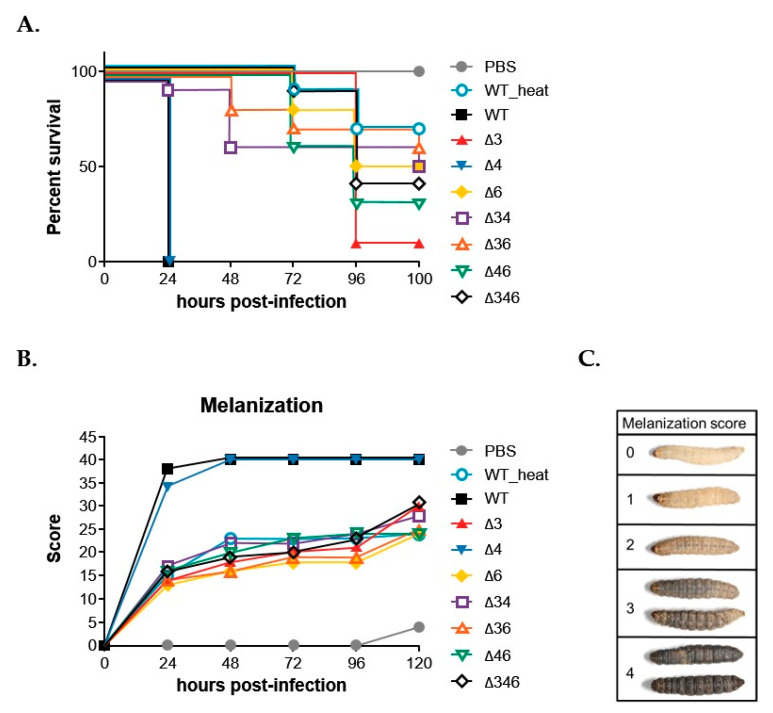
G. mellonella survival rates and melanization scores after infection with A. baumannii ATCC 19606 wild-type (WT) and mutant strains. (A) Kaplan–Meier survival curves, with each curve representing a single experiment performed with 10 larvae. (B) Melanization score curves. (C) Pictorial definition of melanization scores for reference. Larvae were infected with 5 × 10⁶ CFU of wild-type or mutant strains, with PBS used as the buffer and serving as a control. WT_heat indicates wild-type A. baumannii treated at 100 °C for 10 min.

References

    1. Gaona-López C., Julián-Sánchez A., Riveros-Rosas H. Diversity and Evolutionary Analysis of Iron-Containing (Type-III) Alcohol Dehydrogenases in Eukaryotes. PLoS ONE. 2016;11:e0166851. doi: 10.1371/journal.pone.0166851. - DOI - PMC - PubMed
    1. Horinouchi T., Maeda T., Furusawa C. Understanding and engineering alcohol-tolerant bacteria using OMICS technology. World J. Microbiol. Biotechnol. 2018;34:157. doi: 10.1007/s11274-018-2542-4. - DOI - PMC - PubMed
    1. Jörnvall H., Persson B., Jeffery J. Characteristics of alcohol/polyol dehydrogenases. The zinc-containing long-chain alcohol dehydrogenases. Eur. J. Biochem. 1987;167:195–201. doi: 10.1111/j.1432-1033.1987.tb13323.x. - DOI - PubMed
    1. Jörnvall H. Medium- and short-chain dehydrogenase/reductase gene and protein families: MDR and SDR gene and protein superfamilies. Cell. Mol. Life Sci. 2008;65:3873–3878. doi: 10.1007/s00018-008-8586-0. - DOI - PMC - PubMed
    1. Persson B., Hedlund J., Jörnvall H. Medium- and short-chain dehydrogenase/reductase gene and protein families: The MDR superfamily. Cell. Mol. Life Sci. 2008;65:3879–3894. doi: 10.1007/s00018-008-8587-z. - DOI - PMC - PubMed

MeSH terms

LinkOut - more resources