


The Role of Gut Microbiota and Gut-Brain Interplay in Selected Diseases of the Central Nervous System
- PMID: 34576191
- PMCID: PMC8471822
- DOI: 10.3390/ijms221810028
The Role of Gut Microbiota and Gut-Brain Interplay in Selected Diseases of the Central Nervous System
Abstract
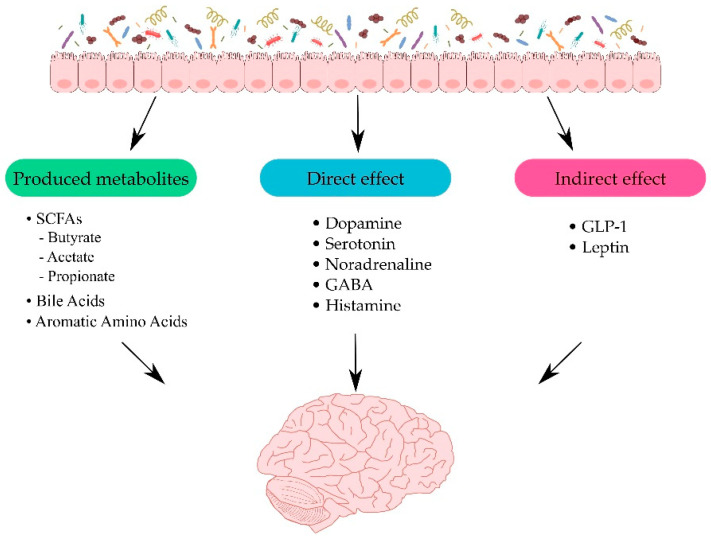
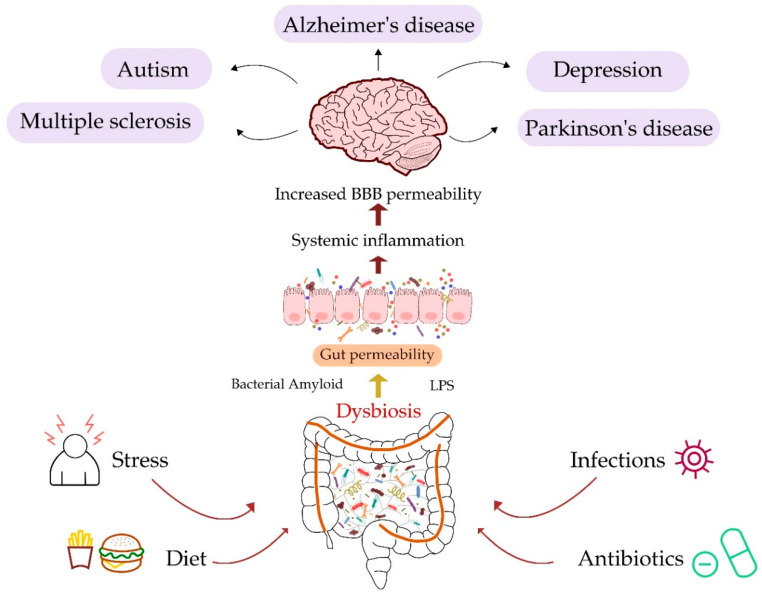
The gut microbiome has attracted increasing attention from researchers in recent years. The microbiota can have a specific and complex cross-talk with the host, particularly with the central nervous system (CNS), creating the so-called "gut-brain axis". Communication between the gut, intestinal microbiota, and the brain involves the secretion of various metabolites such as short-chain fatty acids (SCFAs), structural components of bacteria, and signaling molecules. Moreover, an imbalance in the gut microbiota composition modulates the immune system and function of tissue barriers such as the blood-brain barrier (BBB). Therefore, the aim of this literature review is to describe how the gut-brain interplay may contribute to the development of various neurological disorders, combining the fields of gastroenterology and neuroscience. We present recent findings concerning the effect of the altered microbiota on neurodegeneration and neuroinflammation, including Alzheimer's and Parkinson's diseases, as well as multiple sclerosis. Moreover, the impact of the pathological shift in the microbiome on selected neuropsychological disorders, i.e., major depressive disorders (MDD) and autism spectrum disorder (ASD), is also discussed. Future research on the effect of balanced gut microbiota composition on the gut-brain axis would help to identify new potential opportunities for therapeutic interventions in the presented diseases.
Keywords: central nervous system; dysbiosis; enteric nervous system; gut microbiota; gut–brain axis; neurodegeneration; neuroinflammation; neuropsychiatric disorders.
Conflict of interest statement
The authors declare no conflict of interest.
Figures
Similar articles
-
Dysbiosis of gut microbiota and microbial metabolites in Parkinson's Disease.Ageing Res Rev. 2018 Aug;45:53-61. doi: 10.1016/j.arr.2018.04.004. Epub 2018 Apr 26. Ageing Res Rev. 2018. PMID: 29705121 Review.
-
Impact of Microbiome-Brain Communication on Neuroinflammation and Neurodegeneration.Int J Mol Sci. 2023 Oct 5;24(19):14925. doi: 10.3390/ijms241914925. Int J Mol Sci. 2023. PMID: 37834373 Free PMC article. Review.
-
Mind-altering with the gut: Modulation of the gut-brain axis with probiotics.J Microbiol. 2018 Mar;56(3):172-182. doi: 10.1007/s12275-018-8032-4. Epub 2018 Feb 28. J Microbiol. 2018. PMID: 29492874 Review.
-
The role of the gut microbiota in development, function and disorders of the central nervous system and the enteric nervous system.J Neuroendocrinol. 2019 May;31(5):e12684. doi: 10.1111/jne.12684. Epub 2019 Feb 1. J Neuroendocrinol. 2019. PMID: 30614568 Review.
-
The Microbiota-Gut-Brain Axis.Physiol Rev. 2019 Oct 1;99(4):1877-2013. doi: 10.1152/physrev.00018.2018. Physiol Rev. 2019. PMID: 31460832 Review.
Cited by
-
Iron toxicity, ferroptosis and microbiota in Parkinson's disease: Implications for novel targets.Adv Neurotoxicol. 2024;11:105-132. doi: 10.1016/bs.ant.2024.02.001. Epub 2024 Feb 15. Adv Neurotoxicol. 2024. PMID: 38770370 Free PMC article.
-
Sodium butyrate aids brain injury repair in neonatal rats.Open Life Sci. 2025 Apr 25;20(1):20221046. doi: 10.1515/biol-2022-1046. eCollection 2025. Open Life Sci. 2025. PMID: 40291783 Free PMC article.
-
The Microbiome Connection: A Common Pathway Linking Cancer and Heart Failure.Biomedicines. 2025 May 25;13(6):1297. doi: 10.3390/biomedicines13061297. Biomedicines. 2025. PMID: 40564016 Free PMC article. Review.
-
Mechanism and Therapeutic Prospect of miRNAs in Neurodegenerative Diseases.Behav Neurol. 2023 Nov 23;2023:8537296. doi: 10.1155/2023/8537296. eCollection 2023. Behav Neurol. 2023. PMID: 38058356 Free PMC article. Review.
-
From Microbial Homeostasis to Systemic Pathogenesis: A Narrative Review on Gut Flora's Role in Neuropsychiatric, Metabolic, and Cancer Disorders.J Inflamm Res. 2025 Jul 5;18:8851-8873. doi: 10.2147/JIR.S531671. eCollection 2025. J Inflamm Res. 2025. PMID: 40635765 Free PMC article. Review.
References
-
- Luczynski P., Whelan S.O., O’Sullivan C., Clarke G., Shanahan F., Dinan T.G., Cryan J.F. Adult microbiota-deficient mice have distinct dendritic morphological changes: Differential effects in the amygdala and hippocampus. Eur. J. Neurosci. 2016;44:2654–2666. doi: 10.1111/ejn.13291. - DOI - PMC - PubMed
Publication types
MeSH terms
LinkOut - more resources
Full Text Sources
