Review
. 2021 Sep 21;22(18):10150.
doi: 10.3390/ijms221810150.

Eosinophils as Drivers of Severe Eosinophilic Asthma: Endotypes or Plasticity?

Affiliations
Review

Eosinophils as Drivers of Severe Eosinophilic Asthma: Endotypes or Plasticity?

Glenn Van Hulst et al. Int J Mol Sci. .

Abstract

Asthma is now recognized as a heterogeneous disease, encompassing different phenotypes driven by distinct pathophysiological mechanisms called endotypes. Common phenotypes of asthma, referred to as eosinophilic asthma, are characterized by the presence of eosinophilia. Eosinophils are usually considered invariant, terminally differentiated effector cells and have become a primary therapeutic target in severe eosinophilic asthma (SEA) and other eosinophil-associated diseases (EADs). Biological treatments that target eosinophils reveal an unexpectedly complex role of eosinophils in asthma, including in SEA, suggesting that "not all eosinophils are equal". In this review, we address our current understanding of the role of eosinophils in asthma with regard to asthma phenotypes and endotypes. We further address the possibility that different SEA phenotypes may involve differences in eosinophil biology. We discuss how these differences could arise through eosinophil "endotyping", viz. adaptations of eosinophil function imprinted during their development, or through tissue-induced plasticity, viz. local adaptations of eosinophil function through interaction with their lung tissue niches. In doing so, we also discuss opportunities, technical challenges, and open questions that, if addressed, might provide considerable benefits in guiding the choice of the most efficient precision therapies of SEA and, by extension, other EADs.

Keywords: endotypes; eosinophil subsets; eosinophilic asthma; eosinophils; immunotherapy; plasticity.


Conflict of interest statement

The authors declare no conflict of interest. The funders had no role in the design of the study; in the collection, analyses, or interpretation of data; in the writing of the manuscript, or in the decision to publish the results. C.J.D. received honoraria from GSK Biologicals and consulting fees from AstraZeneca, with no relation to the present work.

Figures
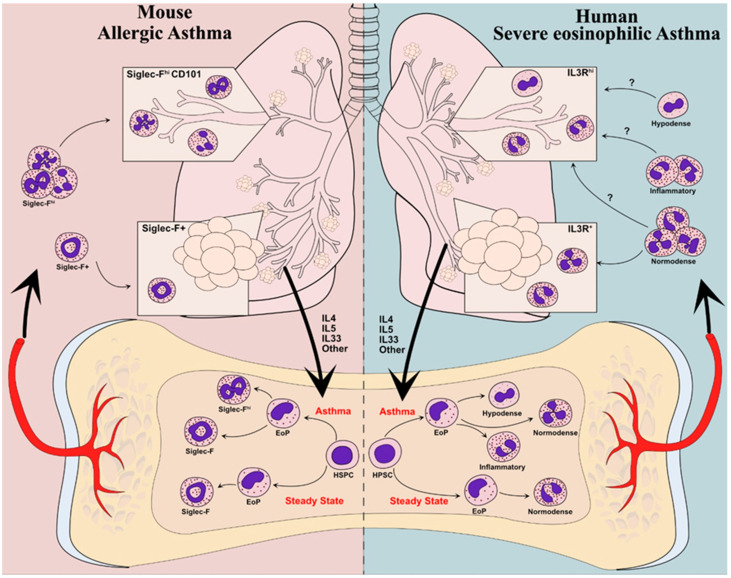
Figure 1
Figure 1
Developmental “endotyping” of murine and human eosinophils in asthma. In mice (left panel), eosinophils in the steady state populate the lung parenchyma but do not infiltrate the bronchial mucosa. In models of allergic asthma, type-2 inflammatory cues, including IL-5, promote the differentiation of eosinophil progenitors (EoPs) into large numbers of “inflammatory” SiglecFhi eosinophils that infiltrate the bronchial mucosa. In humans (right), patients with severe eosinophilic asthma harbor hypodense eosinophils that are most likely derived from the altered development of eosinophil progenitors in response to inflammatory cues. Whether other eosinophils with an “inflammatory” program develop as in mice remains to be established. The respective contribution of normodense, hypodense, and putative inflammatory eosinophils to mucosal inflammation in human asthma remains to be established. (HSPC: hematopoietic stem and progenitor cell; EoP: eosinophil progenitor).
Figure 2
Figure 2
Lung niche-induced plasticity of eosinophils in asthma. Circulating eosinophils may be envisioned as “prototypes” that, once they reach different locations in the lung, occupy specific “niches” that will tailor their final effector functions. Three such potential niches are depicted here. The bronchial mucosa (upper left) is a preferential site of accumulation of eosinophils in asthma, in which eosinophils are exposed to many different clues they can perceive, such as type-2 cytokines and alarmins that may activate and modulate their function. In turn, eosinophils are induced to produce and release many mediators favoring airway remodeling. Eosinophils may also populate a more specific “neuroimmune” niche in the inflamed lung mucosa (lower left), as they are strongly attracted to autonomous nerves with which they tightly interact and whose function they modulate. In the steady state, eosinophils mostly populate the parenchymal lung compartment (lower right) and exert immunoregulatory functions (at least in mice). In these different niches, plasticity could also be involved in determining the type of activation and mediator release of eosinophils, influencing their impact on the surrounding tissue (upper right).

Comment in

References

    1. Soriano J.B., Abajobir A.A., Abate K.H., Abera S.F., Agrawal A., Ahmed M.B., Aichour A.N., Aichour I., Aichour M.T.E., Alam K., et al. Global, regional, and national deaths, prevalence, disability-adjusted life years, and years lived with disability for chronic obstructive pulmonary disease and asthma, 1990–2015: A systematic analysis for the Global Burden of Disease Study 2015. Lancet Respir. Med. 2017;5:691–706. doi: 10.1016/S2213-2600(17)30293-X. - DOI - PMC - PubMed

    1. Reddel H.K., Bateman E.D., Becker A., Boulet L.-P., Cruz A.A., Drazen J.M., Haahtela T., Hurd S.S., Inoue H., de Jongste J.C., et al. A summary of the new GINA strategy: A roadmap to asthma control. Eur. Respir. J. 2015;46:622–639. doi: 10.1183/13993003.00853-2015. - DOI - PMC - PubMed
    1. Castillo J.R., Peters S.P., Busse W.W. Asthma Exacerbations: Pathogenesis, Prevention, and Treatment. J. Allergy Clin. Immunol. Pract. 2017;5:918–927. doi: 10.1016/j.jaip.2017.05.001. - DOI - PMC - PubMed
    1. Papi A., Brightling C., Pedersen S.E., Reddel H.K. Asthma. Lancet. 2018;391:783–800. doi: 10.1016/S0140-6736(17)33311-1. - DOI - PubMed
    1. Chung K.F., Wenzel S.E., Brozek J.L., Bush A., Castro M., Sterk P.J., Adcock I.M., Bateman E.D., Bel E.H., Bleecker E.R., et al. International ERS/ATS guidelines on definition, evaluation and treatment of severe asthma. Eur. Respir. J. 2014;43:343–373. doi: 10.1183/09031936.00202013. - DOI - PubMed