


Joint Cardioprotective Effect of Vitamin C and Other Antioxidants against Reperfusion Injury in Patients with Acute Myocardial Infarction Undergoing Percutaneous Coronary Intervention
- PMID: 34577176
- PMCID: PMC8468345
- DOI: 10.3390/molecules26185702
Joint Cardioprotective Effect of Vitamin C and Other Antioxidants against Reperfusion Injury in Patients with Acute Myocardial Infarction Undergoing Percutaneous Coronary Intervention
Abstract
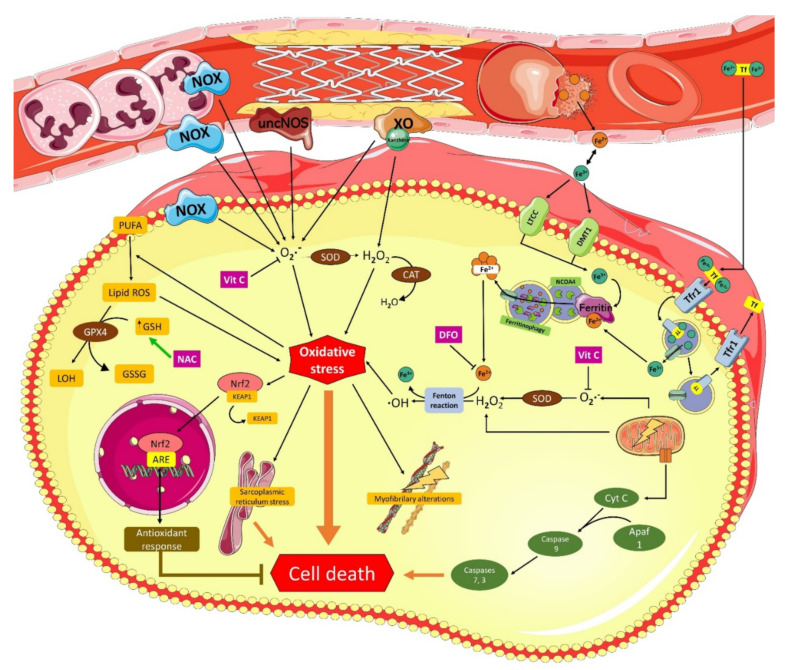
Percutaneous coronary intervention (PCI) has long remained the gold standard therapy to restore coronary blood flow after acute myocardial infarction (AMI). However, this procedure leads to the development of increased production of reactive oxygen species (ROS) that can exacerbate the damage caused by AMI, particularly during the reperfusion phase. Numerous attempts based on antioxidant treatments, aimed to reduce the oxidative injury of cardiac tissue, have failed in achieving an effective therapy for these patients. Among these studies, results derived from the use of vitamin C (Vit C) have been inconclusive so far, likely due to suboptimal study designs, misinterpretations, and the erroneous conclusions of clinical trials. Nevertheless, recent clinical trials have shown that the intravenous infusion of Vit C prior to PCI-reduced cardiac injury biomarkers, as well as inflammatory biomarkers and ROS production. In addition, improvements of functional parameters, such as left ventricular ejection fraction (LVEF) and telediastolic left ventricular volume, showed a trend but had an inconclusive association with Vit C. Therefore, it seems reasonable that these beneficial effects could be further enhanced by the association with other antioxidant agents. Indeed, the complexity and the multifactorial nature of the mechanism of injury occurring in AMI demands multitarget agents to reach an enhancement of the expected cardioprotection, a paradigm needing to be demonstrated. The present review provides data supporting the view that an intravenous infusion containing combined safe antioxidants could be a suitable strategy to reduce cardiac injury, thus improving the clinical outcome, life quality, and life expectancy of patients subjected to PCI following AMI.
Keywords: antioxidants; cardioprotection; ischemia-reperfusion; percutaneous coronary intervention; vitamin C.
Conflict of interest statement
The authors declare no conflict of interest.
Figures
References
-
- WHO WHO Reveals Leading Causes of Death and Disability Worldwide: 2000–2019. [(accessed on 17 May 2021)]. Available online: https://www.who.int/news/item/09-12-2020-who-reveals-leading-causes-of-d....
-
- WHO Cardiovascular Diseases. [(accessed on 17 May 2021)]. Available online: https://www.who.int/health-topics/cardiovascular-diseases/#tab=tab_1.
-
- Ahmad M., Mehta P., Reddivari A.K.R., Mungee S. Percutaneous Coronary Intervention. StatPearls Publishing; Treasure Island, FL, USA: 2021. - PubMed
-
- Massalha S., Luria L., Kerner A., Roguin A., Abergel E., Hammerman H., Boulos M., Dragu R., Kapeliovich M.R., Beyar R., et al. Heart failure in patients with diabetes undergoing primary percutaneous coronary intervention. Eur. Heart J. Acute Cardiovasc. Care. 2016;5:455–462. doi: 10.1177/2048872615598632. - DOI - PubMed
Publication types
MeSH terms
Substances
Grants and funding
LinkOut - more resources
Full Text Sources
Medical
Miscellaneous
