Review
. 2021 Aug 29;14(9):872.
doi: 10.3390/ph14090872.

Peptide Receptor Radionuclide Therapy and Primary Brain Tumors: An Overview

Affiliations
Review

Peptide Receptor Radionuclide Therapy and Primary Brain Tumors: An Overview

Andrea Cimini et al. Pharmaceuticals (Basel). .

Abstract

Primary brain tumors (PBTs) are some of the most difficult types of cancer to treat, and despite advancements in surgery, chemotherapy and radiotherapy, new strategies for the treatment of PBTs are needed, especially for those with poor prognosis such as inoperable/difficult-to-reach lesions or relapsing disease. In regard to the last point, malignant primary brain tumors remain some of the most lethal types of cancer. Nuclear medicine may provide exciting new weapons and significant contributions in the treatment of PBTs. In this review, we performed literature research in order to highlight the possible role of peptide receptor radionuclide therapy (PRRT) in the treatment of PBTs with radiolabeled molecules that bind with high-affinity transmembrane receptors such as somatostatin receptors (SSTRs), neurokinin type-1 receptor and prostate-specific membrane antigen (PSMA). These receptors are overexpressed in some cancer types such as gliomas, meningiomas, pituitary tumors and medulloblastomas. A comprehensive overview of possible applications in this field will be shown, providing knowledge about benefits, feasibility, developments and limitations of PRRT in this type of tumor, also revealing new advantages in the management of the disease.

Keywords: nuclear medicine; peptide receptor radionuclide therapy; primary brain tumors; radiopharmaceuticals; theragnostics.


Conflict of interest statement

The authors declare no conflict of interest.

Figures
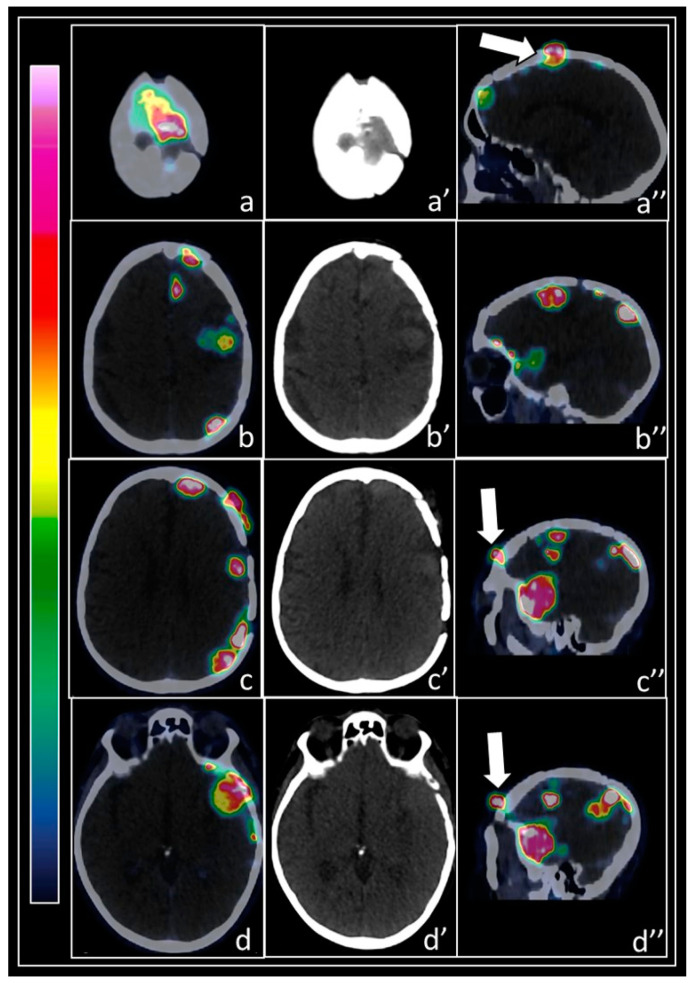
Figure 1
Figure 1
A 70-year-old patient with multiple meningiomatosis, already submitted to several consecutive interventions of surgical excision in the left-brain hemisphere and two treatments with cyberknife stereotactic radiosurgery for recurrences, was examined by brain PET/CT with 68Ga-DOTATOC for an evaluation of tumor extent as suggested by Laudicella et al. [34]. PET/CT displayed multiple foci of pathologic tracer uptake in the left-brain hemisphere, particularly in the cranial vertex, as shown in the axial PET/CT (a) and CT (a’) views, corresponding to a tracer-avid lesion protruding into the scalp, also evident in the correlative sagittal PET/CT view (a’’, arrow). The patient clinically presented skull deformation in the vertex of the skull. Other tracer-avid parafalcal and subcortical lesions were also detected, shown in the axial PET/CT (b) and CT (b’) views and correlative sagittal PET/CT view (b’’). Moreover, multiple cortical tracer-avid lesions were observed in the left-brain hemisphere, as evident in axial PET/CT (c) and CT (c’) details. Some of these lesions were protruding into the subcutaneous tissues in the left frontal region, as depicted in the sagittal PET/CT view (c’’, arrow). Finally, intense 68Ga-DOTATOC uptake was recorded in a slightly hyperdense area in the left temporal region, invading subcutaneous soft tissues in the ipsilateral scalp. This finding is summarized in the axial PET/CT (d) and CT (d’) views and sagittal PET/CT view (d’’, arrow).

References

    1. Cimini A., Ricci M., Chiaravalloti A., Filippi L., Schillaci O. Theragnostic Aspects and Radioimmunotherapy in Pediatric Tumors. Int. J. Mol. Sci. 2020;21:3849. doi: 10.3390/ijms21113849. - DOI - PMC - PubMed
    1. Ostrom Q.T., Gittleman H., Truitt G., Boscia A., Kruchko C., Barnholtz-Sloan J.S. CBTRUS Statistical Report: Primary Brain and Other Central Nervous System Tumors Diagnosed in the United States in 2011-2015. Neuro Oncol. 2018;20:iv1–iv86. doi: 10.1093/neuonc/noy131. - DOI - PMC - PubMed
    1. Lapoint S., Perry A., Butowski N.A. Primary brain tumours in adults. Lancet. 2018;392:432–446. doi: 10.1016/S0140-6736(18)30990-5. - DOI - PubMed
    1. Kanderi T., Gupta V. StatPearls. StatPearls Publishing; Treasure Island, FL, USA: 2021. Glioblastoma Multiforme. - PubMed
    1. Grech N., Dalli T., Mizzi S., Meilak L., Calleja N., Zrinzo A. Rising Incidence of Glioblastoma Multiforme in a Well-Defined Population. Cureus. 2020;12:e8195. doi: 10.7759/cureus.8195. - DOI - PMC - PubMed

LinkOut - more resources
