. 2021 Sep 8;10(9):1154.
doi: 10.3390/pathogens10091154.

An Exaggerated Immune Response in Female BALB/c Mice Controls Initial Toxoplasma gondii Multiplication but Increases Mortality and Morbidity Relative to Male Mice

Affiliations

An Exaggerated Immune Response in Female BALB/c Mice Controls Initial Toxoplasma gondii Multiplication but Increases Mortality and Morbidity Relative to Male Mice

Rasha Alonaizan et al. Pathogens. .

Abstract

Studies indicate that female mice are more susceptible to T. gondii infection, as defined by higher mortality rates in comparison to male mice. However, whether this is due to an inability to control initial parasite multiplication or due to detrimental effects of the immune system has not been determined. Therefore, the following studies were undertaken to determine the influence of sex on early parasite multiplication and the immune response during T. gondii infection and to correlate this with disease outcome. Early parasite replication was studied through applying an in vivo imaging system (IVIS) with luciferase expressing T. gondii. In parallel immunological events were studied by cytometric bead array to quantify key immunological mediators. The results confirmed the previous findings that female mice are more susceptible to acute infection, as determined by higher mortality rates and weight loss compared with males. However, conflicting with expectations, female mice had lower parasite burdens during the acute infection than male mice. Female mice also exhibited significantly increased production of Monocyte Chemoattractant Protein-1 (MCP-1), Interferon (IFN)-γ, and Tumour Necrosis Factor (TNF)-α than male mice. MCP-1 was found to be induced by T. gondii in a dose dependent manner suggesting that the observed increased levels detected in female mice was due to a host-mediated sex difference rather than due to parasite load. However, MCP-1 was not affected by physiological concentration of estrogen or testosterone, indicating that MCP-1 differences observed between the sexes in vivo are due to an as yet unidentified intermediary factor that in turn influences MCP-1 levels. These results suggest that a stronger immune response in female mice compared with male mice enhances their ability to control parasite replication but increases their morbidity and mortality.

Keywords: IVIS; MCP-1; Toxoplasma gondii; immune endocrine; immune response; parasite burdens; sex differences.


Conflict of interest statement

The authors declare no conflict of interest. The funders had no role in the design of the study; in the collection, analyses, or interpretation of data; in the writing of the manuscript; or in the decision to publish the results.

Figures

Figure 1
Figure 1
(A) Percentage survival of male and female mice infected with T. gondii from a representative experiment (B). Table showing the percentage survival of four independent experiments analyzed using the ratio paired t test (p = 0.032). Each value represents the mean of five animals per sex (experiments one and two) or ten animals per sex (experiment three) or nine male and ten female animals (experiment four).
Figure 2
Figure 2
Male mice have increased T. gondii multiplication compared with female mice. Data from a representative experiment from 4 separate experiments are shown in A, B, and C. (A) Five male and five female mice were infected with 2 × 10⁴ (ip) type II Prugniaud tachyzoites, expressing firefly luciferase. Mice were imaged at 4, 6, 8, and 10-days post-infections. This signal increased during the infection course and its peak was at day six. By day 10, the signal was reduced or no longer detectable in some of mice. (B) Quantitative analysis of parasite burdens was significantly higher among males in comparison to females in particularly at six-day post infection when parasite numbers peaked. (C) The result of the mean of total area under curve (AUC) of the parasite burden during infection course between male and female groups was significantly higher in male mice than female mice. Each value represents the mean ± SEM of five mice analyzed using a one-tailed nonparametric Mann–Whitney U test * p < 0.05. (D) The median AUC of four independent experiments using five animals per sex (experiments one and two) or ten animals per sex (experiment three) or nine male and ten female animals (experiment four) (p = 0.023).
Figure 3
Figure 3
Cytokine concentrations in the plasma of male and female mice infected with T. gondii. IL-6, IL-10, MCP-1, IFN-α TNF-α, and IL-12p70 were detected. The levels of these cytokines significantly increased in infected mice compared to uninfected mice. However, in the female group MCP-1, IFN-γ, and TNF-α cytokines were significantly higher in comparison to the male group with (p = 0.05, p = 0.05, and p = 0.03, respectively). Each value represents the mean of five animals per experimental group and were analyzed using one-tailed nonparametric Mann–Whitney analyses ± SEM. * p < 0.05.
Figure 4
Figure 4
Characterization of BMDMs used in the studies. BMDMs were phenotypically characterized by flow cytometry. Live cells were gated by their forward and side scatter; 91.8% of cells were F4/80 positive and 87.7% of cells were CD11b positive; 80.2% of cells were double positive for F4/80 and CD11b.
Figure 5
Figure 5
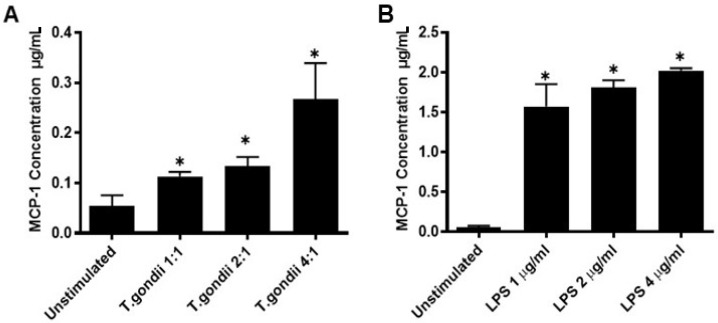
T. gondii stimulates macrophage production of MCP-1 in a dose dependent manner (A). T. gondii induced MCP-1 in a dose dependent fashion. (B) LPS induced MCP-1 at concentrations above 2 μg/mL. Each value represents the mean of three replicates and were analyzed using a one-tailed nonparametric Mann–Whitney U test ± SEM * p < 0.05.
Figure 6
Figure 6
Estradiol 17 beta (E2) and Testosterone downregulate MCP-1 production in a dose-dependent manner. Macrophages were treated with a range of concentrations of Estradiol (E2) then infected (A) T. gondii or stimulated with (B) LPS. Macrophages were also treated with a range of concentrations of Testosterone then infected with (C) T. gondii or stimulated with (D) LPS. Both hormones significantly reduced MCP-1 production in a dose dependent manner. Each value represents the mean of three replicates and were analyzed using a one-tailed nonparametric Mann–Whitney U test ± SEM * p < 0.05.

References

    1. Innes E.A. A brief history and overview of Toxoplasma gondii. Zoonoses Public Health. 2010;57:1–7. doi: 10.1111/j.1863-2378.2009.01276.x. - DOI - PubMed
    1. Halonen S.K., Weiss L.M. Toxoplasmosis. Handb. Clin. Neurol. 2013;114:125–145. - PMC - PubMed
    1. Weiss L.M., Dubey J.P. Toxoplasmosis: A history of clinical observations. Int. J. Parasitol. 2009;39:895–901. doi: 10.1016/j.ijpara.2009.02.004. - DOI - PMC - PubMed
    1. Hunter C.A., Sibley L.D. Modulation of innate immunity by Toxoplasma gondii virulence effectors. Nat. Rev. Microbiol. 2012;10:766–778. doi: 10.1038/nrmicro2858. - DOI - PMC - PubMed
    1. Braun L., Brenier-Pinchart M., Yogavel M., Curt-Varesano A., Curt-Bertini R., Hussain T., Kieffer-Jaquinod S., Coute Y., Pelloux H., Tardieux I., et al. A Toxoplasma dense granule protein, GRA24, modulates the early immune response to infection by promoting a direct and sustained host p38 MAPK activation. J. Exp. Med. 2013;21:2071–2086. doi: 10.1084/jem.20130103. - DOI - PMC - PubMed