. 2021 Sep 13;10(9):1181.
doi: 10.3390/pathogens10091181.

Occurrence and Identification of Ixodes ricinus Borne Pathogens in Northeastern Italy

Affiliations

Occurrence and Identification of Ixodes ricinus Borne Pathogens in Northeastern Italy

Michela Bertola et al. Pathogens. .

Abstract

In Europe, Ixodes ricinus is the main vector for tick-borne pathogens (TBPs), the most common tick species in Italy, particularly represented in pre-alpine and hilly northern areas. From 2011 to 2017, ticks were collected by dragging in Belluno province (northeast Italy) and analyzed by molecular techniques for TBP detection. Several species of Rickettsia spp. and Borrelia spp. Anaplaspa phagocitophilum, Neoerlichia mikurensis and Babesia venatorum, were found to be circulating in the study area carried by I. ricinus (n = 2668, all stages). Overall, 39.1% of screened pools were positive for at least one TBP, with a prevalence of 12.25% and 29.2% in immature stages and adults, respectively. Pathogens were detected in 85% of the monitored municipalities, moreover the presence of TBPs varied from one to seven different pathogens in the same year. The annual TBPs prevalence fluctuations observed in each municipality highlights the necessity of performing continuous tick surveillance. In conclusion, the observation of TBPs in ticks remains an efficient strategy for monitoring the circulation of tick-borne diseases (TBDs) in a specific area.

Keywords: Anaplaspa phagocitophilum; Babesia venatorum; Borrelia spp; Neoerlichia mikurensis; Rickettsia spp.; co-infection; prevalence; surveillance; tick-borne pathogens.


Conflict of interest statement

The authors declare no conflict of interest.

Figures
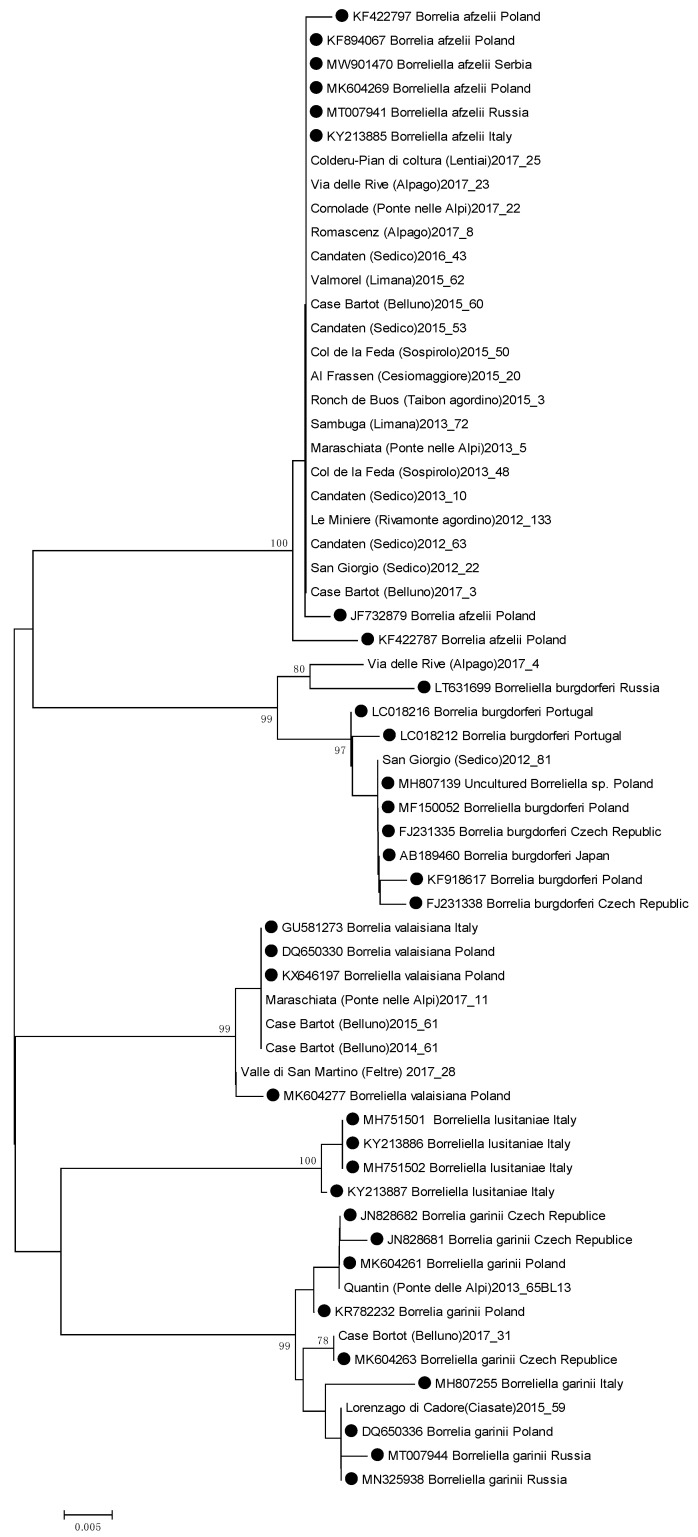
Figure A1
Figure A1
Phylogenetic tree based on Fla gene partial sequences of Borrelia burgdorferi sensu lato. Sequence dataset was analyzed using MEGA v6.0 [103]; the tree was constructed using the neighbor-joining (NJ) method and bootstrap analysis (1000 replicates) based on the ClustalW algorithm. Significant bootstrapping values (>70%) are shown on the nodes. The tree shows the representative sequences of this study based on years and sites. ● Reference sequences from Genbank.
Figure A2
Figure A2
Phylogenetic tree based on rOmpB gene partial sequences of Rickettsia spp. Sequence dataset was analyzed using MEGA v6.0 [103]; the tree was constructed using the neighbor-joining (NJ) method and bootstrap analysis (1000 replicates) based on the ClustalW algorithm. Significant bootstrapping values (>70%) are shown on the nodes. Rickettsia conorii was used as outgroup. The tree shows the representative sequences of this study based on years and sites. ● Reference sequences from Genbank.
Figure 1
Figure 1
Number of pools negative (0) or positive for 1, 2, or 3 TBPs per tick stage collected monthly during 2011–2017 (A) and per year (B). Axes x (Month): 4 = April, 6 = June, 8 = August, 10 = October.
Figure 2
Figure 2
Occurrence of TBPs detected in monitored municipalities in Belluno province during 2011–2017.

References

    1. Rochlin I., Toledo A. Emerging tick-borne pathogens of public health importance: A mini-review. J. Med. Microbiol. 2020;69:781–791. doi: 10.1099/jmm.0.001206. - DOI - PMC - PubMed
    1. Mac S., da Silva S.R., Sander B. The economic burden of lyme disease and the cost-effectiveness of lyme disease interventions: A scoping review. PLoS ONE. 2019;14:1–17. doi: 10.1371/journal.pone.0210280. - DOI - PMC - PubMed
    1. Sprong H., Azagi T., Hoornstra D., Nijhof A.M., Knorr S., Baarsma M.E., Hovius J.W. Control of Lyme borreliosis and other Ixodes ricinus-borne diseases. Parasit Vectors. 2018;11:1–16. doi: 10.1186/s13071-018-2744-5. - DOI - PMC - PubMed
    1. Banović P., Díaz-Sánchez A.A., Galon C., Foucault-Simonin A., Simin V., Mijatović D., Papić L., Wu-Chuang A., Obregón D., Moutailler S., et al. A One Health approach to study the circulation of tick-borne pathogens: A preliminary study. One Health. 2021;13:100270. doi: 10.1016/j.onehlt.2021.100270. - DOI - PMC - PubMed
    1. Estrada-Peña A., De La Fuente J. The ecology of ticks and epidemiology of tick-borne viral diseases. Antivir. Res. 2014;108:104–128. doi: 10.1016/j.antiviral.2014.05.016. - DOI - PubMed

LinkOut - more resources
