Review
. 2021 Sep 14;10(9):1187.
doi: 10.3390/pathogens10091187.

Oxidative Stress Response in Pseudomonas aeruginosa

Affiliations
Review

Oxidative Stress Response in Pseudomonas aeruginosa

Waleska Stephanie da Cruz Nizer et al. Pathogens. .

Abstract

Pseudomonas aeruginosa is a Gram-negative environmental and human opportunistic pathogen highly adapted to many different environmental conditions. It can cause a wide range of serious infections, including wounds, lungs, the urinary tract, and systemic infections. The high versatility and pathogenicity of this bacterium is attributed to its genomic complexity, the expression of several virulence factors, and its intrinsic resistance to various antimicrobials. However, to thrive and establish infection, P. aeruginosa must overcome several barriers. One of these barriers is the presence of oxidizing agents (e.g., hydrogen peroxide, superoxide, and hypochlorous acid) produced by the host immune system or that are commonly used as disinfectants in a variety of different environments including hospitals. These agents damage several cellular molecules and can cause cell death. Therefore, bacteria adapt to these harsh conditions by altering gene expression and eliciting several stress responses to survive under oxidative stress. Here, we used PubMed to evaluate the current knowledge on the oxidative stress responses adopted by P. aeruginosa. We will describe the genes that are often differently expressed under oxidative stress conditions, the pathways and proteins employed to sense and respond to oxidative stress, and how these changes in gene expression influence pathogenicity and the virulence of P. aeruginosa. Understanding these responses and changes in gene expression is critical to controlling bacterial pathogenicity and developing new therapeutic agents.

Keywords: Pseudomonas aeruginosa; antimicrobial resistance; bacterial stress response; oxidative stress; oxidative stress response; reactive chlorine species; reactive oxygen species.


Conflict of interest statement

The authors declare no conflict of interest.

Figures
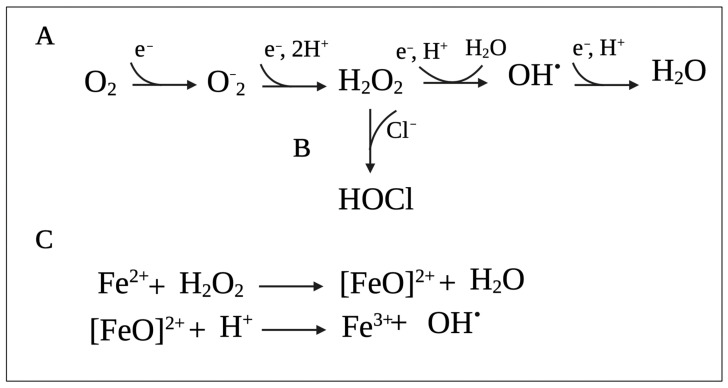
Figure 1
Figure 1
Series of reactions leading to the production of (A) reactive oxygen species (ROS) from molecular oxygen (O2) and (B) hypochlorous acid (HOCl). (C) Fenton reaction between ferrous iron (Fe2+) and hydrogen peroxide (H2O2) leading to the production of hydroxyl radical (HO). Superoxide: O2, hydrogen peroxide: H2O2, hydroxyl radicals: HO, H2O: water, e: electron, H+: hydrogen ion. This figure was created with BioRender.com (accessed on 10 September 2021).
Figure 2
Figure 2
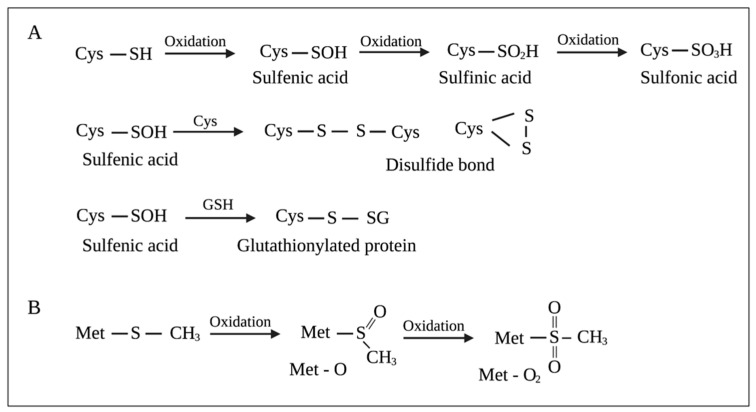
Oxidation of (A) cysteine (Cys) and (B) methionine (Met) residues on proteins by reactive oxygen species (ROS). GSH: glutathione, Met-O: Methionine sulfoxide, Met-O2: methionine sulfone. This figure was created with BioRender.com (accessed on 10 September 2021).
Figure 3
Figure 3
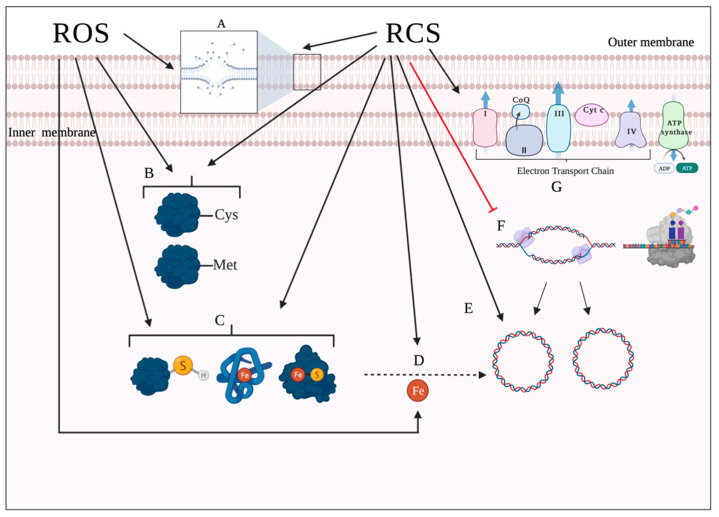
Bacterial targets of reactive oxygen species (ROS) and hypochlorous acid (HOCl), a reactive chlorine species (RCS) with potent antimicrobial effect. (A) Lipids represent a common oxidative target for both ROS and HOCl. Both oxidative agents can also induce lipid peroxidation. (B) Sulfur-containing side chains of methionine and cysteine are particularly prone to oxidation by ROS and RCS. (C) ROS and HOCl actively react with Fe–S clusters and heme proteins in enzymes, which often leads to the release of intracellular iron. (D) H2O2 and HOCl can react with the intracellular iron released after oxidation of Fe–S clusters. This reaction produces HO that oxidatively damage DNA. (E) HOCl can directly damage DNA through deamination, oxidation, and formation of single-stranded breaks and cross-links. (F) HOCl can also inhibit DNA and protein synthesis by the inactivation of proteins. (G) HOCl can also interfere with the electron transport chain, decreasing energy production. H2O2: hydrogen peroxide; HO: hydroxyl radicals. This figure was created with BioRender.com (accessed on 10 September 2021).
Figure 4
Figure 4
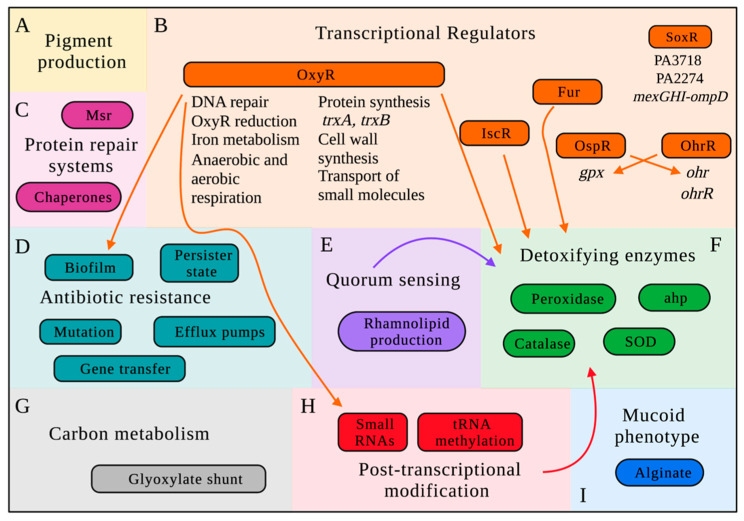
Simplified schematic overview of the interconnected oxidative stress responses adopted by Pseudomonas aeruginosa. (A) Production of pigments. (B) Transcriptional regulators activated by oxidizing agents: OxyR, which has been shown to regulate the expression of several phenotypes, such as the formation of biofilm and induction of small RNAs, in addition to the induction of genes involved in oxidative detoxification (katB, ahpCF, and ahpB); Fur and IscR, which play roles in the expression of detoxifying enzymes; OspR and OhrR, which are homolog regulators that present interconnected activity; and SoxR, which has been shown to activate six genes that are in three transcriptional subunits (PA3718, which encodes an efflux pump of the multiple facilitator superfamily; PA2274, an unknown protein; and four genes in the mexGHI-ompD operon). (C) Activation of chaperones and the Methionine sulfoxide reductase (Msr) system. (D) Antibiotic resistance due to increased mutation frequency, horizontal gene transfer, expression of efflux pumps, and persister state. (E) Induction of quorum sensing genes, which are involved in rhamnolipid production and detoxifying enzymes. (F) Detoxification of toxic oxygen and chlorine species by antioxidant enzymes, such as catalases (katA and katB), peroxidases, superoxide dismutase (sodM and sodB), and alkyl hydroperoxide reductase (ahpA, ahpB, ahpCF, ohr). (G) Genes involved in carbon metabolism, more specifically in the glyoxylate shunt and the Entner–Doudoroff pathaway were involved in P. aeruginosa survival under oxidative stress. (H) Methylation and induction of small RNAs. (I) Induction of the mucoid phenotype due to the overexpression of alginate. Msr: Methionine sulfoxide reductase; SOD: superoxide dismutase; ahp: alkyl hydroperoxide reductase. This figure was created with BioRender.com (accessed on 10 September 2021).

References

    1. Heimesaat M.M., Escher U., Grunau A., Kühl A.A., Bereswill S. Multidrug-Resistant Pseudomonas aeruginosa Accelerate Intestinal, Extra-Intestinal, and Systemic Inflammatory Responses in Human Microbiota-Associated Mice With Subacute Ileitis. Front. Immunol. 2019;10:49. doi: 10.3389/fimmu.2019.00049. - DOI - PMC - PubMed
    1. Mohamed F.A., Shaker G.H., Askoura M.M. Oxidative Stress Influences Pseudomonas aeruginosa Susceptibility to Antibiotics and Reduces Its Pathogenesis in Host. Curr. Microbiol. 2020;77:479–490. doi: 10.1007/s00284-019-01858-7. - DOI - PubMed
    1. Sadikot R.T., Blackwell T.S., Christman J.W., Prince A.S. Pathogen–Host Interactions in Pseudomonas aeruginosa Pneumonia. Am. J. Respir. Crit. Care Med. 2005;171:1209–1223. doi: 10.1164/rccm.200408-1044SO. - DOI - PMC - PubMed
    1. Nixon G.M., Armstrong D.S., Carzino R., Carlin J.B., Olinsky A., Robertson C.F., Grimwood K. Clinical Outcome after Early Pseudomonas aeruginosa Infection in Cystic Fibrosis. J. Pediatrics. 2001;138:699–704. doi: 10.1067/mpd.2001.112897. - DOI - PubMed
    1. Harrison F. Microbial Ecology of the Cystic Fibrosis Lung. Microbiology. 2007;153:917–923. doi: 10.1099/mic.0.2006/004077-0. - DOI - PubMed

LinkOut - more resources