Review
. 2021 Sep 8;13(9):1788.
doi: 10.3390/v13091788.

RNA Structures and Their Role in Selective Genome Packaging

Affiliations
Review

RNA Structures and Their Role in Selective Genome Packaging

Liqing Ye et al. Viruses. .

Abstract

To generate infectious viral particles, viruses must specifically select their genomic RNA from milieu that contains a complex mixture of cellular or non-genomic viral RNAs. In this review, we focus on the role of viral encoded RNA structures in genome packaging. We first discuss how packaging signals are constructed from local and long-range base pairings within viral genomes, as well as inter-molecular interactions between viral and host RNAs. Then, how genome packaging is regulated by the biophysical properties of RNA. Finally, we examine the impact of RNA packaging signals on viral evolution.

Keywords: RNA; RNA structure; RNA virus; evolution; genome packaging; viral assembly.


Conflict of interest statement

The authors declare no conflict of interest. The funders had no role in the writing of the manuscript, or in the decision to publish.

Figures
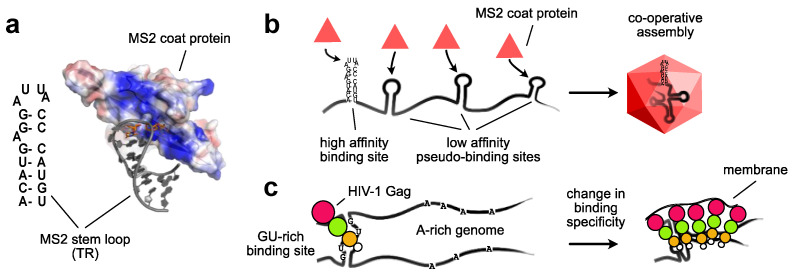
Figure 1
Figure 1
RNA packaging signals (a) MS2 bacteriophage encodes a coat protein (CP) that binds to a 19-nucleotide stem loop structure, known as TR. Secondary structure model of the TR stem loop and three-dimensional structure of the coat protein-TR interaction; (PDB: 1AQ3) (b) MS2 bacteriophage genome is encapsidated through cooperative interactions between coat protein that are bound to a high affinity binding site (TR) and multiple low affinity binding sites encoded throughout the genome; (c) HIV-1 Gag recognizes the genomic RNA through a GU-rich high affinity binding site in the 5′ untranslated region (5′UTR). During assembly at the plasma membrane Gag switches its specificity from GU-rich sequences to A-rich sequences, which is proposed to favour assembly of Gag on its cognate genomic RNA.
Figure 2
Figure 2
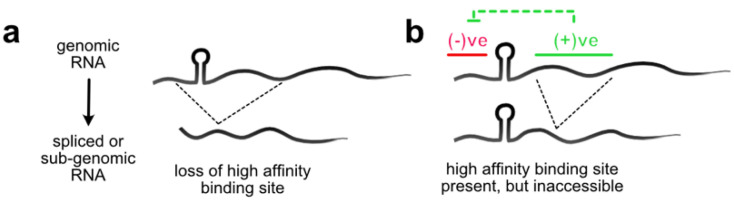
Selection of genomic RNA from non-genomic viral RNA. Dotted lines signify splicing or production of sub-genomic RNA. (a) Non-genomic RNA cannot be packaged because it does not contain the high affinity binding site for the (nucleo)capsid protein; (b) Non-genomic RNA contains the sequences for high affinity binding site, but it is not presented for binding. In HIV-1, negative regulatory elements (−ve) upstream of the splice donor (SD) conceal the Gag binding site unless counteracted by positive regulatory (+ve) sequences downstream of the SD.
Figure 3
Figure 3
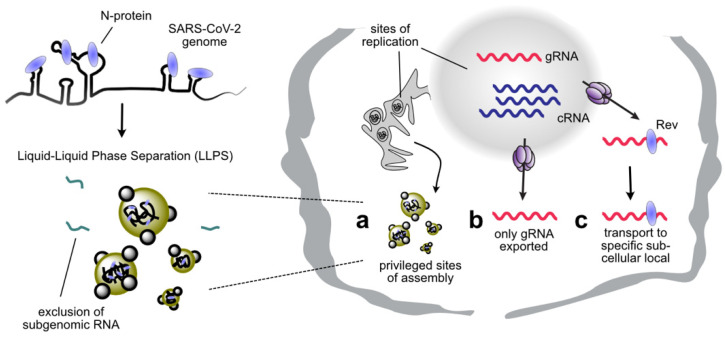
Successful genome packaging requires RNA signals to direct the genome from sites of replication to sites of assembly. (a) Sites of assembly generated by liquid-liquid phase separation (LLPS). Specific interactions between the SARS Coronavirus-2 (SARS-CoV-2) nucleoprotein (N) and its genome induce LLPS. Sub-genomic RNA is excluded. (b) Influenza complementary RNA (cRNA) replication intermediates are not correctly exported from the nucleus and are therefore not packaged. (c) HIV-1 genomic RNA contains the Rev Response Element (RRE) which binds to the viral Rev protein needed to export the RNA from the nucleus. Rev binding is proposed to enhance packaging by transporting RNA to the correct sub-cellular location.
Figure 4
Figure 4
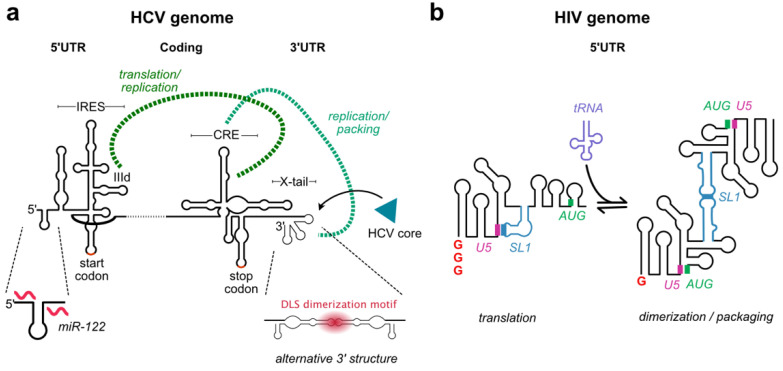
RNA structural switches and long-distance interactions regulate the balance between genome replication, packaging, and translation. (a) The HCV life cycle is regulated by a complex network of long-distance intra-molecular interactions and inter-molecular interactions. The packaging site which binds to the HCV core protein resides in the 3′ untranslated region (3′UTR). A long-distance base pairing between the cis-acting element (CRE) in the coding region and the X-tail in the 3′UTR regulates the balance between replication and packaging (light green dotted line). A long-distance interaction between the CRE and the internal ribosome entry site (IRES) regulates the balance between replication and translation (dark green dotted line). The 3′UTR is alternatively structured, leading to the formation of homodimers through an intermolecular interaction. The HCV 5′UTR binds the host microRNA miR-122 to regulate different aspects of HCV replication; (b) A structural switch in the HIV-1 5′UTR regulates the balance between genome translation and packaging. Transcripts beginning with three G residues fold into a monomer conformation and are preferentially translated. Transcripts beginning with one G residue fold into a dimer conformation. Structural switching is mediated by mutually exclusion interactions between regions U5 (pink), SL1 (blue), the AUG region (green), and a host tRNA (purple).
Figure 5
Figure 5
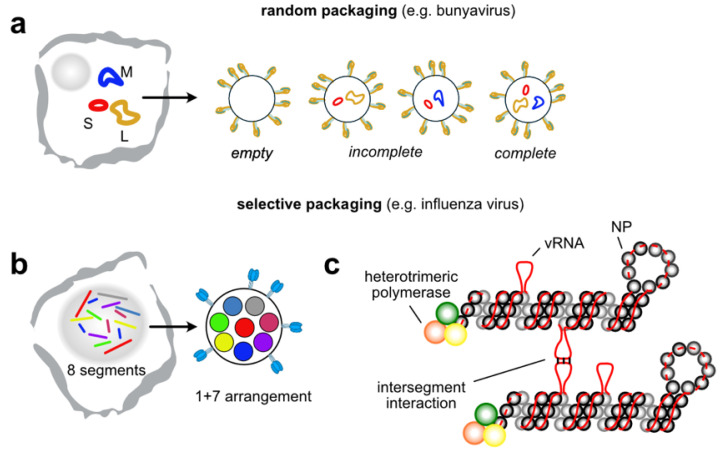
Segmented viruses package their genomes randomly or by using segment specific packaging signals. (a) Bunyavirus randomly package three genome segments, small (S), medium (M) and large (L), such that many progeny virions are empty or incomplete; (b) Influenza A virus package 8 genome segments selectively. Genome segments within budding virions are organized into a 1 + 7 arrangement with one central segment surrounded by seven others; (c) Influenza vRNAs are packaged as viral ribonucleoproteins (vRNPs). vRNAs are bound by nucleoprotein (NP) and a heterotrimeric polymerase. vRNA is incompletely coated by NP allowing for inter-segment vRNA-vRNA interactions to occur as a possible mechanism underlying the selective packaging process.
Figure 6
Figure 6
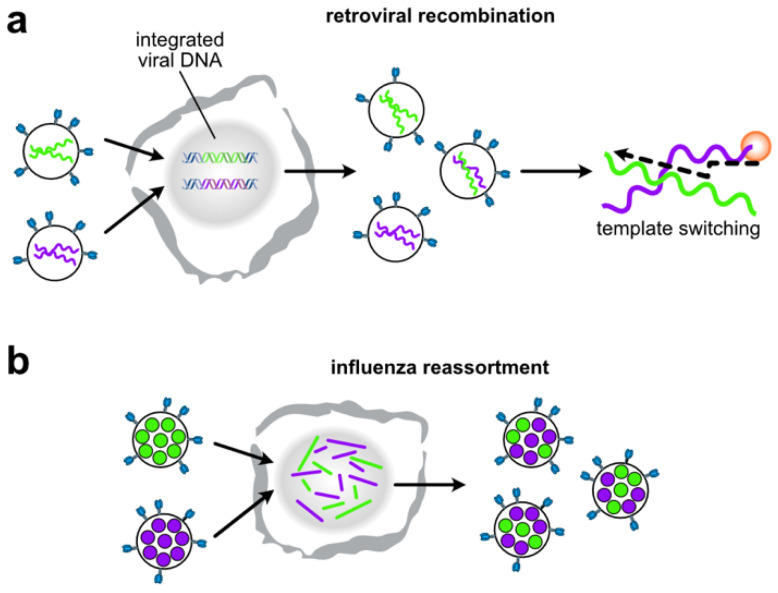
Viral RNA packaging influences viral evolution. (a) HIV-1 virions contain two copies of the genome. After co-infection, up to 50% of progeny co-package different genomes. Template switching during reverse transcription produce cDNA that is a chimera of the two genomes; (b) Influenza A virions contain eight different vRNA segments. After co-infection, reassortant progeny virions are produced containing a mixture of segments from each parental virus.

References

    1. Sun S., Rao V.B., Rossmann M.G. Genome Packaging in Viruses. Curr. Opin. Struct. Biol. 2010;20:114–120. doi: 10.1016/j.sbi.2009.12.006. - DOI - PMC - PubMed
    1. Adams R.L., Pirakitikulr N., Pyle A.M. Functional RNA Structures throughout the Hepatitis C Virus Genome. Curr. Opin. Virol. 2017;24:79–86. doi: 10.1016/j.coviro.2017.04.007. - DOI - PMC - PubMed
    1. Wilkinson K., Gorelick R.J., Vasa S.M., Guex N., Rein A., Mathews D.H., Giddings M.C., Weeks K.M. High-Throughput SHAPE Analysis Reveals Structures in HIV-1 Genomic RNA Strongly Conserved across Distinct Biological States. PLoS Biol. 2008;6:e96. doi: 10.1371/journal.pbio.0060096. - DOI - PMC - PubMed
    1. Rangan R., Zheludev I.N., Hagey R.J., Pham E.A., Wayment-Steele H.K., Glenn J.S., Das R. RNA Genome Conservation and Secondary Structure in SARS-CoV-2 and SARS-Related Viruses: A First Look. RNA. 2020;26:937–959. doi: 10.1261/rna.076141.120. - DOI - PMC - PubMed
    1. Masters P.S. Coronavirus Genomic RNA Packaging. Virology. 2019;537:198–207. doi: 10.1016/j.virol.2019.08.031. - DOI - PMC - PubMed

Publication types

LinkOut - more resources