


Effect of Natural Polysaccharide Matrix-Based Selenium Nanocomposites on Phytophthora cactorum and Rhizospheric Microorganisms
- PMID: 34578589
- PMCID: PMC8466319
- DOI: 10.3390/nano11092274
Effect of Natural Polysaccharide Matrix-Based Selenium Nanocomposites on Phytophthora cactorum and Rhizospheric Microorganisms
Abstract
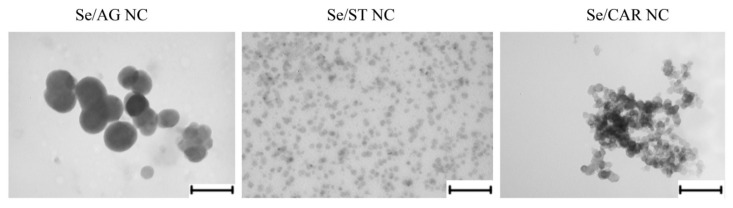
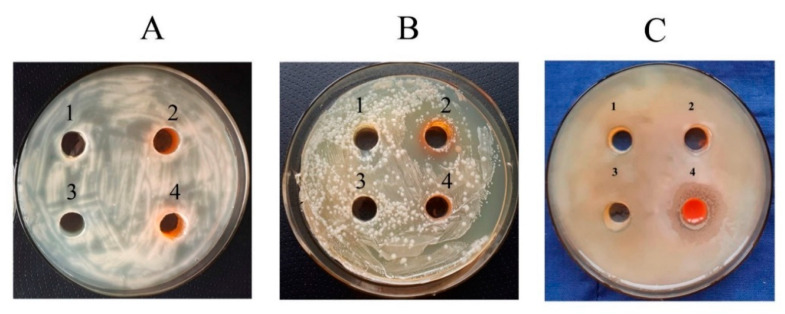
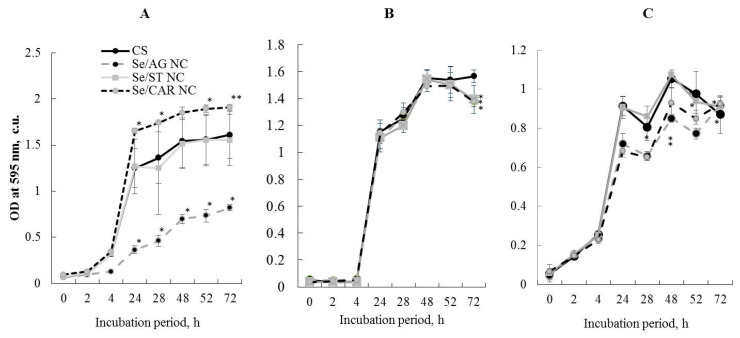
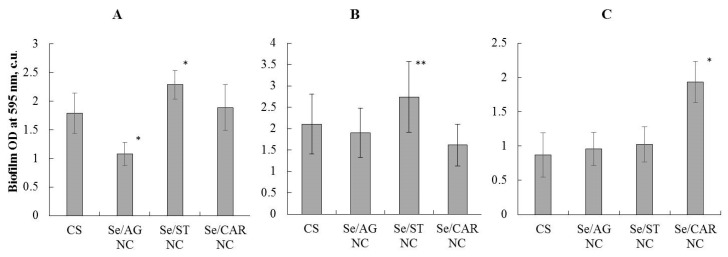
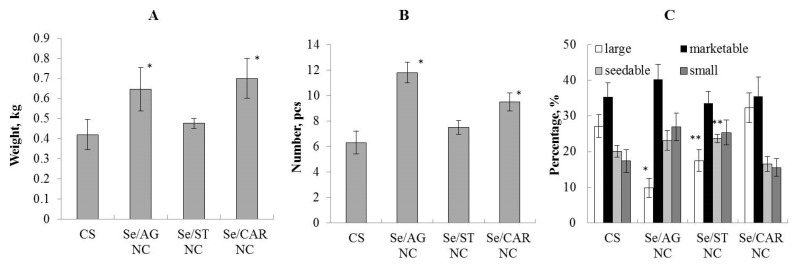
We studied the effects of new chemically synthesized selenium (Se) nanocomposites (NCs) based on natural polysaccharide matrices arabinogalactan (AG), starch (ST), and kappa-carrageenan (CAR) on the viability of phytopathogen Phytophthora cactorum, rhizospheric bacteria, and potato productivity in the field experiment. Using transmission electron microscopy (TEM), it was shown that the nanocomposites contained nanoparticles varying from 20 to 180 nm in size depending on the type of NC. All three investigated NCs had a fungicidal effect even at the lowest tested concentrations of 50 µg/mL for Se/AG NC (3 µg/mL Se), 35 µg/mL for Se/ST NC (0.5 µg/mL Se), and 39 µg/mL for Se/CAR NC (1.4 µg/mL Se), including concentration of 0.000625% Se (6.25 µg/mL) in the final suspension, which was used to study Se NC effects on bacterial growth of the three common rhizospheric bacteria Acinetobacter guillouiae, Rhodococcus erythropolis and Pseudomonas oryzihabitans isolated from the rhizosphere of plants growing in the Irkutsk Region, Russia. The AG-based Se NC (Se/AG NC) and CAR-based Se NC (Se/CAR NC) exhibited the greatest inhibition of fungal growth up to 60% (at 300 µg/mL) and 49% (at 234 µg/mL), respectively. The safe use of Se NCs against phytopathogens requires them to be environmentally friendly without negative effects on rhizospheric microorganisms. The same concentration of 0.000625% Se (6.25 µg/mL) in the final suspension of all three Se NCs (which corresponds to 105.57 µg/mL for Se/AG NC, 428.08 µg/mL for Se/ST NC and 170.30 µg/mL for Se/CAR NC) was used to study their effect on bacterial growth (bactericidal, bacteriostatic, and biofilm formation effects) of the three rhizospheric bacteria. Based on our earlier studies this concentration had an antibacterial effect against the phytopathogenic bacterium Clavibacter sepedonicus that causes diseases of potato ring rot, but did not negatively affect the viability of potato plants at this concentration. In this study, using this concentration no bacteriostatic and bactericidal activity of all three Se NCs were found against Rhodococcus erythropolis based on the optical density of a bacterial suspension, agar diffusion, and intensity of biofilm formation, but Se/CAR and Se/AG NCs inhibited the growth of Pseudomonas oryzihabitans. The cell growth was decrease by 15-30% during the entire observation period, but the stimulation of biofilm formation by this bacterium was observed for Se/CAR NC. Se/AG NC also had bacteriostatic and antibiofilm effects on the rhizospheric bacterium Acinetobacter guillouiae. There was a 2.5-fold decrease in bacterial growth and a 30% decrease in biofilm formation, but Se/CAR NC stimulated the growth of A. guillouiae. According to the results of the preliminary field test, an increase in potato productivity by an average of 30% was revealed after the pre-planting treatment of tubers by spraying them with Se/AG and Se/CAR NCs with the same concentration of Se of 0.000625% (6.25 µg/mL) in a final suspension. The obtained and previously published results on the positive effect of natural matrix-based Se NCs on plants open up prospects for further investigation of their effects on rhizosphere bacteria and resistance of cultivated plants to stress factors.
Keywords: Acinetobacter guillouiae; Phytophthora cactorum; Pseudomonas oryzihabitans; Rhodococcus erythropolis; antibacterial activity; arabinogalactan; fungicidal effect; nanocomposites; polysaccharides; potato productivity; selenium.
Conflict of interest statement
The authors declare no conflict of interest.
Figures

References
-
- Jasrotia P., Kashyap P.L., Bhardwaj A.K., Kumar S., Singh G.P. Scope and applications of nanotechnology for wheat production: A review of recent advances. Wheat Barley Res. 2018;10:1–14. doi: 10.25174/2249-4065/2018/76672. - DOI
Grants and funding
LinkOut - more resources
Full Text Sources
