


Cutaneous Adverse Reactions to COVID-19 Vaccines: Insights from an Immuno-Dermatological Perspective
- PMID: 34579181
- PMCID: PMC8470727
- DOI: 10.3390/vaccines9090944
Cutaneous Adverse Reactions to COVID-19 Vaccines: Insights from an Immuno-Dermatological Perspective
Abstract
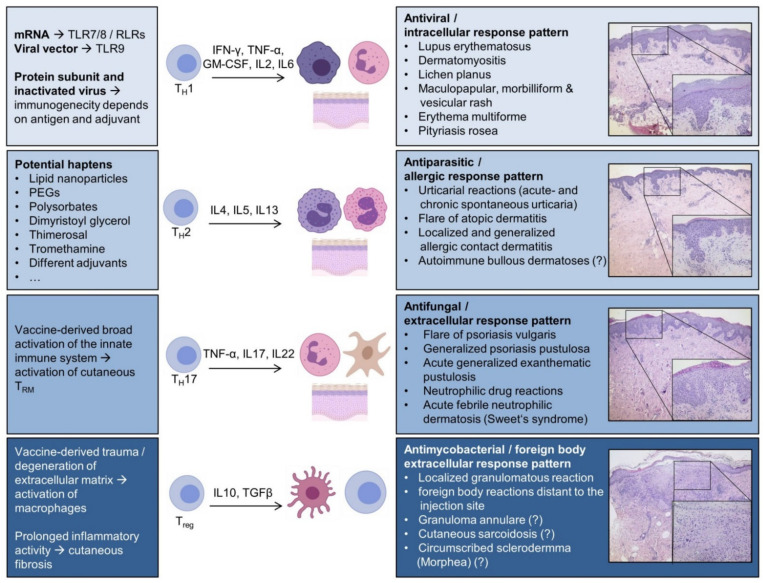
(1) Background: Numerous vaccines are under preclinical and clinical development for prevention of severe course and lethal outcome of coronavirus disease 2019 (COVID-19). In light of high efficacy rates and satisfactory safety profiles, some agents have already reached approval and are now distributed worldwide, with varying availability. Real-world data on cutaneous adverse drug reactions (ADRs) remain limited. (2) Methods: We performed a literature research concerning cutaneous ADRs to different COVID-19 vaccines, and incorporated our own experiences. (3) Results: Injection site reactions are the most frequent side effects arising from all vaccine types. Moreover, delayed cutaneous ADRs may occur after several days, either as a primary manifestation or as a flare of a pre-existing inflammatory dermatosis. Cutaneous ADRs may be divided according to their cytokine profile, based on the preponderance of specific T-cell subsets (i.e., Th1, Th2, Th17/22, Tregs). Specific cutaneous ADRs mimic immunogenic reactions to the natural infection with SARS-CoV-2, which is associated with an abundance of type I interferons. (4) Conclusions: Further studies are required in order to determine the best suitable vaccine type for individual groups of patients, including patients suffering from chronic inflammatory dermatoses.
Keywords: COVID-19; adverse event; exanthema; vaccines.
Conflict of interest statement
D.N. has received financial support (speaker’s honoraria or travel expense reimbursements) from Bristol-Myers Squibb (BMS), Novartis, GlaxoSmithKline, Celgene, Kiowa Kirin, and Merck Sharp & Dohme (MSD). N.N. has received financial support (research grants, speaker’s and consultant’s honoraria) from Alk Abello, HAL Allergy, Stallergenes Geer, Sanofi Genzyme, Novartis, Leo Pharma, Blueprint, and Abbvie. J.Z has received financial support (clinical studies, speaker’s honoraria or travel expense reimbursements) from Sigvaris Group, medi, Bayer, Juzo, and Novartis. D.WT has received financial support (clinical studies, travel grants, speaker’s fees) from AbbVie, Almirall, Amgen, Biogen, Boehringer Ingelheim Pharma, Celgene, Forward Pharma, GlaxoSmithKline, Hexal, Janssen-Cilag, Leo, Lilly, Medac, Merck Sharp & Dohme, Novartis, Pfizer, UCB Pharma, and VBL. T.B. was a speaker and/or consultant and/or investigator for AbbVie, Allmiral, AnaptysBio, Arena, Asana Biosciences, Bayer Health, BioVerSys, Böhringer-Ingelheim, Bristol-Myers Squibb, Celgene, Daichi-Sankyo, Dermavant/Roivant, DermTreat, Domain Therapeutics, DS Pharma, RAPT/FLX Bio, Galapagos/MorphoSys, Galderma, Glenmark, GSK, Incyte, IQVIA, Janssen, Kirin, Kymab, LEO, LG Chem, Lilly, L´Oréal, MenloTx, Novartis, OMPharma/Vifor, Pfizer, Pierre Fabre, Sanofi/Regeneron, and UCB. T.B. is a founder of the nonprofit biotech company “Davos Biosciences” within the International Kühne-Foundation. J.W. (Joerg Wenzel) has received financial support (clinical studies, travel grants, speaker’s fees) from GSK, Novartis, Medac, Merck/Serono, Roche, Actelion, Pfizer, Spirig, ArrayBio, Biogen, and Incyte. C.B. has received financial support (travel grants) from L’OREAL, Novartis, ADF, and EADV/ESDR; she received a scholarship from the Medical Faculty of the University of Bonn. The remaining author declares no competing financial interests. As no specific funding was received, no external institution had a role in the design of the study, in the collection, analyses, or interpretation of data, in the writing of the manuscript, or in the decision to publish the results.
Figures
Comment in
-
Pyoderma gangrenosum following vaccination against coronavirus disease-2019: a case report.Int J Dermatol. 2022 Jul;61(7):905-906. doi: 10.1111/ijd.16255. Epub 2022 May 14. Int J Dermatol. 2022. PMID: 35567368 Free PMC article. No abstract available.
References
Publication types
LinkOut - more resources
Full Text Sources
Miscellaneous
