. 2021 Dec 8;11(12):jkab312.
doi: 10.1093/g3journal/jkab312.

Diverse wMel variants of Wolbachia pipientis differentially rescue fertility and cytological defects of the bag of marbles partial loss of function mutation in Drosophila melanogaster

Affiliations

Diverse wMel variants of Wolbachia pipientis differentially rescue fertility and cytological defects of the bag of marbles partial loss of function mutation in Drosophila melanogaster

Jaclyn E Bubnell et al. G3 (Bethesda). .

Abstract

In Drosophila melanogaster, the maternally inherited endosymbiont Wolbachia pipientis interacts with germline stem cell genes during oogenesis. One such gene, bag of marbles (bam) is the key switch for differentiation and also shows signals of adaptive evolution for protein diversification. These observations have led us to hypothesize that W. pipientis could be driving the adaptive evolution of bam for control of oogenesis. To test this hypothesis, we must understand the specificity of the genetic interaction between bam and W. pipientis. Previously, we documented that the W. pipientis variant, wMel, rescued the fertility of the bamBW hypomorphic mutant as a transheterozygote over a bam null. However, bamBW was generated more than 20 years ago in an uncontrolled genetic background and maintained over a balancer chromosome. Consequently, the chromosome carrying bamBW accumulated mutations that have prevented controlled experiments to further assess the interaction. Here, we used CRISPR/Cas9 to engineer the same single amino acid bam hypomorphic mutation (bamL255F) and a new bam null disruption mutation into the w1118 isogenic background. We assess the fertility of wildtype bam, bamL255F/bamnull hypomorphic, and bamL255F/bamL255F mutant females, each infected individually with 10 W. pipientis wMel variants representing three phylogenetic clades. Overall, we find that all of the W. pipientis variants tested here rescue bam hypomorphic fertility defects with wMelCS-like variants exhibiting the strongest rescue effects. In addition, these variants did not increase wildtype bam female fertility. Therefore, both bam and W. pipientis interact in genotype-specific ways to modulate female fertility, a critical fitness phenotype.

Keywords: Wolbachia; bam; differentiation; germline stem cell; oogenesis.


Figures

Figure 1
Figure 1
Design for recreating the classic bamBW hypomorph allele and a new bam null allele in the w1118 isogenic background with CRISPR/Cas9. (A) Schematic of the bam gene region showing the single gRNA target site in the second exon and the hypomorphic missense mutation. (B) Schematic of the bam gene region showing the single gRNA target site in the second intron with the 3xP3-DsRed eye marker to create a bam null allele.
Figure 2
Figure 2
The bamBW hypomorphic allele and a novel bam null allele in the w1118 isogenic background recapitulates the classic bam phenotypes. (A) The newly generated bamnull-In2-3xP3-DsRed/bamnull-In2-3xP3-DsRed genotype results in tumorous ovaries (arrow). (B) The recreated bamL255F mutation over bamnull-In2-3xP3-DsRed exhibits tumorous ovaries in the w1118 isogenic background (arrow). (C) The recreated bamL255F mutation over the classic bamΔ59 null allele exhibits tumorous ovaries (arrow). (D) The classic bamBW/bamΔ59 hypomorphic genotype exhibits tumorous ovaries (arrow). (E) Ovaries from the w1118 isogenic line wildtype for bam do not exhibit any germline tumors and show developing egg chambers with large nurse cell nuclei (arrowhead). (F) bamL255F/bamL255F homozygotes do not exhibit tumorous ovaries, indicating two copies of the partial loss of function bamL255F mutation is sufficient for GSC daughter differentiation. (G) w1118 females and bamL255F/bamL255F females do not show a significant difference in fertility (mean difference of progeny per female), further indicating that two copies of bamL255F is sufficient for bam function.
Figure 3
Figure 3
Female fertility of genotypes containing the w1118; bamL255F hypomorphic allele are consistent with those of classic alleles. Swarm and Cumming estimation plots of a control fertility experiment showing that the fertility of bamL255F/bamL255F females is not significantly different from w1118 (mean difference = 3.6), nor are bamL255F/bamBW females (mean difference = 17.9). bamL255F/bamnull-In2-3xP3-DsRed females have significantly lower fertility compared to wildtype (mean difference = −44.6, bootstrap 95% confidence interval, effect size), as do bamL255F/bamΔ59 females (mean difference = −36.7, bootstrap 95% confidence interval, effect size).
Figure 4
Figure 4
Total progeny per female and mean difference of progeny per female for the w1118; bam+/bam+ genotype infected with 10 W. pipientis wMel variants compared to uninfected. (A) Cladogram adapted from Chrostek et al. (2013) showing the relationships and clade assignments for the W. pipientis variants tested in this study. (B) Swarm and Cumming estimation plots showing the total progeny per female for each W. pipientis infected line counted on days 1–9 post eclosion. As the fertility assays were performed in batches, each batch is compared to its own uninfected control. No W. pipientis variant was associated with a significant difference in fertility for wildtype bam females over days 1–9 post eclosion (bootstrap 95% confidence interval, effect size). (C) Swarm and Cumming estimation plots showing the total progeny per female for each W. pipientis infected line counted on days 1–17 post eclosion. As the fertility assays were performed in batches, each batch is compared to its own uninfected control. W. pipientis variants wMelPop8X, and wMelCS2b were associated with significantly lower fertility over the longer period of days 1–17 post eclosion compared to uninfected controls (bootstrap 95% confidence interval, effect size)
Figure 5
Figure 5
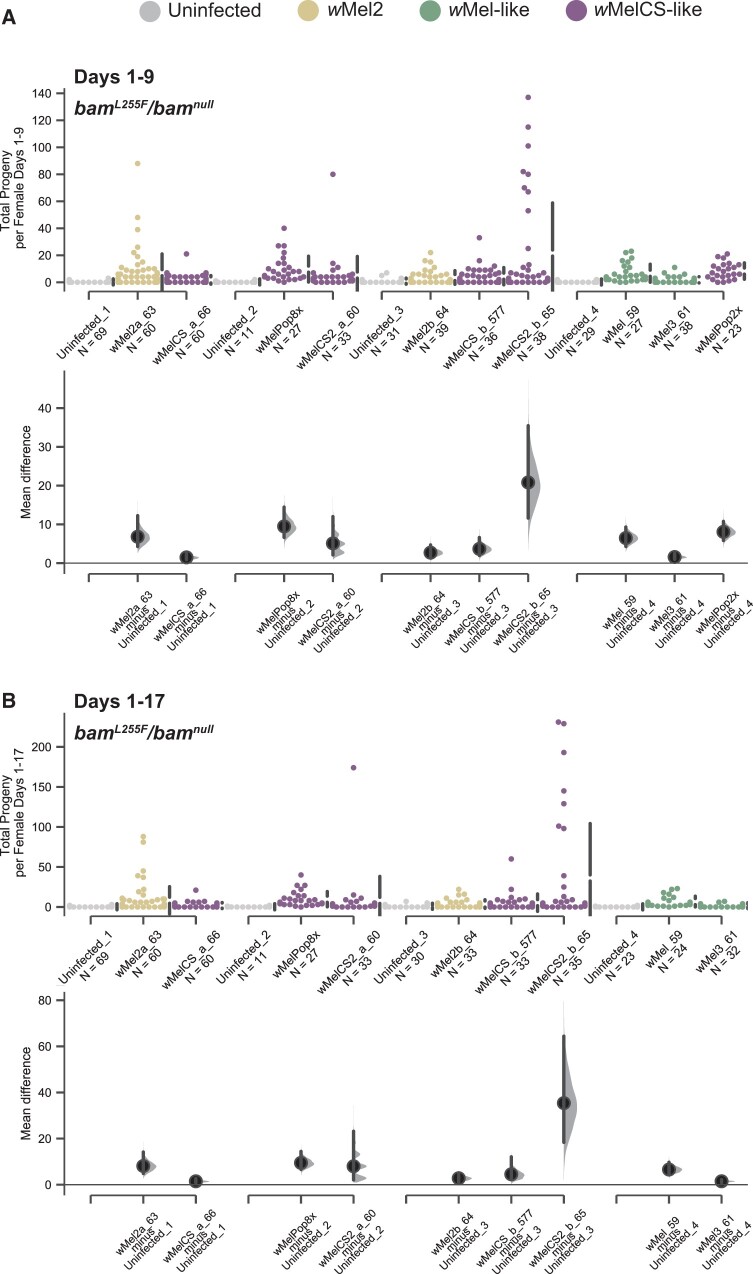
Total progeny per female and mean difference of progeny per female for the w1118; bamL255F/bamnull genotype infected with 10 W. pipientis wMel variants compared to uninfected. (A) Swarm and Cumming estimation plots showing the total progeny per female for each W. pipientis infected line counted on days 1-9 post eclosion. As the fertility assays were performed in batches, each batch is compared to its own uninfected control. All W. pipientis variants were associated with significant increases in female fertility compared to uninfected controls (bootstrap 95% confidence interval, effect size). (B) Swarm and Cumming estimation plots showing the total progeny per female for each W. pipientis infected line counted on days 1-17 post eclosion. As the fertility assays were performed in batches, each batch is compared to its own uninfected control. All W. pipientis variants were associated with significant increases in female fertility compared to uninfected controls (bootstrap 95% confidence interval, effect size). wMelPop2X is not reported for this time frame, as most females died after day 9.
Figure 6
Figure 6
Total cysts containing nurse cells per ovary and mean difference of nurse cell positive cysts for the w1118; bamL255F/bamnull genotype infected with 10 W. pipientis wMel variants compared to uninfected. (A) Representative images of bamL255F/bamnull ovaries from uninfected, wMel59, and wMelpop2X infected females. Nurse cell positive cysts labeled with arrowheads. (B) Swarm and Cumming estimation plots showing the total cysts containing nurse cells per ovary for each W. pipientis infected line assayed on 2–3 days old females. All W. pipientis variants are associated with a significant increase in nurse cell positive cysts per ovary (bootstrap 95% confidence interval, effect size). W. pipientis variants in the wMelCS-like clade have the highest effect on nurse cell positive cysts. (C–E) Swarm and Gardner-Altman plots showing pairwise comparisons of nurse cell positive cyst counts pooled together for each wMel clade. wMelCS-like variants exhibit higher effects on nurse cell positive cysts compared to wMel2 and wMel-like variants (95% confidence interval, effect size), and wMel2 variants exhibit a higher effect on nurse cell positive cysts than wMel-like (95% confidence interval, effect size).
Figure 7
Figure 7
Total progeny per female and mean difference of progeny per female for the w1118; bamL255F/bamL255F genotype infected with four representative W. pipientis variants compared to the uninfected control. (A) Swarm and Cumming estimation plots showing the effect of Wolbachia variants on bamL255F/bamL255F female fertility over days 1–6 of eclosion. We included uninfected bam+/bam+ females as well to compare bamL255F/bamL255F fertility to bam+/bam+ fertility. W. pipientis variants did not have differential effects on female bamL255F/bamL255F fertility during this time frame. The bamL255F/bamL255F genotype regardless of W. pipientis infection showed a wider range of progeny compared to bam+/bam+ females, and uninfected bam+/bam+ mean fertility was significantly lower than uninfected bamL255F/bamL255F mean fertility (95% confidence interval, effect size). (B) Swarm and Cumming estimation plots showing the effect of W. pipientis variants on bamL255F/bamL255F female fertility over days 1–13 of eclosion. W. pipientis variants had differential effects on female bamL255F/bamL255F fertility. No variants had a negative effect on fertility. Wolbachia variants wMel2a_63, wMelCS_a_66 showed significant positive effects on fertility. The bamL255F/bamL255F genotype regardless of W. pipientis infection showed a wider range of progeny compared to bam+/bam+ females, but uninfected bam+/bam+ and uninfected bamL255F/bamL255F mean fertility was not significantly different.

References

    1. Arnold PA, Levin SC, Stevanovic AL, Johnson KN.. 2019. Drosophila melanogaster infected with Wolbachia strain wMelCS prefer cooler temperatures. Ecol Entomol. 44:287–290. doi:10.1111/een.12696.
    1. Aruna S, Flores HA, Barbash DA.. 2009. Reduced fertility of Drosophila melanogaster hybrid male rescue (Hmr) mutant females is partially complemented by Hmr orthologs from sibling species. Genetics. 181:1437–1450. 10.1534/genetics.108.100057 19153254 - DOI - PMC - PubMed
    1. Bailly-Bechet M, Martins-Simões P, Szöllosi GJ, Mialdea G, Sagot MF, et al.2017. How long does Wolbachia remain on board? Mol Biol Evol. 34:1183–1193. doi:10.1093/molbev/msx073. - PubMed
    1. Bauer DuMont VL, Flores HA, Wright MH, Aquadro CF.. 2007. Recurrent positive selection at bgcn, a key determinant of germ line differentiation, does not appear to be driven by simple coevolution with its partner protein Bam. Mol Biol Evol. 24:182–191. doi:10.1093/molbev/msl141. - PubMed
    1. Beckmann JF, Ronau JA, Hochstrasser M.. 2017. A Wolbachia deubiquitylating enzyme induces cytoplasmic incompatibility. Nat Microbiol. 2:17007.doi:10.1038/nmicrobiol.2017.7. - PMC - PubMed

Publication types

Substances

Supplementary concepts

LinkOut - more resources