


Clinical outcome and prognostic factors in recurrent oral squamous cell carcinoma after primary surgical treatment: a retrospective study
- PMID: 34581884
- PMCID: PMC8816316
- DOI: 10.1007/s00784-021-04186-y
Clinical outcome and prognostic factors in recurrent oral squamous cell carcinoma after primary surgical treatment: a retrospective study
Abstract
Objectives: Survival for patients with recurrent oral squamous cell carcinoma is usually poor, and the most effective treatment has not yet been clearly defined. The present study evaluates the outcome in radiotherapy-naïve patients after recurrence of oral squamous cell carcinoma with respect to different treatment modalities including surgery, radiation, chemoradiation, and palliative treatment.
Patients and methods: In this retrospective study, we included all patients with primary oral squamous cell carcinoma who received exclusively surgical therapy between 2010 and 2020 and who suffered from locoregional recurrence in their follow-up. Patients with previous adjuvant therapy were excluded from this protocol. Clinical and pathological parameters were collected and statistically evaluated. Survival analysis was performed according to Kaplan-Meier. The primary endpoints were overall and progression-free survival in dependance of treatment strategy for recurrent tumors.
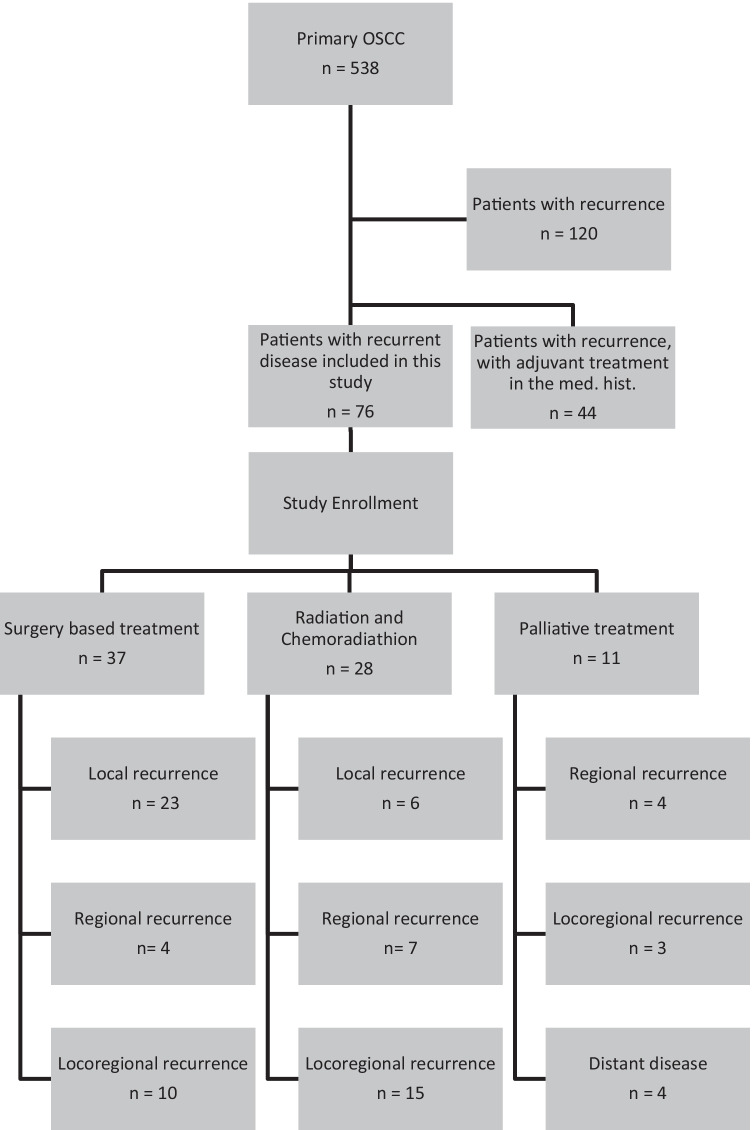
Results: Out of a total of 538 patients with surgically treated primary oral squamous cell carcinoma, 76 patients met the inclusion criteria. The mean follow-up was 38 ± 32 months. Patients who received surgically based therapy had a significantly better outcome in terms of disease-free survival (DFS) and overall survival (OS) (DFS p < 0.001; OS p < 0.001). The presence of regional metastases and a short disease-free interval (DFI) between primary and recurrent cancer were significant predictors for adverse outcomes (DFI p < 0.001).
Conclusion: We recommend primary surgical therapy for radiotherapy-naïve patients with recurrent oral squamous cell carcinoma, supplemented by risk-adapted adjuvant therapy.
Clinical relevance: Surgical therapy continues to play a central role in the treatment of radiotherapy-naïve patients with recurrent oral squamous cell carcinoma.
Keywords: Ablative surgery; Disease-free interval; Oral cancer; Recurrent oral squamous cell carcinoma; Salvage surgery.
© 2021. The Author(s).
Conflict of interest statement
The authors declare no competing interests.
Figures

References
-
- Stenzinger A, et al. Pathology of malignant head and neck tumors. Epidemiology and histological subtypes Onkologe. 2014;20(2):116–129. doi: 10.1007/s00761-013-2584-z. - DOI
MeSH terms
LinkOut - more resources
Full Text Sources
Medical
Miscellaneous
