Factors associated with the prevalence of HIV, HSV-2, pregnancy, and reported sexual activity among adolescent girls in rural western Kenya: A cross-sectional analysis of baseline data in a cluster randomized controlled trial
- PMID: 34582445
- PMCID: PMC8478198
- DOI: 10.1371/journal.pmed.1003756
Factors associated with the prevalence of HIV, HSV-2, pregnancy, and reported sexual activity among adolescent girls in rural western Kenya: A cross-sectional analysis of baseline data in a cluster randomized controlled trial
Abstract
Background: Adolescence is a sensitive time for girls' sexual and reproductive health (SRH), as biological changes occur concurrently with heightening pressures for sexual activity. In western Kenya, adolescent girls are vulnerable to acquiring sexually transmitted infections (STIs), such as HIV and herpes simplex virus type 2 (HSV-2), and to becoming pregnant prior to reaching adulthood. This study examines associations between individual, household, and partner-related risk factors and the prevalence of sex, adolescent pregnancy, HIV, and HSV-2.
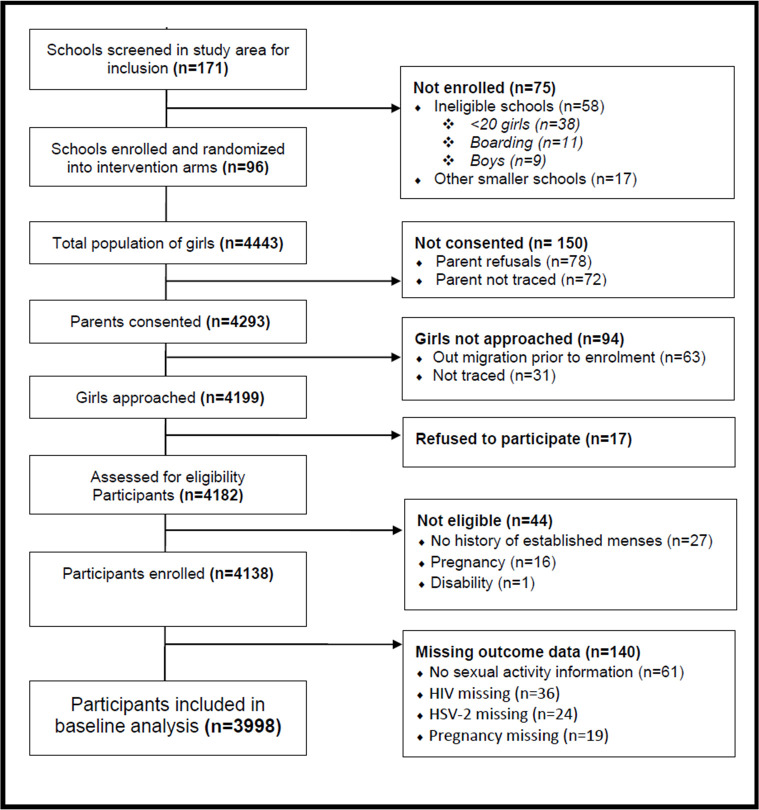
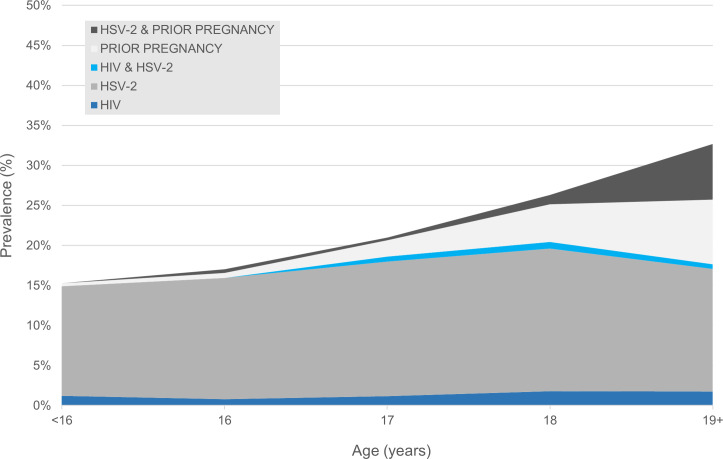
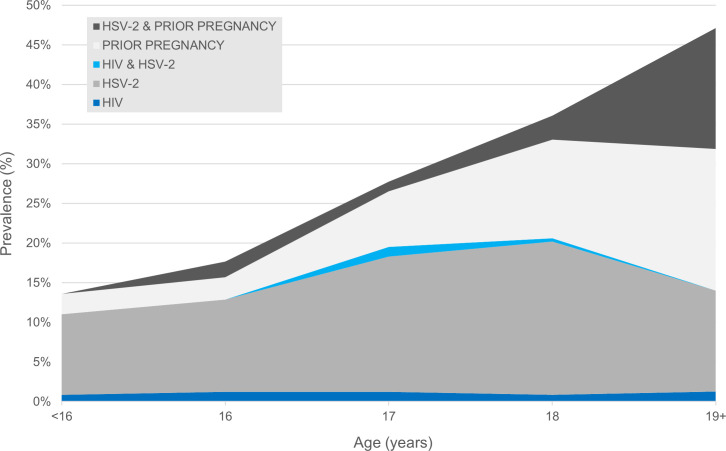
Methods and findings: We report baseline findings among 4,138 girls attending secondary school who were enrolled between 2017 and 2018 in the Cups or Cash for Girls (CCG) cluster randomized controlled trial in Siaya County, rural western Kenya. Laboratory confirmed biomarkers and survey data were utilized to assess the effects of girls' individual, household, and partner characteristics on the main outcome measures (adolescent reported sex, prior pregnancy, HIV, and HSV-2) through generalized linear model (GLM) analysis. Complete data were available for 3,998 girls (97%) with median age 17.1 years (interquartile range [IQR] 16.3 to 18.0 years); 17.2% were HSV-2 seropositive (n = 686) and 1.7% tested positive for HIV (n = 66). Sexual activity was reported by 27.3% girls (n = 1,090), of whom 12.2% had been pregnant (n = 133). After adjustment, orphanhood (adjusted risk ratio [aRR] 2.81, 95% confidence interval [CI] 1.18 to 6.71, p-value [p] = 0.020), low body mass index (BMI) (aRR 2.07; CI: 1.00 to 4.30, p = 0.051), and age (aRR 1.34, 1.18 to 1.53, p < 0.001) were all associated with HIV infection. Girls reporting light menstrual bleeding (aRR 2.42, 1.22 to 4.79, p = 0.012) for fewer than 3 days (aRR 2.81, 1.16 to 6.82, p = 0.023) were over twice as likely to have HIV. Early menarche (aRR 2.05, 1.33 to 3.17, p = 0.001) was associated with adolescent pregnancy and HSV-2-seropositive girls reported higher rates of pregnancy (aRR 1.62, CI: 1.16 to 2.27, p = 0.005). High BMI was associated with HSV-2 (aRR 1.24, 1.05 to 1.46, p = 0.010) and sexual activity (aRR 1.14, 1.02 to 1.28, p = 0.016). High levels of harassment were detected in the cohort (41.2%); being touched indecently conveyed the strongest association related to reported sexual activity (aRR 2.52, 2.26 to 2.81, p < 0.001). Study limitations include the cross-sectional design of the study, which informs on the SRH burdens found in this population but limits causal interpretation of associations, and the self-reported exposure ascertainment, which may have led to possible underreporting of risk factors, most notably prior sexual activity.
Conclusions: Our findings indicate that adolescent girls attending school in Kenya face frequent harassment for sex and are at high risk of pregnancy and HSV-2, with girls experiencing early menarche particularly vulnerable. Targeted interventions, such as earlier sexual education programs, are warranted to address their vulnerability to SRH harms.
Trial registration: ClinicalTrials.gov NCT03051789.
Conflict of interest statement
The authors have declared that no competing interests exist.
Figures
References
Publication types
MeSH terms
Associated data
Grants and funding
LinkOut - more resources
Full Text Sources
Medical