Recovery of Memory B-cell Subsets and Persistence of Antibodies in Convalescent COVID-19 Patients
- PMID: 34583334
- PMCID: PMC8592221
- DOI: 10.4269/ajtmh.21-0883
Recovery of Memory B-cell Subsets and Persistence of Antibodies in Convalescent COVID-19 Patients
Abstract
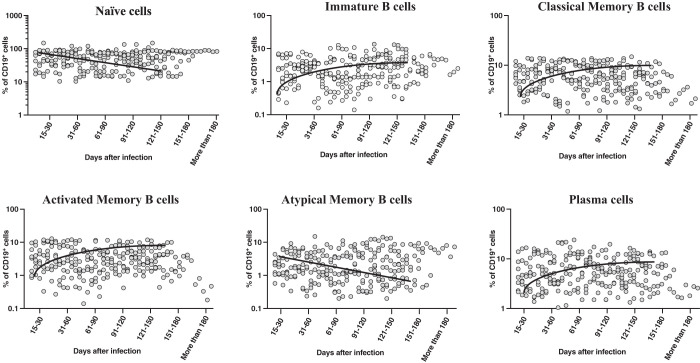
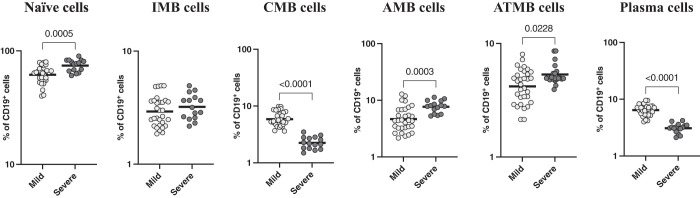
It is essential to examine the longevity of the defensive immune response engendered by severe acute respiratory syndrome coronavirus-2 (SARS-CoV-2) infection. We examined the SARS-CoV-2-specific antibody responses and ex vivo memory B-cell subsets in seven groups of individuals with COVID-19 classified based on days since reverse-transcription polymerase chain reaction confirmation of SARS-CoV-2 infection. Our data showed that the levels of IgG and neutralizing antibodies started increasing from days 15 to 30 to days 61 to 90, and plateaued thereafter. The frequencies of naive B cells and atypical memory B cells decreased from days 15 to 30 to days 61 to 90, and plateaued thereafter. In contrast, the frequencies of immature B cells, classical memory B cells, activated memory B cells, and plasma cells increased from days 15 to 30 to days 61 to 90, and plateaued thereafter. Patients with severe COVID-19 exhibited increased frequencies of naive cells, atypical memory B cells, and activated memory B cells, and lower frequencies of immature B cells, central memory B cells, and plasma cells when compared with patients with mild COVID-19. Therefore, our data suggest modifications in memory B-cell subset frequencies and persistence of humoral immunity in convalescent individuals with COVID-19.
Figures

References
MeSH terms
Substances
LinkOut - more resources
Full Text Sources
Medical
Miscellaneous