Review
. 2021 Sep 28;14(1):507.
doi: 10.1186/s13071-021-05019-3.

The specificity of Babesia-tick vector interactions: recent advances and pitfalls in molecular and field studies

Affiliations
Review

The specificity of Babesia-tick vector interactions: recent advances and pitfalls in molecular and field studies

Anna Bajer et al. Parasit Vectors. .

Abstract

Background: Babesia spp. are protozoan parasites of great medical and veterinary importance, especially in the northern Hemisphere. Ticks are known vectors of Babesia spp., although some Babesia-tick interactions have not been fully elucidated.

Methods: The present review was performed to investigate the specificity of Babesia-tick species interactions that have been identified using molecular techniques in studies conducted in the last 20 years under field conditions. We aimed to indicate the main vectors of important Babesia species based on published research papers (n = 129) and molecular data derived from the GenBank database.

Results: Repeated observations of certain Babesia species in specific species and genera of ticks in numerous independent studies, carried out in different areas and years, have been considered epidemiological evidence of established Babesia-tick interactions. The best studied species of ticks are Ixodes ricinus, Dermacentor reticulatus and Ixodes scapularis (103 reports, i.e. 80% of total reports). Eco-epidemiological studies have confirmed a specific relationship between Babesia microti and Ixodes ricinus, Ixodes persulcatus, and Ixodes scapularis and also between Babesia canis and D. reticulatus. Additionally, four Babesia species (and one genotype), which have different deer species as reservoir hosts, displayed specificity to the I. ricinus complex. Eco-epidemiological studies do not support interactions between a high number of Babesia spp. and I. ricinus or D. reticulatus. Interestingly, pioneering studies on other species and genera of ticks have revealed the existence of likely new Babesia species, which need more scientific attention. Finally, we discuss the detection of Babesia spp. in feeding ticks and critically evaluate the data on the role of the latter as vectors.

Conclusions: Epidemiological data have confirmed the specificity of certain Babesia-tick vector interactions. The massive amount of data that has been thus far collected for the most common tick species needs to be complemented by more intensive studies on Babesia infections in underrepresented tick species.

Keywords: Phylogenetic analysis; Piroplasm; Polymerase chain reaction; Sequencing; Ticks.


Conflict of interest statement

The authors declare that they have no competing interests.

Figures

Fig. 1 a–j
Fig. 1 a–j
Percentage share of certain tick species as the source of 18S ribosomal DNA (rDNA) sequences of specific Babesia species. a 70 sequences of Babesia vogeli: from Brazil (n = 1), China (n = 5), Cuba (n = 1), Egypt (n = 4), France (n = 29), India (n = 4), Portugal (n = 1), Taiwan (n = 22), Tunisia (n = 1), Palestine (n = 2). b 41 sequences of Babesia canis: from Austria (n = 1), Hungary (n = 5), Italy (n = 2), Kazakhstan (n = 1), Latvia (n = 1), Lithuania (n = 6), Poland (n = 6), Romania (n = 3), Russia (n = 2), Serbia (n = 2), Slovakia (n = 7), Ukraine (n = 4), UK (n = 1). c 11 sequences of Babesia rossi: from Nigeria (n = 3), Turkey (n = 8). d 64 sequences of Babesia venatorum: from China (n = 3), Czech Republic (n = 4), Germany (n = 2), Japan (n = 1), Latvia (n = 6), Lithuania (n = 2), Mongolia (n = 14), Norway (n = 12), Romania (n = 1), Russia (n = 2), Slovakia (n = 1), Sweden (n = 15), Great Britain (n = 1). e Babesia bovis: four sequences from Egypt. f 34 sequences of Babesia divergens: from Belgium (n = 3), China (n = 5), Germany (n = 3), Japan (n = 14), Luxembourg (n = 1), the Netherlands (n = 1), Norway (n = 3), Russia (n = 1), Sweden (n = 1), Switzerland (n = 2). g 17 sequences of Babesia crassa: from China (n = 1), Hungary (n = 3), Russia (n = 1), Turkey (n = 12). h 19 sequences of Babesia capreoli: from Belgium (n = 2), Germany (n = 6), Latvia (n = 2), Italy (n = 2), Norway (n = 2), Poland (n = 2), Slovakia (n = 2), South Korea (n = 1). i 102 sequences of Babesia microti: from Austria (n = 1), Belarus (n = 3), Belgium (n = 3), China (n = 2), Estonia (n = 8), Germany (n = 27), Japan (n = 4), Latvia (n = 11), Lithuania (n = 1), Luxembourg (n = 3), Mongolia (n = 21), Poland (n = 2), Russia (n = 3), Slovakia (n = 1), Sweden (n = 10), Ukraine (n = 2), USA (n = 6). j 25 sequences of Babesia caballi: from Brazil (n = 2), Bulgaria (n = 1), China (n = 7), Ethiopia (n = 1), Guinea (n = 2), Italy (n = 1), Kenya (n = 4), Malaysia (n = 3), Mongolia (n = 2)
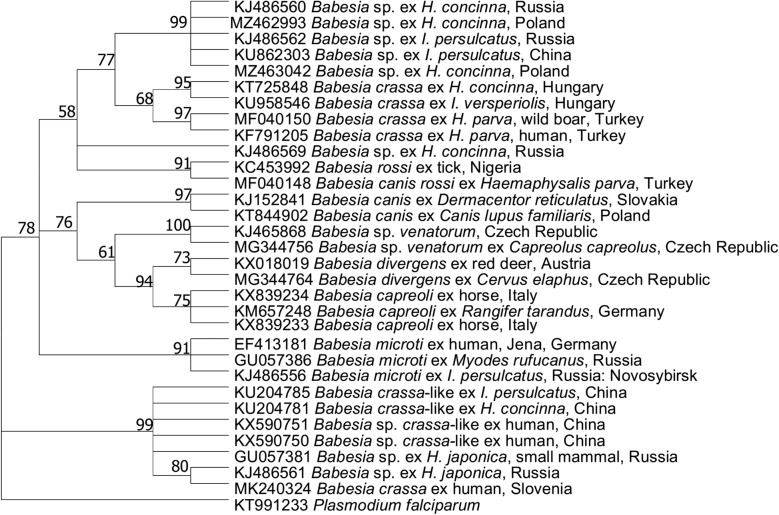
Fig. 2
Fig. 2
Molecular phylogenetic analysis of 18S rDNA of selected Babesia spp. (550 base pairs). The evolutionary history was inferred by using the maximum likelihood method and the Kimura two-parameter model. The tree with the highest log likelihood (− 2752,03) is shown. The percentage of trees in which the associated taxa clustered together is shown next to the branches. Initial tree(s) for the heuristic search were obtained automatically by applying neighbour-joining and BioNJ algorithms to a matrix of pairwise distances estimated using the maximum composite likelihood approach, and then selecting the topology with a superior log likelihood value. A discrete γ distribution was used to model evolutionary rate differences among sites [five categories (+ G, parameter = 2,1600)]. This analysis involved 32 nucleotide sequences. There were a total of 458 positions in the final dataset. Evolutionary analyses were conducted in MEGA X

References

    1. Gray JS, Estrada-Peña A, Zintl A. Vectors of babesiosis. Annu Rev Entomol. 2019;64:149–165. doi: 10.1146/annurev-ento-011118-111932. - DOI - PubMed
    1. Krause PJ. Human babesiosis. Int J Parasitol. 2019;49:165–174. doi: 10.1016/j.ijpara.2018.11.007. - DOI - PubMed
    1. Bock R, Jackson L, de Vos A, Jorgensen W. Babesiosis of cattle. Parasitology. 2004;129(Suppl):S247–S269. doi: 10.1017/S0031182004005190. - DOI - PubMed
    1. Birkenheuer AJ, Buch J, Beall MJ, Braff J, Chandrashekar R. Global distribution of canine Babesia species identified by a commercial diagnostic laboratory. Vet Parasitol Reg Stud Rep. 2020;22:100471. - PubMed
    1. Solano-Gallego L, Sainz Á, Roura X, Estrada-Pena A, Guadalupe M. A review of canine babesiosis: the European perspective. Parasit Vectors. 2016;9:336. doi: 10.1186/s13071-016-1596-0. - DOI - PMC - PubMed

LinkOut - more resources