


An adapted European LeukemiaNet genetic risk stratification for acute myeloid leukemia patients undergoing allogeneic hematopoietic cell transplant. A CIBMTR analysis
- PMID: 34584240
- PMCID: PMC8758206
- DOI: 10.1038/s41409-021-01450-3
An adapted European LeukemiaNet genetic risk stratification for acute myeloid leukemia patients undergoing allogeneic hematopoietic cell transplant. A CIBMTR analysis
Erratum in
-
Correction to: An adapted European LeukemiaNet genetic risk stratification for acute myeloid leukemia patients undergoing allogeneic hematopoietic cell transplant. A CIBMTR analysis.Bone Marrow Transplant. 2022 May;57(5):852. doi: 10.1038/s41409-022-01625-6. Bone Marrow Transplant. 2022. PMID: 35297406 No abstract available.
Abstract
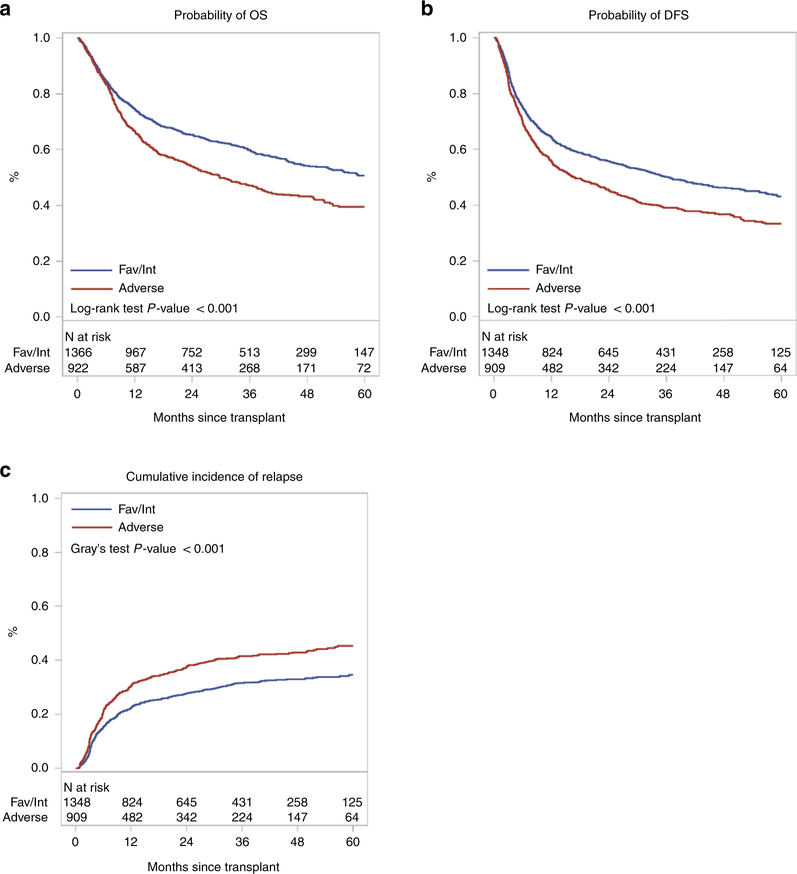
Cytogenetic and molecular abnormalities are known to influence post-transplant outcomes in acute myeloid leukemia (AML) but data assessing the prognostic value of combined genetic models in the HCT setting are limited. We developed an adapted European LeukemiaNet (aELN) risk classification based on available genetic data reported to the Center for International Blood and Marrow Transplant Research, to predict post-transplant outcomes in 2289 adult AML patients transplanted in first remission, between 2013 and 2017. Patients were stratified according to aELN into three groups: favorable (Fav, N = 181), intermediate (IM, N = 1185), and adverse (Adv, N = 923). Univariate analysis demonstrated significant differences in 2-year overall survival (OS) (Fav: 67.7%, IM: 64.9% and Adv: 53.9%; p < 0.001); disease-free survival (DFS) (Fav: 57.8%, IM: 55.5% and Adv: 45.3; p < 0.001) and relapse (Fav: 28%, IM: 27.5% and Adv: 37.5%; p < 0.001). Multivariate analysis (MVA) revealed no differences in outcomes between the Fav and IM groups, thus they were combined. On MVA, patients in the Adv risk group had the highest risk of relapse (HR 1.47 p ≤ 0.001) and inferior DFS (HR 1.35 p < 0.001) and OS (HR 1.39 p < 0.001), even using myeloablative conditioning or in those without the pre-HCT measurable-residual disease. Novel approaches to mitigate relapse in this high-risk group are urgently needed.
© 2021. The Author(s), under exclusive licence to Springer Nature Limited.
Figures
References
-
- Slovak ML, Kopecky KJ, Cassileth PA, Harrington DH, Theil KS, Mohamed A, et al. Karyotypic analysis predicts outcome of preremission and postremission therapy in adult acute myeloid leukemia: a Southwest Oncology Group/Eastern Cooperative Oncology Group Study. Blood. 2000;96(13):4075–83. - PubMed
-
- Grimwade D, Hills RK, Moorman AV, Walker H, Chatters S, Goldstone AH, et al. Refinement of cytogenetic classification in acute myeloid leukemia: determination of prognostic significance of rare recurring chromosomal abnormalities among 5876 younger adult patients treated in the United Kingdom Medical Research Council trials. Blood. 2010;116(3):354–65. - PubMed
-
- Dholaria B, Savani BN, Hamilton BK, Oran B, Liu HD, Tallman MS, et al. Hematopoietic Cell Transplantation in the Treatment of Newly Diagnosed Adult Acute Myeloid Leukemia: An Evidence-Based Review from the American Society of Transplantation and Cellular Therapy. Biol Blood Marrow Transplant. 2020. - PubMed
Publication types
MeSH terms
Grants and funding
- U01 AI126612/AI/NIAID NIH HHS/United States
- P01 CA111412/CA/NCI NIH HHS/United States
- R01 CA215134/CA/NCI NIH HHS/United States
- R01 HL131731/HL/NHLBI NIH HHS/United States
- R01 HL126589/HL/NHLBI NIH HHS/United States
- R01 CA152108/CA/NCI NIH HHS/United States
- R01 AI128775/AI/NIAID NIH HHS/United States
- U24 CA076518/CA/NCI NIH HHS/United States
- U24 HL138660/HL/NHLBI NIH HHS/United States
- U01 AI069197/AI/NIAID NIH HHS/United States
- R01 CA231141/CA/NCI NIH HHS/United States
- UG1 HL069246/HL/NHLBI NIH HHS/United States
- U01 HL128568/HL/NHLBI NIH HHS/United States
- R01 HL129472/HL/NHLBI NIH HHS/United States
- OT3 HL147741/HL/NHLBI NIH HHS/United States
- R01 CA218285/CA/NCI NIH HHS/United States
- R01 HL130388/HL/NHLBI NIH HHS/United States
