. 2021 Sep;129(9):97011.
doi: 10.1289/EHP9424. Epub 2021 Sep 29.

Associations of Maternal Serum Perfluoroalkyl Substances Concentrations with Early Adolescent Bone Mineral Content and Density: The Health Outcomes and Measures of the Environment (HOME) Study

Affiliations

Associations of Maternal Serum Perfluoroalkyl Substances Concentrations with Early Adolescent Bone Mineral Content and Density: The Health Outcomes and Measures of the Environment (HOME) Study

Jessie P Buckley et al. Environ Health Perspect. 2021 Sep.

Abstract

Background: Per- and polyfluoroalkyl substances (PFAS) may impair bone accrual and strength via endocrine disruption and nuclear receptor agonism, but human studies are primarily of adults or cross-sectional.

Objectives: We assessed associations of individual PFAS and their mixture during pregnancy with child bone mineral content (BMC) and areal bone mineral density (aBMD) at age 12 y.

Methods: Among 206 mother-child pairs enrolled in a prospective cohort (2003-2006), we quantified perfluorooctanoic acid (PFOA), perfluorononanoic acid (PFNA), perfluorohexane sulfonic acid (PFHxS), and perfluorooctane sulfonic acid (PFOS) in maternal serum collected during gestation or delivery. When children were age 12 y, we performed dual energy X-ray absorptiometry and calculated BMC, aBMD, and bone mineral apparent density (BMAD) z-scores for six skeletal sites. We estimated covariate-adjusted z-score differences per doubling of individual PFAS using linear regression and assessed the PFAS mixture using quantile g-computation and Bayesian kernel machine regression. We explored whether associations were modified by child's sex or mediated by whole-body lean mass.

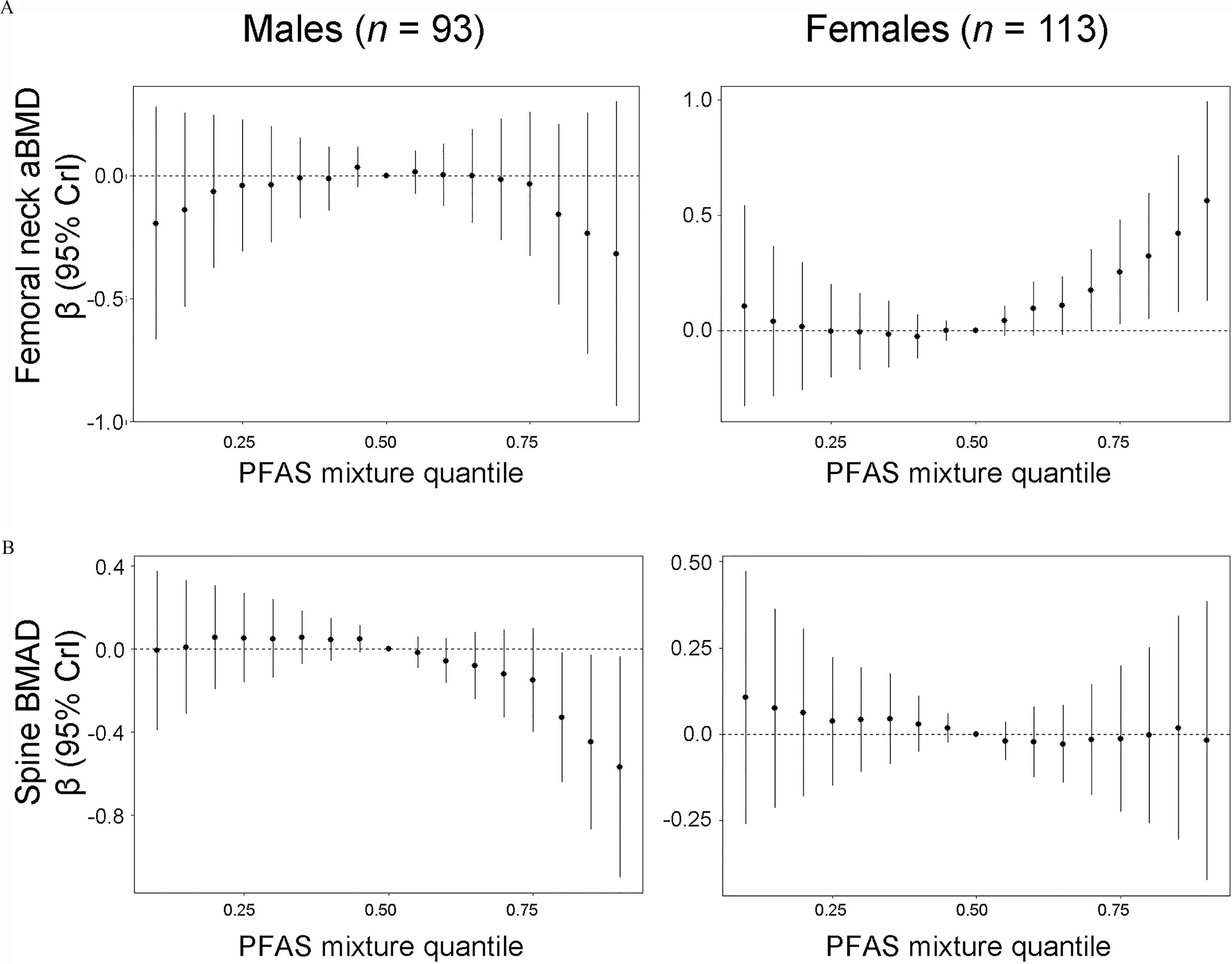
Results: In covariate-adjusted models, we found that higher maternal serum concentrations of PFOA, PFNA, and the PFAS mixture were associated with lower total hip and forearm (one-third distal radius) BMC z-scores in children. Differences in forearm BMC z-scores were -0.17 [95% confidence interval (CI): -0.35, 0.01] and -0.24 (95% CI: -0.44, -0.05) per doubling of PFOA and PFNA, respectively, and -0.18 (95% CI: -0.34, -0.02) per quartile increase in the PFAS mixture. Child's sex modified PFOA associations for some skeletal sites; for example, differences in spine BMAD z-score per doubling were -0.31 (95% CI: -0.58, -0.03) among males and 0.07 (95% CI: -0.16, 0.30) among females (modification p=0.04). Except for PFNA among females, these associations were not mediated by whole-body lean mass.

Discussion: Maternal PFAS concentrations during pregnancy may be associated with lower bone mineral accrual and strength in early adolescence. https://doi.org/10.1289/EHP9424.


Figures
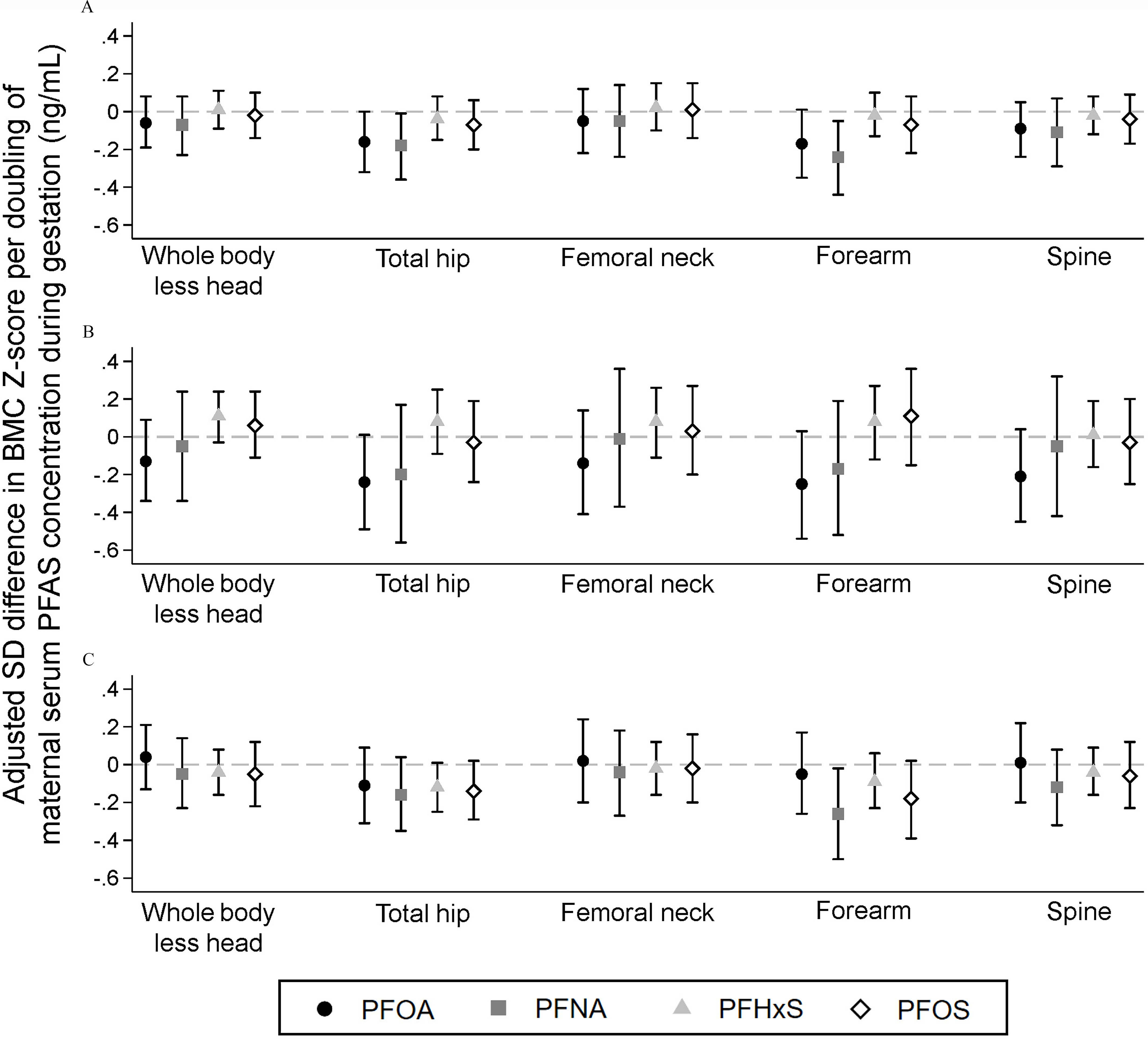
Figures 1A, 1B, and 1C are error bar graphs, plotting Adjusted standard deviation difference in bone mineral content z-score per doubling of maternal serum Per- and polyfluoroalkyl substances concentration during gestation (nanogram per milliliter), ranging from negative 0.6 to 0.4 in increments of 0.2 (y-axis) across whole body less head, total hip, femoral neck, forearm, and spine (x-axis) for perfluorooctanoic acid, perfluorononanoic acid, perfluorohexane sulfonic acid, and perfluorooctane sulfonic acid, respectively.
Figure 1.
Adjusted associations of maternal serum perfluoroalkyl substances concentrations with BMC z-scores at 12 years of age: The Health Outcomes and Measures of the Environment (HOME) Study. (A) overall (n=206), (B) males (n=93), (C) females (n=113). Difference (95% confidence interval) in BMC z-score per log2 unit increase in perfluoroalkyl substance concentrations estimated in separate linear regression models adjusted for maternal age at delivery, midpregnancy BMI, race/ethnicity, household income, parity, prenatal vitamin use, average blood lead concentration, and child age at follow-up. Models for the overall population are additionally adjusted for child sex and child sex by child age at follow-up. Missing covariate information accounted for using full-information maximum likelihood. Numeric results are reported in Tables S3 and S4. Note: BMC, bone mineral content; BMI, body mass index; PFHxS, perfluorohexane sulfonic acid; PFNA, perfluorononanoic acid; PFOA, perfluorooctanoic acid; PFOS, perfluorooctane sulfonic acid.
Figure 2A is a set of two error bar graphs, plotting Femoral neck areal bone mineral density lowercase beta (95 percent credible interval), ranging from negative 1.0 to 0.0 in increments of 0.5 and 0.0 to 1.0 in increments of 0.5 (y-axis) across per- and polyfluoroalkyl substances mixture quantile, ranging from 0.25 to 0.75 in increments of 0.25 (x-axis) for males (lowercase italic n equals 93) and female (lowercase italic n equals 113), respectively. Figure 2B is a set of two error bar graphs, plotting spine bone mineral apparent density lowercase beta (95 percent credible interval), ranging from negative 0.8 to 0.4 in increments of 0.4 and negative 0.25 to 0.50 in increments of 0.25 (y-axis) across from 0.25 to 0.75 in increments of 0.25 (x-axis) for males (lowercase italic n equals 93) and female (lowercase italic n equals 113), respectively.
Figure 2.
Adjusted associations of the maternal serum perfluoroalkyl substances mixture with bone outcome z-scores at age 12 y by child’s sex (n=206): The Health Outcomes and Measures of the Environment (HOME) Study. (A) femoral neck aBMD, (B) spine BMAD. Difference (95% CrI) in outcome z-score setting all PFAS to selected quantiles compared to the median, estimated using Bayesian kernel machine regression models adjusted for maternal age at delivery, mid-pregnancy BMI, race/ethnicity, household income, parity, prenatal vitamin use, average blood lead concentration, and child age at follow-up. Missing covariate information accounted for using single stochastic imputation by chained equations. Numeric results are reported in Table S7. Note: aBMD, areal bone mineral density; BMAD, spine bone mineral apparent density; BMI, body mass index; CrI, credible interval; PFAS, per- and polyfluoroalkyl substances.

Comment in

References

    1. Agas D, Lacava G, Sabbieti MG. 2018. Bone and bone marrow disruption by endocrine-active substances. J Cell Physiol 234(1):192–213, PMID: 29953590, 10.1002/jcp.26837. - DOI - PubMed
    1. Agas D, Sabbieti MG, Marchetti L. 2013. Endocrine disruptors and bone metabolism. Arch Toxicol 87(4):735–751, PMID: 23192238, 10.1007/s00204-012-0988-y. - DOI - PubMed
    1. Bailey DA, McKay HA, Mirwald RL, Crocker PR, Faulkner RA. 1999. A six-year longitudinal study of the relationship of physical activity to bone mineral accrual in growing children: the University of Saskatchewan bone mineral accrual study. J Bone Miner Res 14(10):1672–1679, PMID: 10491214, 10.1359/jbmr.1999.14.10.1672. - DOI - PubMed
    1. Bassett JH, Williams GR. 2016. Role of thyroid hormones in skeletal development and bone maintenance. Endocr Rev 37(2):135–187, PMID: 26862888, 10.1210/er.2015-1106. - DOI - PMC - PubMed
    1. Bobb JF, Valeri L, Claus Henn B, Christiani DC, Wright RO, Mazumdar M, et al. 2015. Bayesian kernel machine regression for estimating the health effects of multi-pollutant mixtures. Biostatistics 16(3):493–508, PMID: 25532525, 10.1093/biostatistics/kxu058. - DOI - PMC - PubMed

Publication types