


Microbiota Influences Fitness and Timing of Reproduction in the Fruit Fly Drosophila melanogaster
- PMID: 34585986
- PMCID: PMC8557915
- DOI: 10.1128/Spectrum.00034-21
Microbiota Influences Fitness and Timing of Reproduction in the Fruit Fly Drosophila melanogaster
Abstract
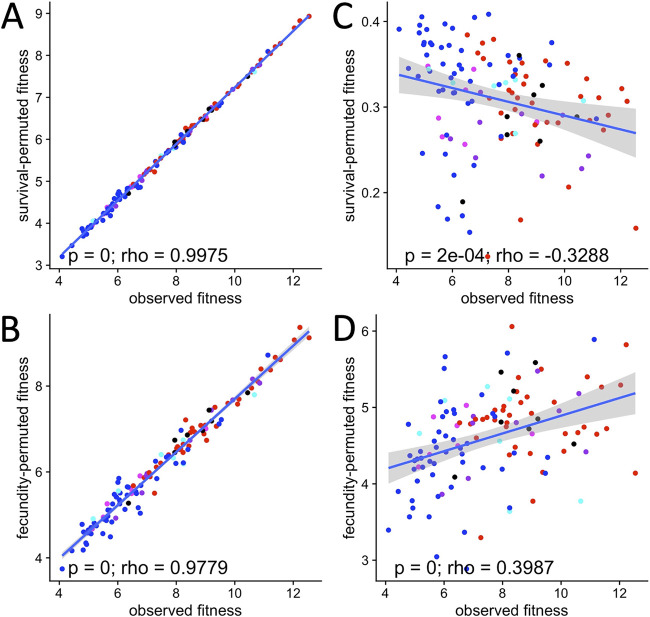
Associated microorganisms ("microbiota") play a central role in determining many animals' survival and reproduction characteristics. The impact of these microbial influences on an animal's fitness, or population growth, in a given environment has not been defined as clearly. We focused on microbiota-dependent host fitness by measuring life span and fecundity in Drosophila melanogaster fruit flies reared individually with 14 different bacterial species. Consistent with previous observations, the different bacteria significantly influenced the timing of fly life span and fecundity. Using Leslie matrices, we show that fly fitness was lowest when the microbes caused the flies to invest in life span over fecundity. Computational permutations showed that the positive fitness effect of investing in reproduction was reversed if fly survival over time was low, indicating that the observed fitness influences of the microbes could be context dependent. Finally, we showed that fly fitness is not influenced by bacterial genes that shape fly life span or fly triglyceride content, a trait that is related to fly survival and reproduction. Also, metagenome-wide association did not identify any microbial genes that were associated with variation in fly fitness. Therefore, the bacterial genetic basis for influencing fly fitness remains unknown. We conclude that bacteria influence a fly's reproductive timing more than total reproductive output and that (e.g., environmental) conditions that influence fly survival likely determine which bacteria benefit fly fitness. IMPORTANCE The ability of associated microorganisms ("microbiota") to influence animal life history traits has been recognized and investigated, especially in the past 2 decades. For many microbial communities, there is not always a clear definition of whether the microbiota or its members are beneficial, pathogenic, or relatively neutral to their hosts' fitness. In this study, we report the influence of individual members of the microbiota on Drosophila melanogaster fitness using Leslie matrices that combine the microbial influences on fly survival and reproduction into a single fitness measure. Our results are consistent with a previous report that, in the laboratory, acetic acid bacteria are more beneficial to the flies than many strains of lactic acid bacteria. We add to the previous finding by showing that this benefit depends on fly survival rate. Together, our work helps to show how the microbiota of a fly influences its laboratory fitness and how these effects may translate to a wild setting.
Keywords: Drosophila melanogaster; Leslie matrix; acetic acid bacteria; fitness; lactic acid bacteria; microbiota.
Figures



References
-
- Promislow DE, Harvey PH. 1990. Living fast and dying young: a comparative analysis of life-history variation among mammals. J Zoology 220:417–437. doi: 10.1111/j.1469-7998.1990.tb04316.x. - DOI
-
- Ricklefs RE, Wikelski M. 2002. The physiology/life-history nexus. Trends Ecol Evol 17:462–468. doi: 10.1016/S0169-5347(02)02578-8. - DOI
-
- Kawecki TJ, Ebert D. 2004. Conceptual issues in local adaptation. Ecol Lett 7:1225–1241. doi: 10.1111/j.1461-0248.2004.00684.x. - DOI
Publication types
MeSH terms
Grants and funding
LinkOut - more resources
Full Text Sources
Molecular Biology Databases
Miscellaneous
