Comment
doi: 10.1371/journal.pbio.3001404.
eCollection 2021 Sep.
Can brain stimulation boost memory performance?
Affiliations
- PMID: 34587149
- PMCID: PMC8480892
- DOI: 10.1371/journal.pbio.3001404
Item in Clipboard
Comment
Can brain stimulation boost memory performance?
PLoS Biol.
.
Abstract
Memory performance is crucial across the human life, from early education to age-related decline. A new study in PLOS Biology found that verbal learning can be enhanced by applying repetitive transcranial magnetic stimulation (rTMS) over the left prefrontal cortex.
Conflict of interest statement
The authors have declared that no competing interests exist.
Figures
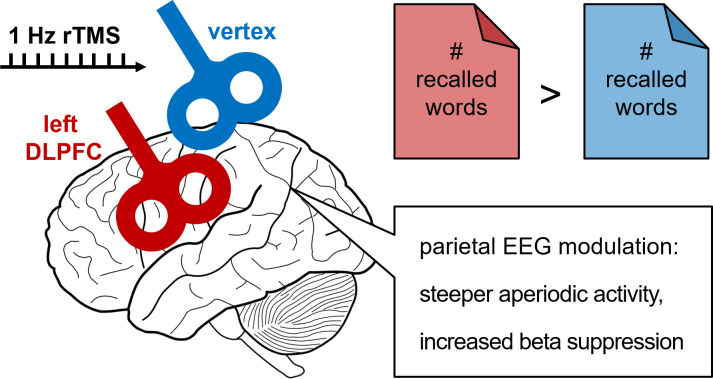
Applying slow (1 pulse per second) rTMS over the left DLPFC (compared to the vertex at top of the head as control region) is associated with enhanced word memory performance (10% to 20% increase). Apart from the effect of rTMS on memory performance, prefrontal stimulation causes enhanced event-related beta suppression at the parietal cortex, a neural response known to be a correlate of memory encoding. However, a further follow-up investigation reveals that increased beta suppression is driven by a steeper slope of aperiodic (scale free) rather than periodic (oscillatory) activity, a feature that reflects a decreased excitation to inhibition ratio of neural electrical currents. DLPFC, dorsolateral prefrontal cortex; EEG, electroencephalogram; rTMS, repetitive transcranial magnetic stimulation.
Comment on
-
Stimulation of the left dorsolateral prefrontal cortex with slow rTMS enhances verbal memory formation.PLoS Biol. 2021 Sep 28;19(9):e3001363. doi: 10.1371/journal.pbio.3001363. eCollection 2021 Sep. PLoS Biol. 2021. PMID: 34582432 Free PMC article.
References
Publication types
MeSH terms
LinkOut - more resources
Full Text Sources