


Proposed Anti-Inflammatory Diet Reduces Inflammation in Compliant, Weight-Stable Patients with Rheumatoid Arthritis in a Randomized Controlled Crossover Trial
- PMID: 34587253
- PMCID: PMC8643575
- DOI: 10.1093/jn/nxab313
Proposed Anti-Inflammatory Diet Reduces Inflammation in Compliant, Weight-Stable Patients with Rheumatoid Arthritis in a Randomized Controlled Crossover Trial
Abstract
Background: It is unclear to what extent adjuvant dietary intervention can influence inflammation in rheumatoid arthritis (RA).
Objectives: The objective was to assess the effects of dietary manipulation on inflammation in patients with RA.
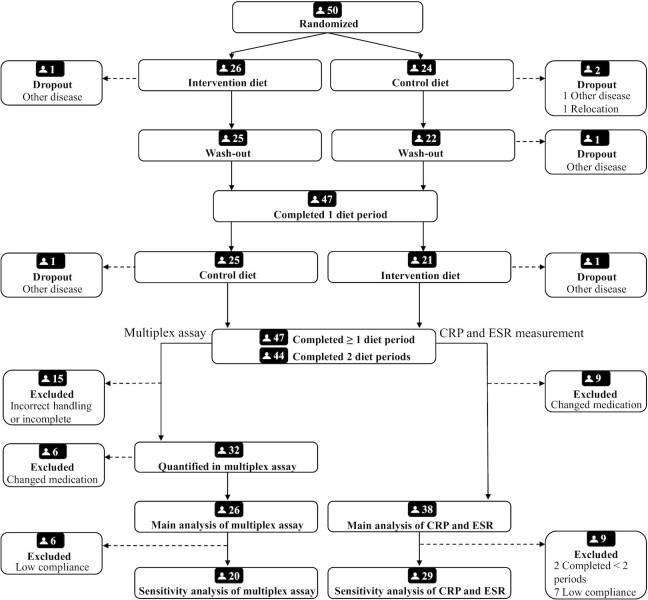
Methods: In a crossover design, participants [n = 50, 78% females, median BMI (in kg/m2) 27, median age 63 y] were randomly assigned to begin with either a 10-wk portfolio diet of proposed anti-inflammatory foods (i.e., a high intake of fatty fish, whole grains, fruits, nuts, and berries) or a control diet resembling a Western diet with a 4-mo washout in between. This report evaluates the secondary outcome markers of inflammation among participants with stable medication. Analyses were performed using a linear mixed ANCOVA model.
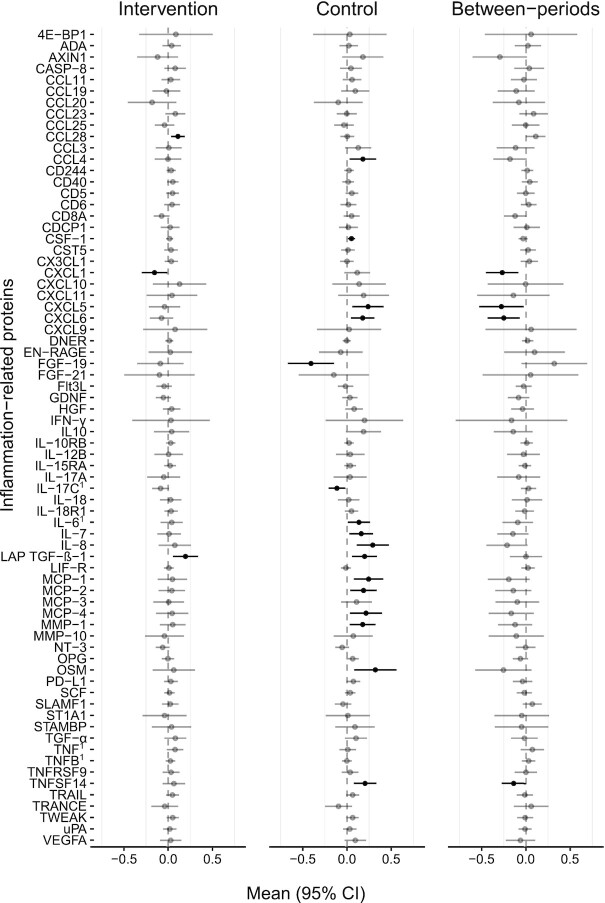
Results: There were no significant effects on CRP or ESR in the group as a whole. In those with high compliance (n = 29), changes in ESR within the intervention diet period differed significantly compared with changes within the control diet period (mean: -5.490; 95% CI: -10.310, -0.669; P = 0.027). During the intervention diet period, there were lowered serum concentrations of C-X-C motif ligand 1 (CXCL1) (mean: -0.268; 95% CI: -0.452, -0.084;P = 0.006), CXCL5 (mean: -0.278; 95% CI: -0.530, -0.026 P = 0.031), CXCL6 (mean: -0.251; 95% CI: -0.433, -0.069; P = 0.009), and tumor necrosis factor ligand superfamily member 14 (TNFSF14) (mean: -0.139; 95% CI: -0.275, -0.002; P = 0.047) compared with changes within the control diet period.
Conclusion: A proposed anti-inflammatory diet likely reduced systemic inflammation, as indicated by a decreased ESR in those who completed the study with high compliance (n = 29). These findings warrant further studies to validate our results, and to evaluate the clinical relevance of changes in CXCL1, CXCL5, CXCL6, and TNFSF14 in patients with RA.
Keywords: Rheumatoid arthritis; Western diet; anti-inflammatory diet; biomarkers of inflammation; diet intervention; inflammation.
© The Author(s) 2021. Published by Oxford University Press on behalf of the American Society for Nutrition.
Figures
References
-
- Hayter SM, Cook MC. Updated assessment of the prevalence, spectrum and case definition of autoimmune disease. Autoimmun Rev. 2012;11(10):754–65. - PubMed
-
- Minichiello E, Semerano L, Boissier M-C. Time trends in the incidence, prevalence, and severity of rheumatoid arthritis: a systematic literature review. Joint Bone Spine. 2016;83(6):625–30. - PubMed
-
- Yu C, Jin S, Wang Y, Jiang N, Wu C, Wang Q, Tian X, Li M, Zeng X. Remission rate and predictors of remission in patients with rheumatoid arthritis under treat-to-target strategy in real-world studies: a systematic review and meta-analysis. Clin Rheumatol. 2019;38(3):727–38. - PubMed
-
- Palominos PE, Gasparin AA, de Andrade NPB, Xavier RM, da Silva Chakr RM, Igansi F, Gossec L. Fears and beliefs of people living with rheumatoid arthritis: a systematic literature review. Advanc Rheumatol. 2018;58(1):1. doi: 10.1186/s42358-018-0001-4. - PubMed
-
- Salminen E, Heikkilä S, Poussa T, Lagström H, Saario R, Salminen S. Female patients tend to alter their diet following the diagnosis of rheumatoid arthritis and breast cancer. Prev Med. 2002;34(5):529–35. - PubMed
Publication types
MeSH terms
Substances
LinkOut - more resources
Full Text Sources
Medical
Research Materials
Miscellaneous
