


What factors are associated with ambulance use for non-emergency problems in children? A systematic mapping review and qualitative synthesis
- PMID: 34588248
- PMCID: PMC8480005
- DOI: 10.1136/bmjopen-2021-049443
What factors are associated with ambulance use for non-emergency problems in children? A systematic mapping review and qualitative synthesis
Abstract
Objective: To explore what factors are associated with ambulance use for non-emergency problems in children.
Methods: This study is a systematic mapping review and qualitative synthesis of published journal articles and grey literature. Searches were conducted on the following databases, for articles published between January 1980 and July 2020: MEDLINE, EMBASE, PsycINFO, CINAHL and AMED. A Google Scholar and a Web of Science search were undertaken to identify reports or proceedings not indexed in the above. Book chapters and theses were searched via the OpenSigle, EThOS and DART databases. A literature advisory group, including experts in the field, were contacted for relevant grey literature and unpublished reports. The inclusion criteria incorporated articles published in the English language reporting findings for the reasons behind why there are so many calls to the ambulance service for non-urgent problems in children. Data extraction was divided into two stages: extraction of data to generate a broad systematic literature 'map', and extraction of data from highly relevant papers using qualitative methods to undertake a focused qualitative synthesis. An initial table of themes associated with reasons for non-emergency calls to the ambulance for children formed the 'thematic map' element. The uniting feature running through all of the identified themes was the determination of 'inappropriateness' or 'appropriateness' of an ambulance call out, which was then adopted as the concept of focus for our qualitative synthesis.
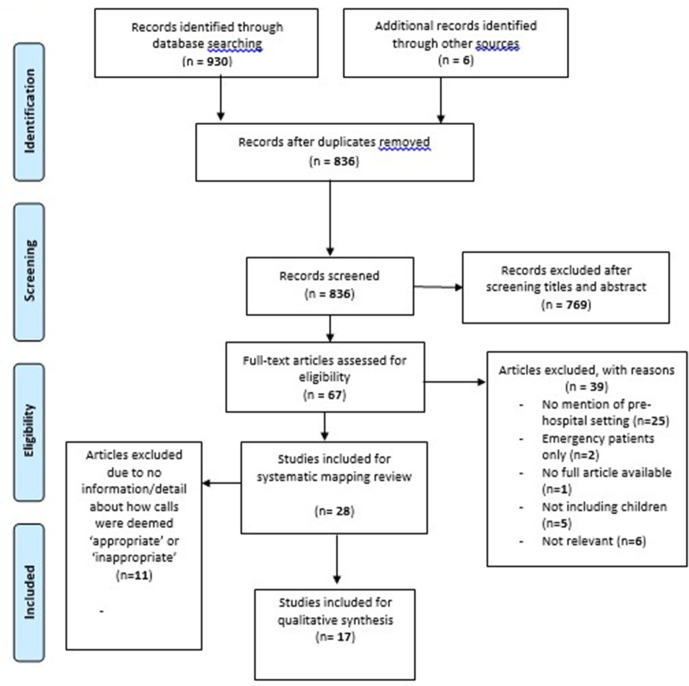
Results: There were 27 articles used in the systematic mapping review and 17 in the qualitative synthesis stage of the review. Four themes were developed in the systematic mapping stage: socioeconomic status/geographical location, practical reasons, fear of consequences and parental education. Three analytical themes were developed in the qualitative synthesis stage including practicalities and logistics of obtaining care, arbitrary scoring system and retrospection.
Conclusions: There is a lack of public and caregiver understanding about the use of ambulances for paediatrics. There are factors that appear specific to choosing ambulance care for children that are not so prominent in adults (fever, reassurance, fear of consequences). Future areas for attention to decrease ambulance activation for paediatric low-acuity reports were highlighted as: identifying strategies for helping caregivers to mitigate perceived risk, increasing availability of primary care, targeted education to particular geographical areas, education to first-time parents with infants and providing alternate means of transportation.
Prospero registration number: CRD42019160395.
Keywords: accident & emergency medicine; general medicine (see internal medicine); paediatrics.
© Author(s) (or their employer(s)) 2021. Re-use permitted under CC BY-NC. No commercial re-use. See rights and permissions. Published by BMJ.
Conflict of interest statement
Competing interests: None declared.
Figures
References
-
- England NHS. High quality care for all, now and for future generations: transforming urgent and emergency care services in England, 2013. Available: https://www.england.nhs.uk/wp-content/uploads/2013/06/urg-emerg-care-ev-... [Accessed 30 Jul 2020].
Publication types
MeSH terms
LinkOut - more resources
Full Text Sources
Miscellaneous
