


The health consequences of stress in couples: A review and new integrated Dyadic Biobehavioral Stress Model
- PMID: 34589814
- PMCID: PMC8474672
- DOI: 10.1016/j.bbih.2021.100328
The health consequences of stress in couples: A review and new integrated Dyadic Biobehavioral Stress Model
Abstract
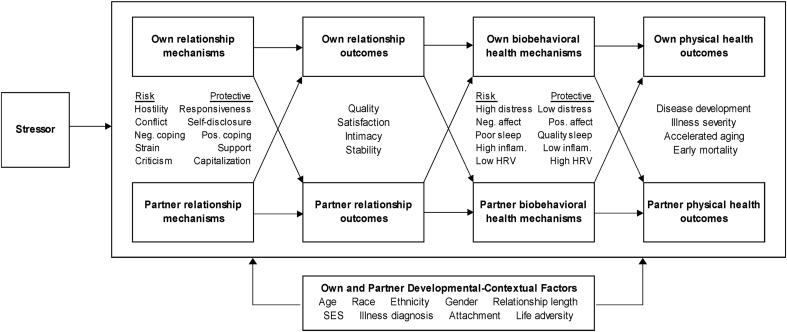
Despite marriage's health benefits, all couples experience stress that can increase morbidity and mortality risks. Marital stress can alter endocrine, cardiovascular, and immune function-key pathways from troubled relationships to poor health. This review discusses how partners "get under each other's skin" to influence psychological, behavioral, and biological health. Then, I offer a comprehensive Dyadic Biobehavioral Stress Model to build on this foundational work and inspire transdisciplinary research integrating psychoneuroimmunological and relational lenses. This conceptual and empirically driven model provides promising new directions to investigate mechanisms linking individuals' relationships behaviors to their own and their partners' health, with particular emphasis on biological pathways. These mechanisms may impact each partner's physical health outcomes, such as disease development, illness severity, and accelerated biological aging. Risk and protective factors across developmental stages and diverse contexts are also discussed to help explain how, and under what conditions, partners influence each other's health. Research applying this model can push the boundaries of our current understanding on dyadic stress its far-reaching health effects on self-report and biological markers across the lifespan.
Keywords: Dyadic coping; Inflammation; Interdependence; Marriage; Psychoneuroimmunology; Stress reactivity.
© 2021 The Author(s).
Conflict of interest statement
The authors declare that they have no known competing financial interests or personal relationships that could have appeared to influence the work reported in this paper.
Figures

References
-
- Antelmi I., De Paula R.S., Shinzato A.R., Peres C.A., Mansur A.J., Grupi C.J. Influence of age, gender, body mass index, and functional capacity on heart rate variability in a cohort of subjects without heart disease. Am. J. Cardiol. 2004;93(3):381–385. doi: 10.1016/j.amjcard.2003.09.065. - DOI - PubMed
LinkOut - more resources
Full Text Sources
