


Strategies to reduce the risk of SARS-CoV-2 importation from international travellers: modelling estimations for the United Kingdom, July 2020
- PMID: 34596018
- PMCID: PMC8485583
- DOI: 10.2807/1560-7917.ES.2021.26.39.2001440
Strategies to reduce the risk of SARS-CoV-2 importation from international travellers: modelling estimations for the United Kingdom, July 2020
Abstract
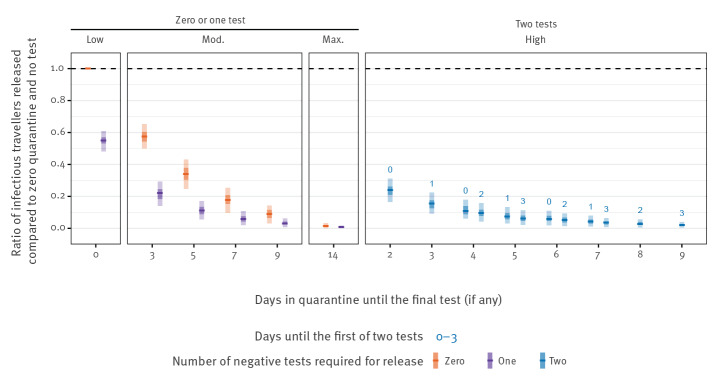
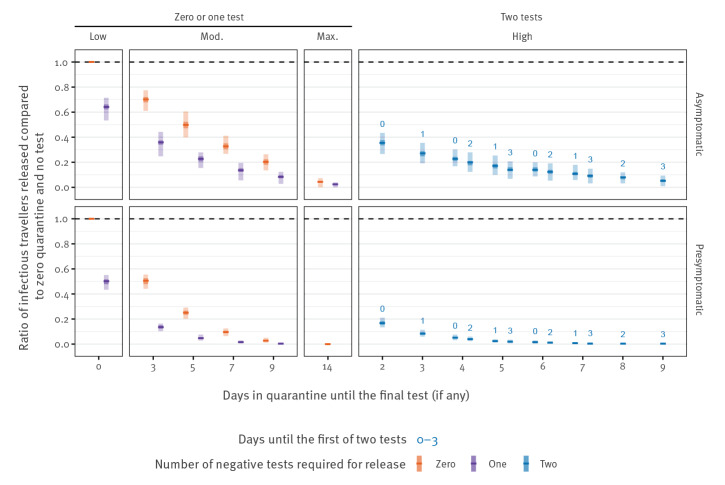
BackgroundTo mitigate SARS-CoV-2 transmission risks from international air travellers, many countries implemented a combination of up to 14 days of self-quarantine upon arrival plus PCR testing in the early stages of the COVID-19 pandemic in 2020.AimTo assess the effectiveness of quarantine and testing of international travellers to reduce risk of onward SARS-CoV-2 transmission into a destination country in the pre-COVID-19 vaccination era.MethodsWe used a simulation model of air travellers arriving in the United Kingdom from the European Union or the United States, incorporating timing of infection stages while varying quarantine duration and timing and number of PCR tests.ResultsQuarantine upon arrival with a PCR test on day 7 plus a 1-day delay for results can reduce the number of infectious arriving travellers released into the community by a median 94% (95% uncertainty interval (UI): 89-98) compared with a no quarantine/no test scenario. This reduction is similar to that achieved by a 14-day quarantine period (median > 99%; 95% UI: 98-100). Even shorter quarantine periods can prevent a substantial amount of transmission; all strategies in which travellers spend at least 5 days (mean incubation period) in quarantine and have at least one negative test before release are highly effective (median reduction 89%; 95% UI: 83-95)).ConclusionThe effect of different screening strategies impacts asymptomatic and symptomatic individuals differently. The choice of an optimal quarantine and testing strategy for unvaccinated air travellers may vary based on the number of possible imported infections relative to domestic incidence.
Keywords: COVID-19; PCR testing; SARS-CoV-2; quarantine; travel screening.
Conflict of interest statement
Figures
References
-
- Department of Health and Social Care and Department for Transport. Coronavirus (COVID-19): how to self-isolate when you travel to the UK. London: United Kingdom Government. [Accessed: 20 Jul 2020]. Available from: https://www.gov.uk/government/publications/coronavirus-covid-19-how-to-s...
-
- World Health Organisation (WHO). Operational considerations for case management of COVID-19 in health facility and community. Report No.: WHO/2019-nCoV/HCF_operations/2020.1. Geneva: WHO; 2020. Available from: https://www.who.int/publications/i/item/10665-331492
MeSH terms
Substances
Grants and funding
LinkOut - more resources
Full Text Sources
Medical
Miscellaneous