Review
. 2021 Oct 1;131(19):e148288.
doi: 10.1172/JCI148288.

Defining circadian disruption in neurodegenerative disorders

Review

Defining circadian disruption in neurodegenerative disorders

Christopher S Colwell. J Clin Invest. .

Abstract

Neurodegenerative diseases encompass a large group of conditions that are clinically and pathologically diverse yet are linked by a shared pathology of misfolded proteins. The accumulation of insoluble aggregates is accompanied by a progressive loss of vulnerable neurons. For some patients, the symptoms are motor focused (ataxias), while others experience cognitive and psychiatric symptoms (dementias). Among the shared symptoms of neurodegenerative diseases is a disruption of the sleep/wake cycle that occurs early in the trajectory of the disease and may be a risk factor for disease development. In many cases, the disruption in the timing of sleep and other rhythmic physiological markers immediately raises the possibility of neurodegeneration-driven disruption of the circadian timing system. The aim of this Review is to summarize the evidence supporting the hypothesis that circadian disruption is a core symptom within neurodegenerative diseases, including Alzheimer's disease, Huntington's disease, and Parkinson's disease, and to discuss the latest progress in this field. The Review discusses evidence that neurodegenerative processes may disrupt the structure and function of the circadian system and describes circadian-based interventions as well as timed drug treatments that may improve a wide range of symptoms associated with neurodegenerative disorders. It also identifies key gaps in our knowledge.


Conflict of interest statement

Conflict of interest: The author has declared that no conflict of interest exists.

Figures

Figure 1
Figure 1. Illustration of the tight reciprocal relationships between circadian rhythms, sleep, and neurodegenerative disease.
Circadian disruption and sleep loss are likely to contribute to symptoms associated with NDD in humans. Work in animal models as well as in human subjects suggests that alterations in amplitude, regularity, and coherence of measured rhythms are common. Many researchers in this area favor a bidirectional model in which the ongoing disease pathology can impact circadian rhythms, and the disrupted circadian rhythms may accelerate the disease pathology. If this hypothesis is correct, future studies should be able to demonstrate that circadian-based interventions can improve a wide range of symptoms associated with NDDs.
Figure 2
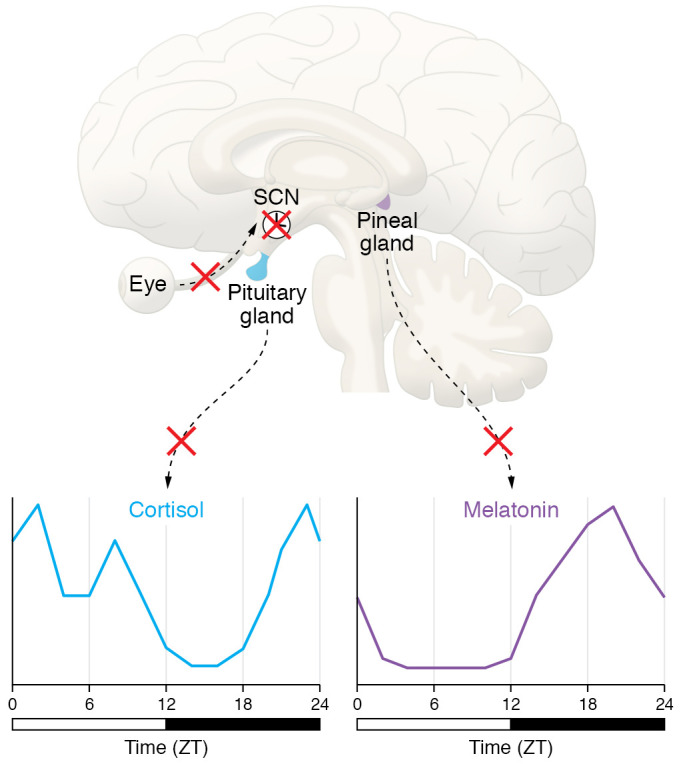
Figure 2. Schematic representation of the pathways that may be compromised in the circadian system of patients with NDD.
The light/dark (LD) cycle is the main external synchronizer of the central circadian pacemaker (via melanopsin and visual photoreceptors) and a direct retinohypothalamic tract. There is evidence for an NDD-driven loss of melanopsin-expressing intrinsically photoreceptive retinal ganglion cells (ipRGCs). The reduction in the ability of light to reset the circadian clock could provide an explanation for the reduction in rhythm amplitude under LD conditions, as well as the increase in cycle-to-cycle variability. The master clock in the SCN serves to synchronize central and peripheral oscillators to optimize the function of the organism relative to the 24-hour periodicities in the environment. There are a number of cell populations within the SCN as defined by gene expression and anatomical analysis. Some of these cell populations are vulnerable to AD-driven degeneration, and the data are at least consistent with the possibility that damage to the SCN itself underlies circadian disruption in NDD, at least in later stages of disease. SCN circuits send projections throughout the CNS and endocrine system, providing multiple pathways by which the SCN can convey temporal information to the brain and body. There is evidence that NDD can alter the amplitude and regularity of SCN-driven outputs such as rhythms in melatonin and cortisol. The weakening of the rhythms in these three key outputs would be expected to reduce the synchrony of molecular clocks found throughout the body, leading to a state of internal desynchronization. ZT, zeitgeber time.
Figure 3
Figure 3. Circadian-regulated pathways essential to NDDs.
At the beginning of the cycle, CLOCK and BMAL1 protein complexes bind DNA at specific promoter regions (E-box) to activate the transcription of a family of genes including the Period (Per1, Per2, and Per3) and Cryptochrome (Cry1 and Cry2) genes. The levels of the transcripts for Per and Cry reach their peak during mid- to late day, while the PER and CRY proteins peak in the early night. The PERs, CRYs, and other proteins form complexes that translocate back into the nucleus and turn off the transcriptional activity driven by CLOCK-BMAL1 with a delay (due to transcription, translation, dimerization, and nuclear entry). The proteins would be degraded by ubiquitination, allowing the cycle to begin again. Many cells contain this molecular feedback loop that regulates the rhythmic transcription of a number of genes. Other feedback loops within the cells serve to contribute to the precision and robustness of the core oscillation. Of particular importance, a rhythm in the transcription of BMAL1 is driven by a secondary feedback loop involving the activator retinoic acid receptor–related orphan receptor (ROR) and the repressor REV-ERBα/β. Mechanistically, this circadian clockwork drives a number of processes implicated in NDD. For example, the circadian clock regulates a number of pathways involved in proteostasis, including molecular chaperones as well as autophagy. In addition, many of the genes involved in control of excitability and secretion are rhythmically regulated by this molecular feedback loop. While the precise mechanisms involved in the transmission of misfolded proteins are not known, they are likely impacted by circadian disruption. Finally, it has long been appreciated that there is a close relationship between the circadian clock and the immune system, and disruptions of the circadian timing system drive neuroinflammation, mediated by glial cells. CCGs, circadian clock genes; RORE, ROR response element.

References

    1. Soto C, Pritzkow S. Protein misfolding, aggregation, and conformational strains in neurodegenerative diseases. Nat Neurosci. 2018;21(10):1332–1340. doi: 10.1038/s41593-018-0235-9. - DOI - PMC - PubMed
    1. Peng C, et al. Protein transmission in neurodegenerative disease. Nat Rev Neurol. 2020;16(4):199–212. doi: 10.1038/s41582-020-0333-7. - DOI - PMC - PubMed
    1. Roenneberg T, Merrow M. The circadian clock and human health. Curr Biol. 2016;26(10):R432–R443. doi: 10.1016/j.cub.2016.04.011. - DOI - PubMed
    1. Cederroth CR, et al. Medicine in the fourth dimension. Cell Metab. 2019;30(2):238–250. doi: 10.1016/j.cmet.2019.06.019. - DOI - PMC - PubMed
    1. Wen S, et al. Spatiotemporal single-cell analysis of gene expression in the mouse suprachiasmatic nucleus. Nat Neurosci. 2020;23(3):456–467. doi: 10.1038/s41593-020-0586-x. - DOI - PubMed