


Cancer in Children With Fanconi Anemia and Ataxia-Telangiectasia-A Nationwide Register-Based Cohort Study in Germany
- PMID: 34597127
- PMCID: PMC8683217
- DOI: 10.1200/JCO.21.01495
Cancer in Children With Fanconi Anemia and Ataxia-Telangiectasia-A Nationwide Register-Based Cohort Study in Germany
Abstract
Purpose: Fanconi anemia (FA) and ataxia-telangiectasia (AT) are rare inherited syndromes characterized by abnormal DNA damage response and caused by pathogenic variants in key DNA repair proteins that are also relevant in the pathogenesis of breast cancer and other cancer types. The risk of cancer in children with these diseases is poorly understood and has never been assessed in a population-based cohort before.
Methods: We identified 421 patients with FA and 160 patients with AT diagnosed between 1973 and 2020 through German DNA repair disorder reference laboratories. We linked patients' laboratory data with childhood cancer data from the German Childhood Cancer Registry.
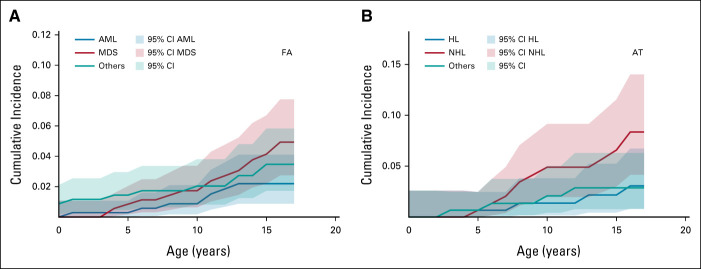
Results: Among 421 patients with FA, we observed 33 cases of childhood cancer (15 cases of myelodysplastic syndrome; seven cases of acute myeloid leukemia; two cases of lymphoma, carcinoma, medulloblastoma, and nephroblastoma, respectively; and one case of rhabdomyosarcoma, acute lymphoblastic leukemia, and glioma, respectively) versus 0.74 expected (on the basis of population-based incidence rates in Germany). This corresponds to a 39-fold increased risk (standardized incidence ratio [SIR] = 39; 95% CI, 26 to 56). For all FA subgroups combined, the cancer-specific SIR for myeloid neoplasms was 445 (95% CI, 272 to 687). Among the 160 patients with AT, we observed 19 cases of childhood cancer (15 cases of lymphoma, three cases of leukemia, and one case of medulloblastoma) versus 0.32 expected. This corresponds to a 56-fold increased risk (SIR = 56; 95% CI, 33 to 88). The cancer-specific SIR for Hodgkin lymphoma was 215 (95% CI, 58 to 549) and for non-Hodgkin lymphoma 470 (95% CI, 225 to 865).
Conclusion: Approximately 11% of patients with FA and 14% of patients with AT develop cancer by age 18 years.
Conflict of interest statement
The following represents disclosure information provided by authors of this manuscript. All relationships are considered compensated unless otherwise noted. Relationships are self-held unless noted. I = Immediate Family Member, Inst = My Institution. Relationships may not relate to the subject matter of this manuscript. For more information about ASCO's conflict of interest policy, please refer to
Open Payments is a public database containing information reported by companies about payments made to US-licensed physicians (
No potential conflicts of interest were reported.
Figures
Comment in
-
Importance of Population-Based Cancer Risk Information in the Care of Patients With Rare Genetic Disorders.J Clin Oncol. 2022 Jan 1;40(1):5-7. doi: 10.1200/JCO.21.02251. Epub 2021 Nov 18. J Clin Oncol. 2022. PMID: 34793247 Free PMC article. No abstract available.
References
-
- Savitsky K, Bar-Shira A, Gilad S, et al. : A single ataxia telangiectasia gene with a product similar to PI-3 kinase. Science 268:1749-1753, 1995 - PubMed
-
- Amirifar P, Ranjouri MR, Lavin M, et al. : Ataxia-telangiectasia: Epidemiology, pathogenesis, clinical phenotype, diagnosis, prognosis and management. Expert Rev Clin Immunol 16:859-871, 2020 - PubMed
Publication types
MeSH terms
LinkOut - more resources
Full Text Sources
Medical
