


Trends in fever case management for febrile inpatients in a low malaria incidence setting of Tanzania
- PMID: 34598312
- PMCID: PMC8639662
- DOI: 10.1111/tmi.13683
Trends in fever case management for febrile inpatients in a low malaria incidence setting of Tanzania
Abstract
Objectives: In 2010, WHO published guidelines emphasising parasitological confirmation of malaria before treatment. We present data on changes in fever case management in a low malaria transmission setting of northern Tanzania after 2010.
Methods: We compared diagnoses, treatments and outcomes from two hospital-based prospective cohort studies, Cohort 1 (2011-2014) and Cohort 2 (2016-2019), that enrolled febrile children and adults. All participants underwent quality-assured malaria blood smear-microscopy. Participants who were malaria smear-microscopy negative but received a diagnosis of malaria or received an antimalarial were categorised as malaria over-diagnosis and over-treatment, respectively.
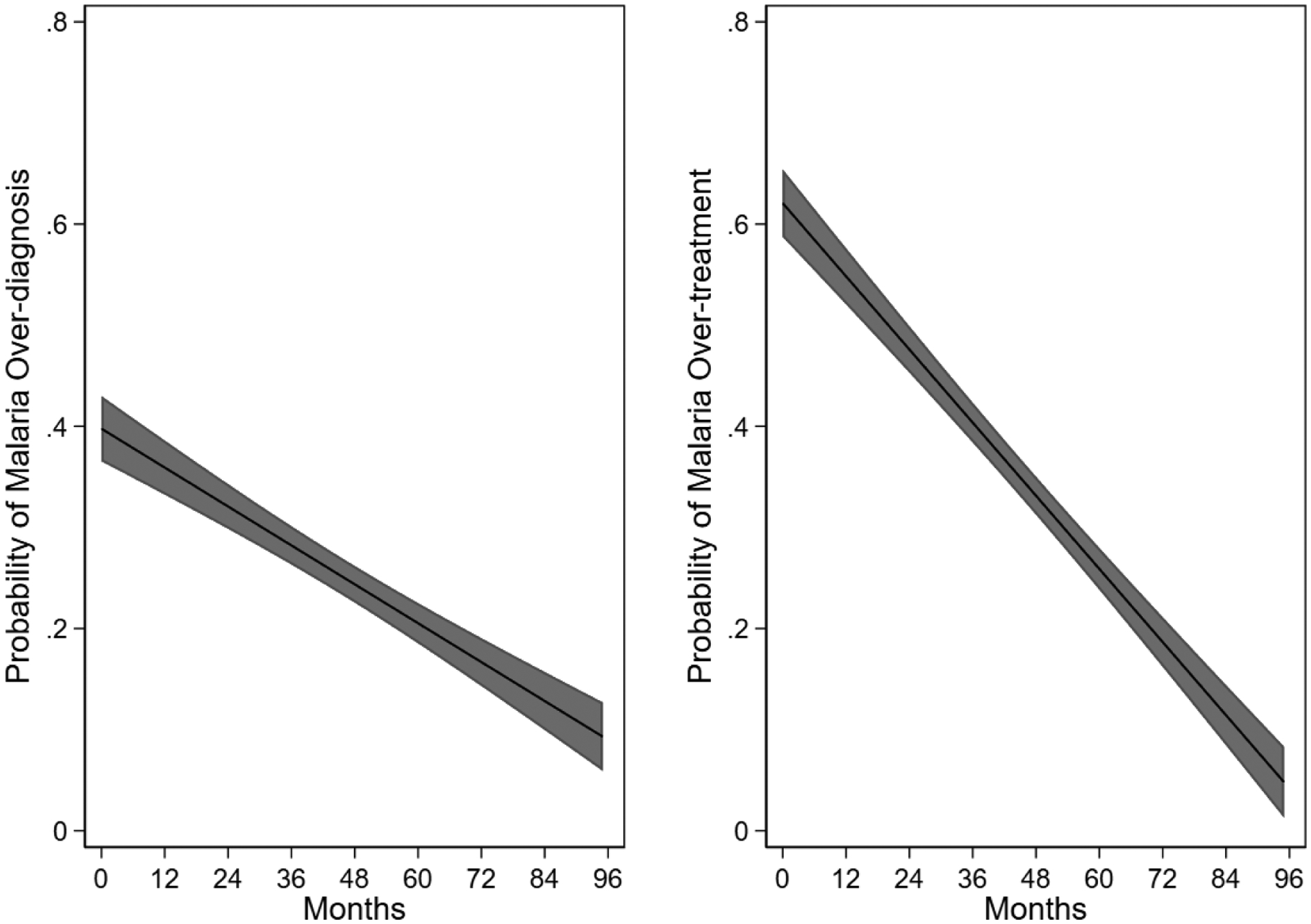
Results: We analysed data from 2098 participants. The median (IQR) age was 27 (3-43) years and 1047 (50.0%) were female. Malaria was detected in 23 (2.3%) participants in Cohort 1 and 42 (3.8%) in Cohort 2 (p = 0.059). Malaria over-diagnosis occurred in 334 (35.0%) participants in Cohort 1 and 190 (17.7%) in Cohort 2 (p < 0.001). Malaria over-treatment occurred in 528 (55.1%) participants in Cohort 1 and 196 (18.3%) in Cohort 2 (p < 0.001). There were 30 (3.1%) deaths in Cohort 1 and 60 (5.4%) in Cohort 2 (p = 0.007). All deaths occurred among smear-negative participants.
Conclusion: We observed a substantial decline in malaria over-diagnosis and over-treatment among febrile inpatients in northern Tanzania between two time periods after 2010. Despite changes, some smear-negative participants were still diagnosed and treated for malaria. Our results highlight the need for continued monitoring of fever case management across different malaria epidemiological settings in sub-Saharan Africa.
Keywords: Africa; Tanzania; antimalarials; fever; malaria.
© 2021 John Wiley & Sons Ltd.
Figures

References
-
- World malaria report 2019. Geneva: World Health Organization; 2019. License: CC BY-NC-SA 3.0 IGO.
-
- WHO. IMAI district clinician manual: hospital care for adolescents and adults – guidelines for the management of illnesses with limited resources. 2011.
-
- Amexo M, Tolhurst R, Barnish G, Bates I. Malaria misdiagnosis: effects on the poor and vulnerable. Lancet. 2004. November 20;364(9448):1896–8. - PubMed
Publication types
MeSH terms
Substances
Grants and funding
- R25 TW009337/TW/FIC NIH HHS/United States
- U01 AI062563/AI/NIAID NIH HHS/United States
- D43 TW009337/TW/FIC NIH HHS/United States
- K23 AI116869/AI/NIAID NIH HHS/United States
- R01 AI121378/AI/NIAID NIH HHS/United States
- R01 TW009237/TW/FIC NIH HHS/United States
- T32 AI007392/AI/NIAID NIH HHS/United States
- BB/J010367/1/BB_/Biotechnology and Biological Sciences Research Council/United Kingdom
- BB/L018926/BB_/Biotechnology and Biological Sciences Research Council/United Kingdom
- BB/L017679/BB_/Biotechnology and Biological Sciences Research Council/United Kingdom
- BB/L018845/BB_/Biotechnology and Biological Sciences Research Council/United Kingdom
LinkOut - more resources
Full Text Sources
Medical
