. 2022 Jan 1:195:113656.
doi: 10.1016/j.bios.2021.113656. Epub 2021 Sep 23.

Magnetofluidic immuno-PCR for point-of-care COVID-19 serological testing

Affiliations

Magnetofluidic immuno-PCR for point-of-care COVID-19 serological testing

Pengfei Zhang et al. Biosens Bioelectron. .

Abstract

Serological tests play an important role in the fight against Coronavirus Disease 2019 (COVID-19), including monitoring the dynamic immune response after vaccination, identifying past infection and determining community infection rate. Conventional methods for serological testing, such as enzyme-linked immunosorbent assays and chemiluminescence immunoassays, provide reliable and sensitive antibody detection but require sophisticated laboratory infrastructure and/or lengthy assay time. Conversely, lateral flow immunoassays are suitable for rapid point-of-care tests but have limited sensitivity. Here, we describe the development of a rapid and sensitive magnetofluidic immuno-PCR platform that can address the current gap in point-of-care serological testing for COVID-19. Our magnetofluidic immuno-PCR platform automates a magnetic bead-based, single-binding, and one-wash immuno-PCR assay in a palm-sized magnetofluidic device and delivers results in ∼30 min. In the device, a programmable magnetic arm attracts and transports magnetically-captured antibodies through assay reagents pre-loaded in a companion plastic cartridge, and a miniaturized thermocycler and a fluorescence detector perform immuno-PCR to detect the antibodies. We evaluated our magnetofluidic immuno-PCR with 108 clinical serum/plasma samples and achieved 93.8% (45/48) sensitivity and 98.3% (59/60) specificity, demonstrating its potential as a rapid and sensitive point-of-care serological test for COVID-19.

Keywords: COVID-19; Immuno-PCR; Magnetofluidic device; Point-of-care; Serological testing.


Conflict of interest statement

The authors declare that they have no known competing financial interests or personal relationships that could have appeared to influence the work reported in this paper.

Figures

Fig. 1
Fig. 1
Overview of the magnetofluidic immuno-PCR platform. (A) The magnetofluidic immuno-PCR features a streamlined immuno-PCR assay performed in a disposable 3-well cartridge using a portable magnetofluidic device, which automates magnetic bead transfer and PCR thermal cycling and communicates results via Bluetooth to a smartphone app. (B) Receptor-binding domain (RBD)-coated magnetic beads capture anti-SARS-CoV-2 IgG together with oligo-goat anti-human IgG antibody (oligo-anti-IgG) conjugates before being loaded into the sample well of the cartridge. The IgG-captured magnetic beads are then transferred to the washing well to remove nonspecifically-adsorbed oligo-anti-IgG conjugates followed by another bead transfer to the PCR well to initiate PCR. The entire process is completed in ∼0.5 h, including 15 min immunobinding, 2 min washing, and 15 min for rapid PCR.
Fig. 2
Fig. 2
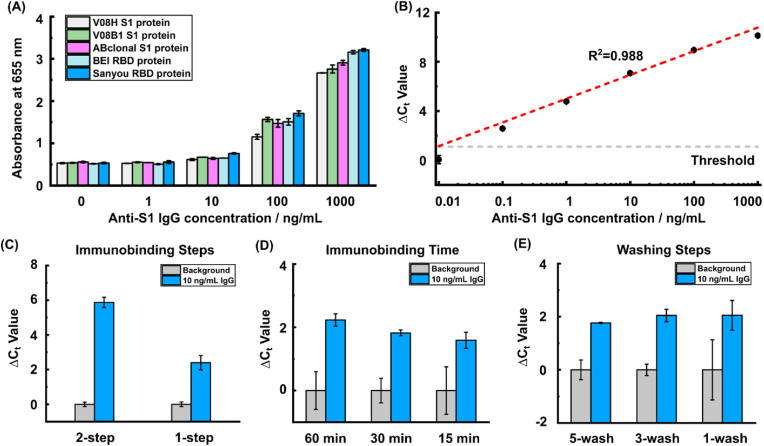
Development of a streamlined immuno-PCR assay. (A) Five different recombinant SARS-CoV-2 antigens were tested using ELISA for assessing anti-SARS-CoV-2 IgG capture efficiency. (B) A dilution series of anti-SARS-CoV-2 IgG spike-in in diluted human serum were tested using benchtop immuno-PCR to evaluate the assay sensitivity. (C) The 1-step, one-pot immunobinding showed differentiable Ct values between background and 10 ng/mL spike-in sample even though the ΔCt decreased compared with the 2-step workflow. (D) The immunobinding time was reduced from 60 min to 15 min to shorten the assay time. (E) The immuno-PCR was further simplified by reducing the number of washing steps from 5 times to 1 time. The error bars are standard deviations from duplicated experiments.
Fig. 3
Fig. 3
Implementation of SARS-CoV-2 immuno-PCR assay in the magnetofluidic device. (A) The real-time amplification curves of the magnetofluidic immuno-PCR tests showed earlier amplification with higher spike-in anti-S1 IgG concentrations. (B)As a result, the ΔCt values of IgG spike-in series in diluted human serum increased linearly with the IgG concentrations across three orders of magnitude with an estimated LOD of 2 ng/mL. (C) Our magnetofluidic immuno-PCR was also compatible with whole blood sample input though the LOD (∼22 ng/mL) was inferior to that of serum.
Fig. 4
Fig. 4
Clinical evaluation of the magnetofluidic immuno-PCR using convalescent serum/plasma samples. We tested two independent cohorts, 48 in total, of convalescent serum/plasma samples from SARS-CoV-2 patients and 60 pre-pandemic plasma/serum samples to characterize the sensitivity and specificity of our magnetofluidic immuno-PCR. (A) ΔCt values from magnetofluidic immuno-PCR analysis of clinical specimens. Negative specimens (black) are from archived samples collected prior to the pandemic. Red and blue dots indicate test-positive samples from ECLIA and custom Luminex analyses, respectively. (B) Receiver operating curve (ROC) analysis was performed on the ΔCt values of 60 pre-pandemic samples and 48 convalescent samples, resulting in an area under the curve (AUC) of 0.968 (95% CI: [0.933, 1.000]). (For interpretation of the references to color in this figure legend, the reader is referred to the Web version of this article.)

References

    1. Amanat F., Stadlbauer D., Strohmeier S., Nguyen T.H.O., Chromikova V., McMahon M., Jiang K., Arunkumar G.A., Jurczyszak D., Polanco J., Bermudez-Gonzalez M., Kleiner G., Aydillo T., Miorin L., Fierer D.S., Lugo L.A., Kojic E.M., Stoever J., Liu S.T.H., Cunningham-Rundles C., Felgner P.L., Moran T., García-Sastre A., Caplivski D., Cheng A.C., Kedzierska K., Vapalahti O., Hepojoki J.M., Simon V., Krammer F. Nat. Med. 2020;26:1033–1036. doi: 10.1038/s41591-020-0913-5. - DOI - PMC - PubMed
    1. Assarsson E., Lundberg M., Holmquist G., Björkesten J., Thorsen S.B., Ekman D., Eriksson A., Dickens E.R., Ohlsson S., Edfeldt G., Andersson A.C., Lindstedt P., Stenvang J., Gullberg M., Fredriksson S. PloS One. 2014;9 doi: 10.1371/journal.pone.0095192. - DOI - PMC - PubMed
    1. Chen F.E., Trick A.Y., Hsieh W., Shin D.J., Chen L., Chang E., Kaushik A., Wang T.H. Int. Conf. Solid-State Sensors, Actuators Microsystems Eurosensors XXXIII. 2019. TRANSDUCERS 2019 EUROSENSORS XXXIII 1116–1119, 2019 20th. - DOI
    1. Cheng M.P., Yansouni C.P., Basta N.E., Desjardins M., Kanjilal S., Paquette K., Caya C., Semret M., Quach C., Libman M., Mazzola L., Sacks J.A., Dittrich S., Papenburg J. Ann. Intern. Med. 2020;173:450–460. doi: 10.7326/M20-2854. - DOI - PMC - PubMed
    1. CSSE COVID-19 dashboard by the Center for Systems Science and Engineering (CSSE) at Johns Hopkins Univeristy (JHU) https://coronavirus.jhu.edu/map.html URL. 12.30.20.

Substances