


Seroprevalence of SARS-CoV-2 antibodies in the general population of Oman: results from four successive nationwide sero-epidemiological surveys
- PMID: 34601146
- PMCID: PMC8482550
- DOI: 10.1016/j.ijid.2021.09.062
Seroprevalence of SARS-CoV-2 antibodies in the general population of Oman: results from four successive nationwide sero-epidemiological surveys
Abstract
Objective: To assess the seroprevalence of severe acute respiratory syndrome coronavirus-2 (SARS-CoV-2) in Oman and longitudinal changes in antibody levels over time within the first 11 months of the coronavirus disease 2019 (COVID-19) pandemic.
Methods: This nationwide cross-sectional study was conducted as a four-cycle serosurvey using a multi-stage stratified sampling method from July to November 2020. A questionnaire was used and included demographics, history of acute respiratory infection and list of symptoms, COVID-19 contact, previous diagnosis or admission, travel history and risk factors.
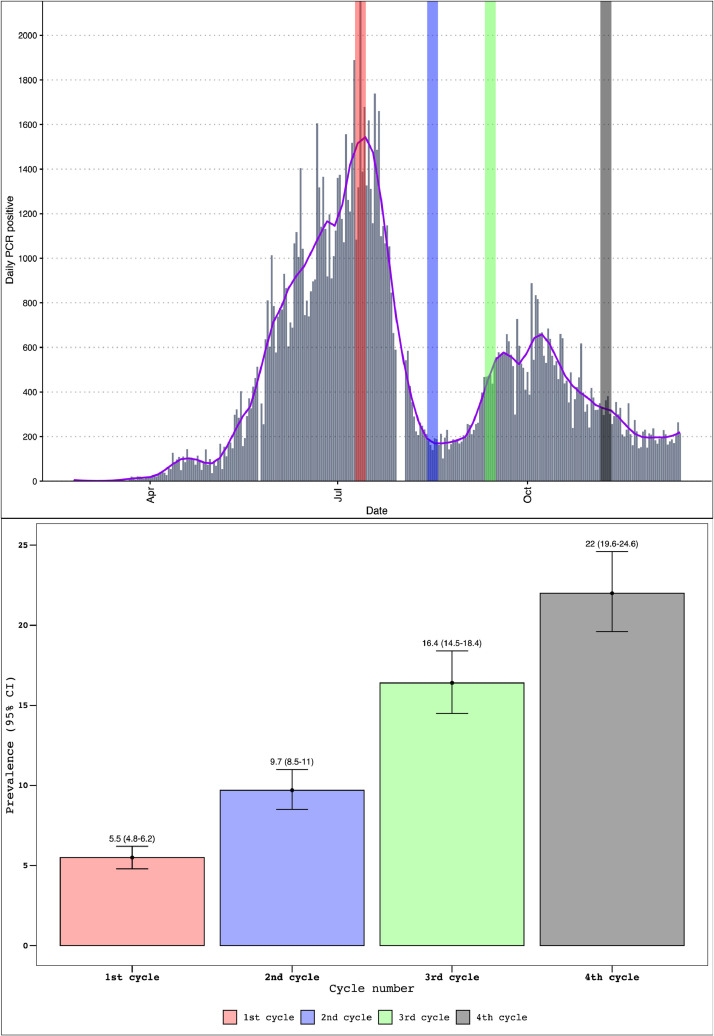
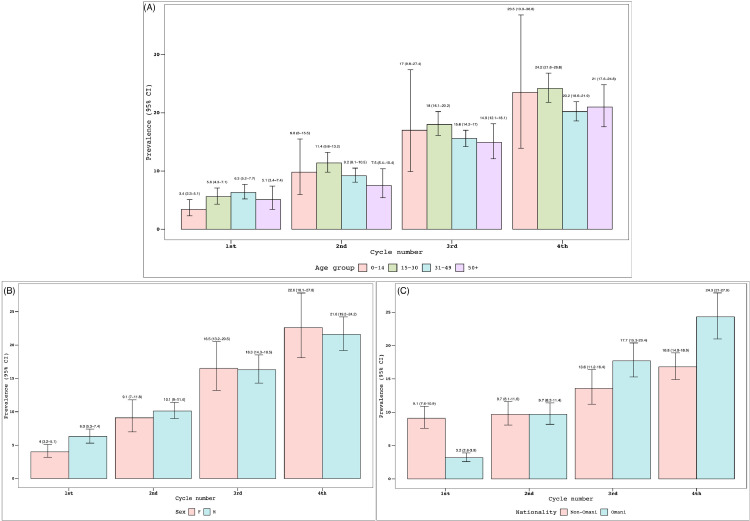
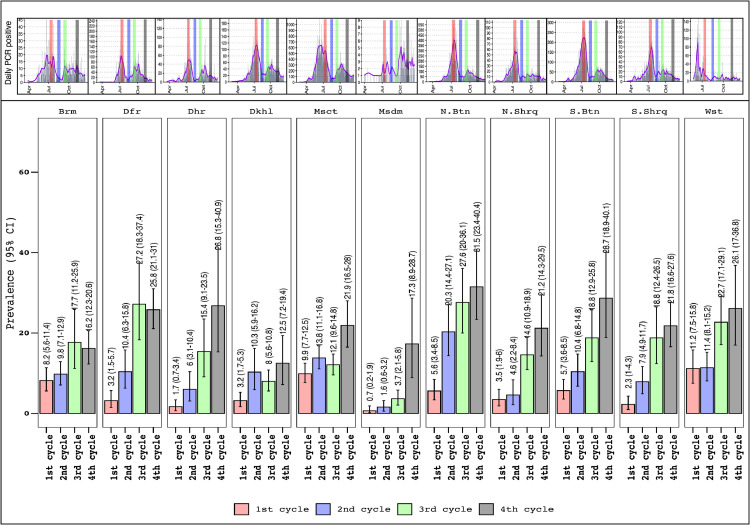
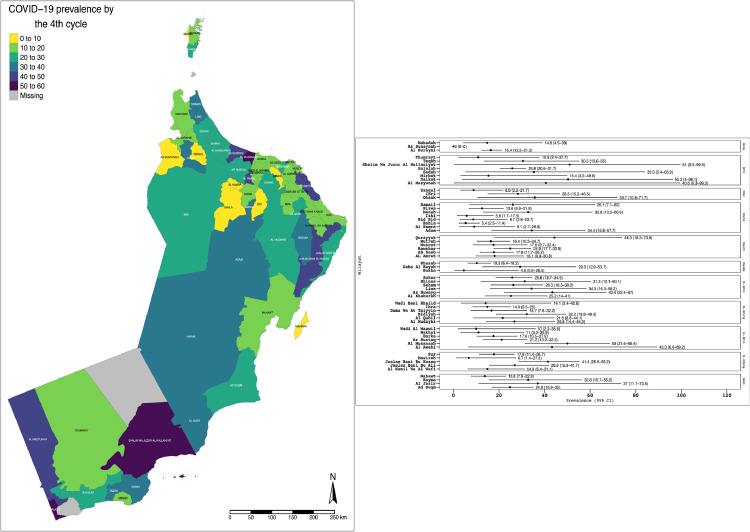
Results: In total, 17,457 participants were surveyed. Thirty percent were female and 66.3% were Omani. There was a significant increase in seroprevalence throughout the study cycles, from 5.5% (4.8-6.2%) in Cycle 1 to 22% (19.6-24.6%) in Cycle 4. There was no difference in seroprevalence between genders, but significant differences were found between age groups. There was a transition of seroprevalence from being higher in non-Omanis than Omanis in Cycle 1 [9.1% (7.6-10.9%) vs 3.2% (2.6-3.9%)] to being higher in Omanis than non-Omanis in Cycle 4 [24.3% (21.0-27.9%) vs 16.8% (14.9-18.9%)]. There was remarkable variation in the seroprevalence of SARS-CoV-2 according to governorate. Close contacts of people with COVID-19 had a 96% higher risk of having the disease [adjusted odds ratio (AOR) 1.96, 95% confidence intervals (CI) 1.64-2.34]. Labourers had 58% higher risk of infection compared with office workers (AOR 1.58, 95% CI 1.04-2.35).
Conclusion: This study showed a wide variation in the spread of SARS-CoV-2 across governorates in Oman, with higher estimated seroprevalence in migrants in the first two cycles. Prevalence estimates remain low and are insufficient to provide herd immunity.
Keywords: Antibody seroprevalence; COVID-19; Herd immunity; Oman; Prevalence; SARS-CoV-2; Sero-epidemiological surveys; Serosurvey.
Copyright © 2021 The Author(s). Published by Elsevier Ltd.. All rights reserved.
Conflict of interest statement
Conflict of interest statement None declared.
Figures
References
-
- Al Balushi L, Al Fahdi F, Al Ghafri T, Amin M, Singh J, Al Siyabi B, et al. Epidemiological characteristics of COVID-19 confirmed cases in Muscat Governorate, Sultanate of Oman. Open J Epidemiol. 2020;11:56–69.
-
- Al Fahdi F, Kurup PJ, Al Balushi L, Amin M, Al Siyabi B, Al Kalbani M, et al. Work related clusters of COVID-19 in Muscat Governorate in Oman: epidemiology & future implications. Open J Epidemiol. 2021;11:135–151.
MeSH terms
Substances
LinkOut - more resources
Full Text Sources
Medical
Miscellaneous
