. 2021 Dec 7;37(23):4556-4558.
doi: 10.1093/bioinformatics/btab688.

Panache: a web browser-based viewer for linearized pangenomes

Affiliations

Panache: a web browser-based viewer for linearized pangenomes

Éloi Durant et al. Bioinformatics. .

Abstract

Motivation: Pangenomics evolved since its first applications on bacteria, extending from the study of genes for a given population to the study of all of its sequences available. While multiple methods are being developed to construct pangenomes in eukaryotic species there is still a gap for efficient and user-friendly visualization tools. Emerging graph representations come with their own challenges, and linearity remains a suitable option for user-friendliness.

Results: We introduce Panache, a tool for the visualization and exploration of linear representations of gene-based and sequence-based pangenomes. It uses a layout similar to genome browsers to display presence absence variations and additional tracks along a linear axis with a pangenomics perspective.

Availability and implementation: Panache is available at github.com/SouthGreenPlatform/panache under the MIT License.


Figures

Fig. 1.
Fig. 1.
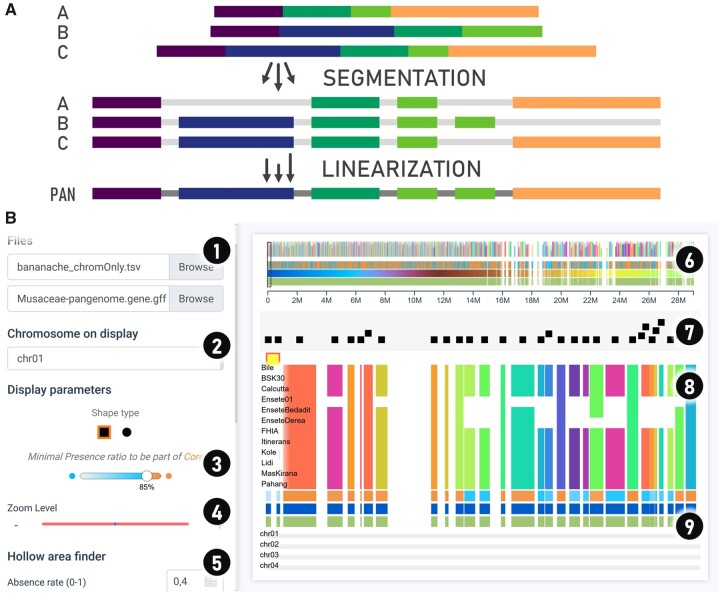
Panache offers a linear representation of pangenomes, with block information detailed through multiple tracks much like classic genome browsers. (A) Linearized pangenomes represent chains of present/absent pangenomic blocks on a single string. (B) Panache’s interface for browsing through the Presence/Absence matrix and navigating through panchromosomes. The interface is divided into multiple parts: (1) file inputs; (2) panchromosome to display and navigation options; (3) customizable threshold for the core and variable genomes; (4) zoom option to modify blocks’ sizes; (5) further exploration options including a Hollow Area Finder for automatic detection of areas with consecutive absence and sorting options; (6) miniature overview of a whole panchromosome used for navigation on click; (7) track of gene annotations displayed as centered marks in a swarm plot preventing overlaps, detailed cards of annotation are available on hovering; (8) presence/absence matrix of pangenomic blocks, displaying genomes in line and blocks in column; (9) hoverable tracks of summary information (core/variable status, pangenomic coordinates and blocks’ width, amount of repetition and their distribution)

References

    1. Beyer W. et al. (2019) Sequence tube maps: making graph genomes intuitive to commuters. Bioinformatics, 35, 5318–5320. - PMC - PubMed
    1. Computational Pan-Genomics Consortium. (2018) Computational pan-genomics: status, promises and challenges. Brief. Bioinf., 19, 118–135. - PMC - PubMed
    1. Ding W. et al. (2018) panX: pan-genome analysis and exploration. Nucleic Acids Res., 46, e5. - PMC - PubMed
    1. Droc G. et al. (2013) The Banana Genome Hub. Database, 2013, bat035. - PMC - PubMed
    1. Garrison E. et al. (2018) Variation graph toolkit improves read mapping by representing genetic variation in the reference. Nat. Biotechnol., 36, 875–879. - PMC - PubMed

Publication types