. 2021 Nov;56(11):1022-1032.
doi: 10.1007/s00535-021-01828-6. Epub 2021 Oct 3.

Risk of cardiovascular disease in patients with fatty liver disease as defined from the metabolic dysfunction associated fatty liver disease or nonalcoholic fatty liver disease point of view: a retrospective nationwide claims database study in Japan

Affiliations

Risk of cardiovascular disease in patients with fatty liver disease as defined from the metabolic dysfunction associated fatty liver disease or nonalcoholic fatty liver disease point of view: a retrospective nationwide claims database study in Japan

Masato Yoneda et al. J Gastroenterol. 2021 Nov.

Abstract

Background: Nonalcoholic fatty liver disease (NAFLD) and metabolic dysfunction associated fatty liver disease (MAFLD) have important associations with cardiovascular disease (CVD). The main objective of this study was to compare the frequency of incidence rate of CVD in the NAFLD or MAFLD patients utilizing a large claims database.

Methods: Using the JMDC database from April 2013 to March 2019, we retrospectively analyzed data for 1,542,688 and 2,452,949 people to estimate the relationship between CVD and NAFLD, MAFLD, respectively.

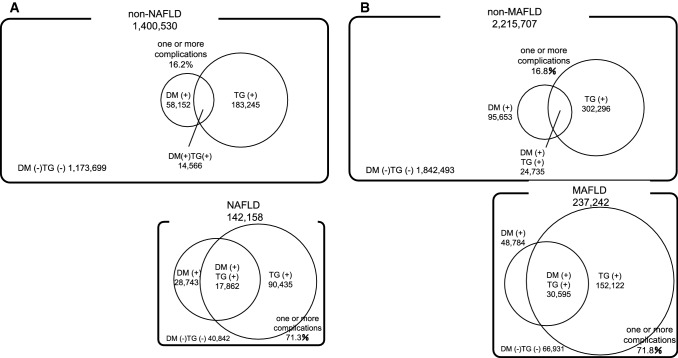
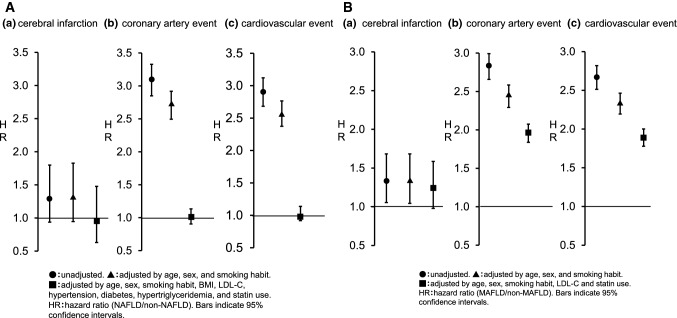
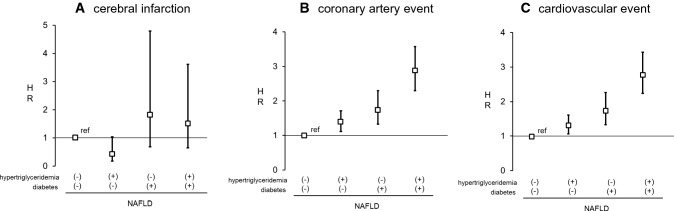
Results: The incidence rates of CVD were 0.97 (95% CI 0.94-1.01) and 2.82 (95% CI 2.64-3.01) per 1000 person-years in the non-NAFLD and NAFLD groups, respectively, and 1.01 (95% CI 0.98-1.03) and 2.69 (95% CI 2.55-2.83) per 1000 person-years in the non-MAFLD and MAFLD groups, respectively. The overall prevalence of hypertriglyceridemia and diabetes mellitus (DM) was 13.1, and 4.2%, respectively, in the non-NAFLD group and 63.6, and 20.2%, respectively, in the NAFLD group. The overall prevalenceof hypertriglyceridemia and DM was 13.6 and 4.3%, respectively, in the non-MAFLD group and 64.1, and 20.6%, respectively, in the MAFLD group. HRs for CVD increased with hypertriglyceridemia and DM.

Conclusions: Results indicated that incident rate of CVD increased with NAFLD/MAFLD; the complication rate of DM and hypertriglyceridemia among NAFLD/MAFLD patients is high and may affect the development of CVD.

Keywords: Cardiovascular disease; Diabetes mellitus; Hypertriglyceridemia; Metabolic dysfunction associated fatty liver disease; Non-alcoholic fatty liver disease.


Conflict of interest statement

The authors declare that they have no conflict of interest.

Figures
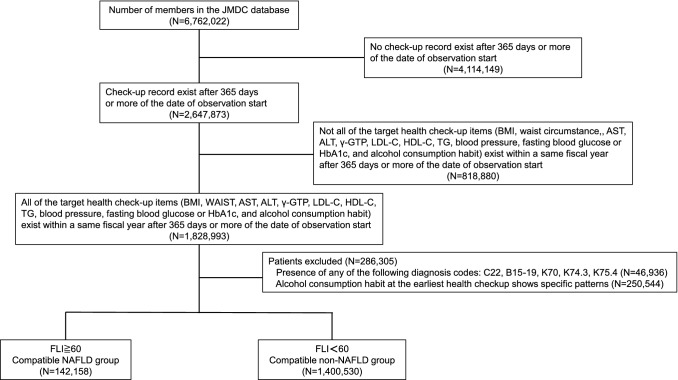
Fig. 1
Fig. 1
Flowchart of the NAFLD subjects enrollment
Fig. 2
Fig. 2
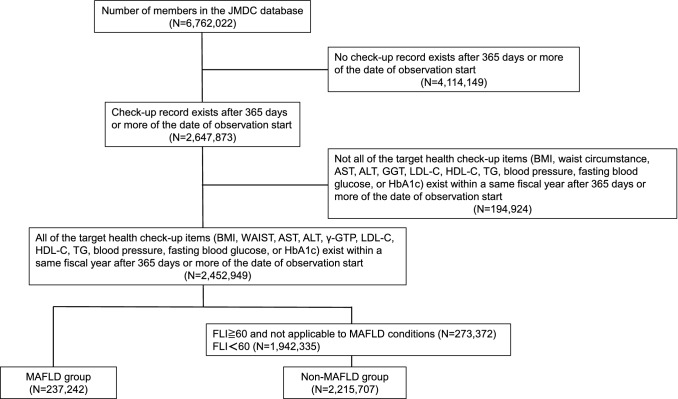
Flowchart of the MAFLD subjects enrollment
Fig. 3
Fig. 3
Prevalence of hypertriglyceridemia and diabetes (A) in non-NAFLD and NAFLD patients, (B) in non-MAFLD and MAFLD patients. NAFLD non-alcoholic fatty liver disease, MAFLD metabolic dysfunction associated fatty liver disease
Fig. 4
Fig. 4
Hazard ratio for primary outcomes (A) NAFLD patients. ●: unadjusted. ▲: adjusted by age, sex, and smoking habit. ■: adjusted by age, sex, smoking habit, body mass index, low density lipoprotein cholesterol, hypertension, diabetes, hypertriglyceridemia, and statin use. Hazard ratios in NAFLD and non-NAFLD patients. a Cerebral infarction, b coronary artery event, and c cardiovascular event. B MAFLD patients. ●: unadjusted. ▲: adjusted by age, sex, and smoking habit. ■: adjusted by age, sex, smoking habit, low density lipoprotein cholesterol, and statin use. Hazard ratios in MAFLD and non-MAFLD patients. Bars indicate 95% confidence intervals. NAFLD: non-alcoholic fatty liver disease, MAFLD: metabolic dysfunction associated fatty liver disease. a Cerebral infarction, b coronary artery event, and c cardiovascular event
Fig. 5
Fig. 5
Hazard ratios of primary outcomes in NAFLD patients with or without diabetes and/or hypertriglyceridemia. A Cerebral infarction, B coronary artery event, and C cardiovascular event. Primary outcomes were adjusted by age, sex, smoking habit, body mass index, low density lipoprotein cholesterol hypertension, and statin use. Bars indicates 95% confidence intervals. HR hazard ratio, NAFLD non-alcoholic fatty liver disease

References

    1. Younossi ZM, Koenig AB, Abdelatif D, et al. Global epidemiology of nonalcoholic fatty liver disease-meta-analytic assessment of prevalence, incidence, and outcomes. Hepatology. 2016;64:73–84. doi: 10.1002/hep.28431. - DOI - PubMed
    1. Li J, Zou B, Yeo YH, et al. Prevalence, incidence, and outcome of non-alcoholic fatty liver disease in Asia, 1999–2019: a systematic review and meta-analysis. Lancet Gastroenterol Hepatol. 2019;4:389–398. doi: 10.1016/S2468-1253(19)30039-1. - DOI - PubMed
    1. Yki-Järvinen H. Non-alcoholic fatty liver disease as a cause and a consequence of metabolic syndrome. Lancet Diabetes Endocrinol. 2014;2:901–910. doi: 10.1016/S2213-8587(14)70032-4. - DOI - PubMed
    1. Eslam M, Newsome PN, Sarin SK, et al. A new definition for metabolic dysfunction-associated fatty liver disease: an international expert consensus statement. J Hepatol. 2020;73:202–209. doi: 10.1016/j.jhep.2020.03.039. - DOI - PubMed
    1. Angulo P, Kleiner DE, Dam-Larsen S, et al. Liver fibrosis, but no other histologic features, is associated with long-term outcomes of patients with nonalcoholic fatty liver disease. Gastroenterology. 2015;149:389–97.e10. doi: 10.1053/j.gastro.2015.04.043. - DOI - PMC - PubMed

MeSH terms