


Cervical Cancer Screening: Is the Age Group 30-65 Years Optimum for Screening in Low-Resource Settings?
- PMID: 34602765
- PMCID: PMC8440710
- DOI: 10.1007/s13224-021-01479-w
Cervical Cancer Screening: Is the Age Group 30-65 Years Optimum for Screening in Low-Resource Settings?
Abstract
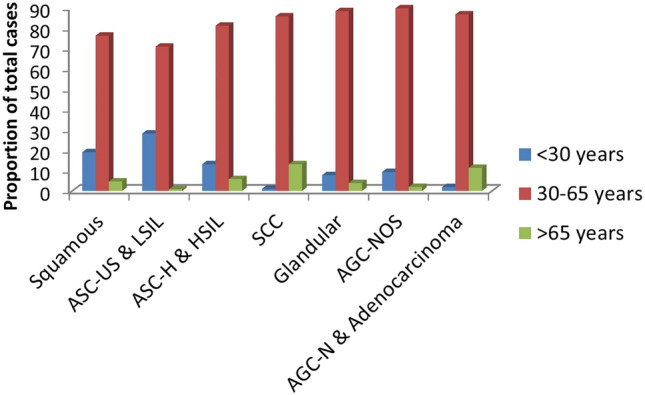
Background: An Operational Framework document for population-wide screening of common cancers in India was launched in 2016. The target age for screening is 30-65 years for cervical, breast and oral cancers. This study was designed to review the frequency and distribution of cervical lesions among women aged 21-29, 30-65 and > 65 years.
Study design: A retrospective review of all satisfactory cervical smears (n = 79,896) received over a ten-year period (2010-2019) was conducted. Three age bands were defined: 21-29 years, 30-65 years and > 65 years. The frequency and distribution of the various epithelial cell abnormalities (ECAs) across the three age bands were calculated. Cytohistologic correlation was performed wherever available.
Results: Of the 1357 ECAs (1.7% of all smears), about 16.9% were seen in the age band 21-29 years, while 4.5% presented in > 65 years of age. About 80% of the ECAs seen in younger women were low-grade squamous lesions, while 75% of lesions in women > 65 years were high-grade squamous abnormalities. Among the total 512 significant high-grade and malignant (squamous and glandular) lesions, 5.6% presented in women 21-29 years, while 10.1% were seen in > 65 years of age.
Conclusion: Majority of the significant cervical lesions would be detected if the screening focuses on the 30-65 years age group. However, about 19% of high-grade squamous preneoplastic lesions (ASC-H/ HSIL) and 13% of preneoplastic glandular lesions (AGC-N) are likely to be missed if women 21-29 years and > 65 years are excluded. The cost of screening incurred by including these age groups has to be weighed against the benefits derived, especially in low-resource settings. In the absence of universal implementation of HPV immunization, there is a felt need to enhance cervical cancer awareness and encourage screening, more so in high-risk category and symptomatic females beyond the selected age group.
Keywords: Age; Cervical cancer; High-grade lesions; Low-resource settings; Screening.
© Federation of Obstetric & Gynecological Societies of India 2021.
Conflict of interest statement
Conflict of interestThe authors declare that they have no known competing financial interests or personal relationships that could have influenced the work reported in this paper.
Figures
References
-
- Global Cancer Observatory (GLOBOCAN). Estimated number of cancer cases in 2020, India. Lyon: IARC; 2020 (https://gco.iarc.fr/today/data/factsheets/populations/356-india-fact-she...). Accessed Mar 04 2021.
-
- Operational Framework. Management of Common Cancers. Available from http://cancerindia.org.in/wp-content/uploads/2017/11/Operational_Framewo.... Accessed Oct 27 2020.
LinkOut - more resources
Full Text Sources
Miscellaneous