A Prospective Study to Assess the Optimal Incubation Times for Culture and Aerobic Bacterial Profile in Prosthetic Joint Infections
- PMID: 34602786
- PMCID: PMC8478509
- DOI: 10.1055/s-0041-1730879
A Prospective Study to Assess the Optimal Incubation Times for Culture and Aerobic Bacterial Profile in Prosthetic Joint Infections
Abstract
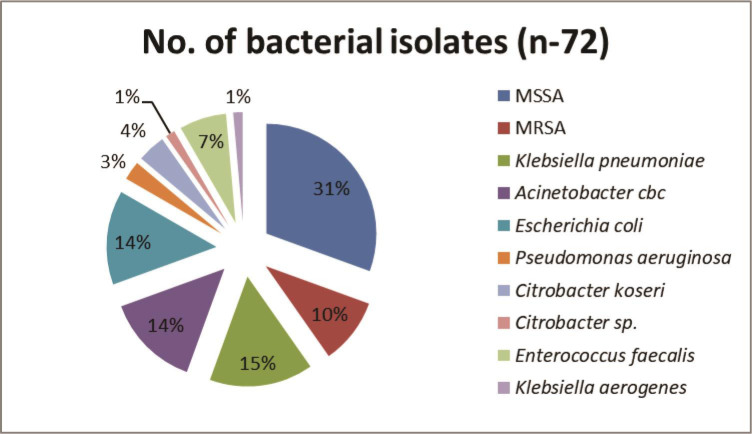
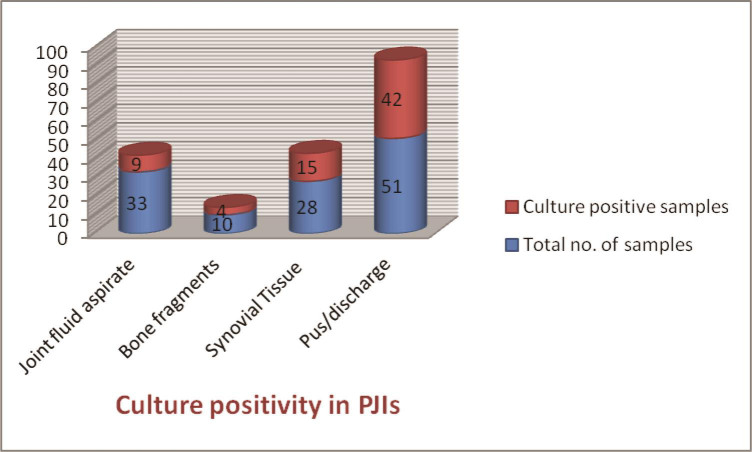
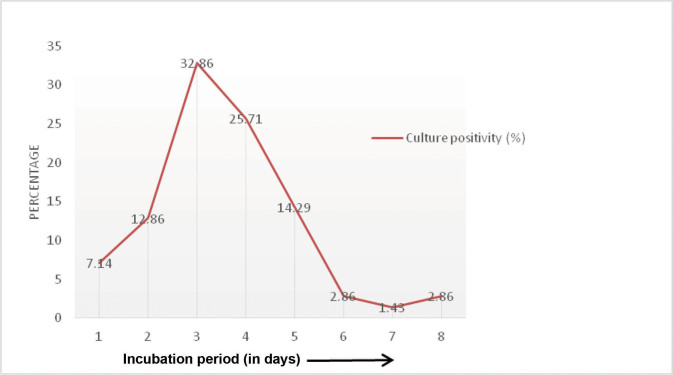
Introduction With an increase in the number of total joint arthroplasties, the count of prosthetic joint infections (PJIs) is also increasing and has become a nightmare for an orthopaedic surgeon. Microbiological diagnosis is important for administering definitive antimicrobial treatment. Negative culture reports hamper patient management and prolonged incubation periods have increased the culture yield but at the risk of culture contamination in conventional microbiology settings. Thus, we aimed to optimize the best incubation time for culture and the aerobic bacterial profile of PJIs. Material and Methods Over a year, samples from clinically suspected PJI patients were collected and processed for culture using standard techniques. The samples were incubated for up to 10 days with daily subculturing on to solid media. The bacterial isolates were identified and antibiotic susceptibility was performed. Results Out of 200 patients, 105 were included in the study and samples were collected in triplicate. In 70 cases culture was positive and 35 were culture negative PJIs. Mean incubation days to culture positivity was 3.6 days with 97.14% culture positivity seen by the seventh day of incubation. Twenty-four percent methicillin-resistant Staphylococcus aureus , and more than 50% extended spectrum β lactamase producing Klebsiella pneumoniae and Escherichia coli were isolated. Discussion Culture positivity in PJIs provides definitive evidence of infection and guides the treatment. Increasing the incubation times can help in maximizing the culture yield, and we found that 97.14% pathogens grew within 7 days of incubation. Prolonging it further would not provide an added advantage especially in a resource-constraint setting.
Keywords: Staphylococcus aureus; culture; infections; prolonged incubation; prosthesis.
The Indian Association of Laboratory Physicians. This is an open access article published by Thieme under the terms of the Creative Commons Attribution-NonDerivative-NonCommercial-License, permitting copying and reproduction so long as the original work is given appropriate credit. Contents may not be used for commercial purposes, or adapted, remixed, transformed or built upon. (https://creativecommons.org/licenses/by-nc-nd/4.0/).
Conflict of interest statement
Conflict of Interest None declared.
Figures
References
-
- Sebastian S, Malhotra R, Dhawan B. Prosthetic joint infection: a major threat to successful total joint arthroplasty. Indian J Med Microbiol. 2018;36(04):475–487. - PubMed
-
- Larsen L H, Lange J, Xu Y, Schønheyder H C.Optimizing culture methods for diagnosis of prosthetic joint infections: a summary of modifications and improvements reported since 1995 J Med Microbiol 201261(Pt 3)309–316. - PubMed
-
- Korea Knee Research Group . Koh I J, Cho W-S, Choi N Y, Parvizi J, Kim T K. How accurate are orthopedic surgeons in diagnosing periprosthetic joint infection after total knee arthroplasty? A multicenter study. Knee. 2015;22(03):180–185. - PubMed
-
- Parvizi J, Tan T L, Goswami K. The 2018 definition of periprosthetic hip and knee infection: an evidence-based and validated criteria. J Arthroplasty. 2018;33(05):1309–131400. - PubMed
-
- Schäfer P, Fink B, Sandow D, Margull A, Berger I, Frommelt L. Prolonged bacterial culture to identify late periprosthetic joint infection: a promising strategy. Clin Infect Dis. 2008;47(11):1403–1409. - PubMed
LinkOut - more resources
Full Text Sources