


The Sick Adipose Tissue: New Insights Into Defective Signaling and Crosstalk With the Myocardium
- PMID: 34603210
- PMCID: PMC8479191
- DOI: 10.3389/fendo.2021.735070
The Sick Adipose Tissue: New Insights Into Defective Signaling and Crosstalk With the Myocardium
Abstract
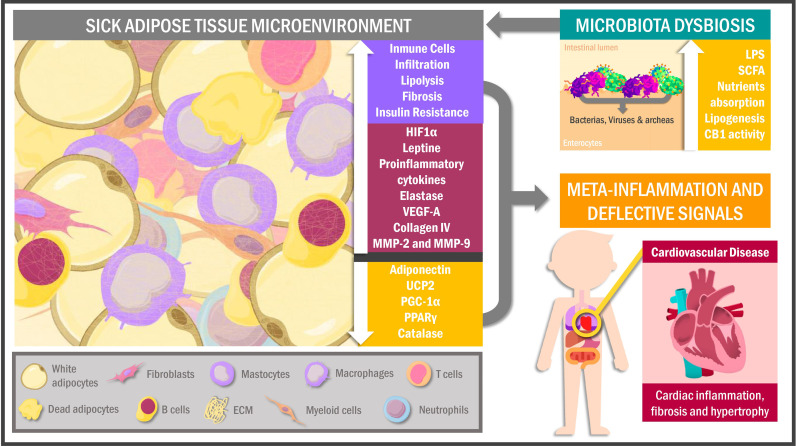
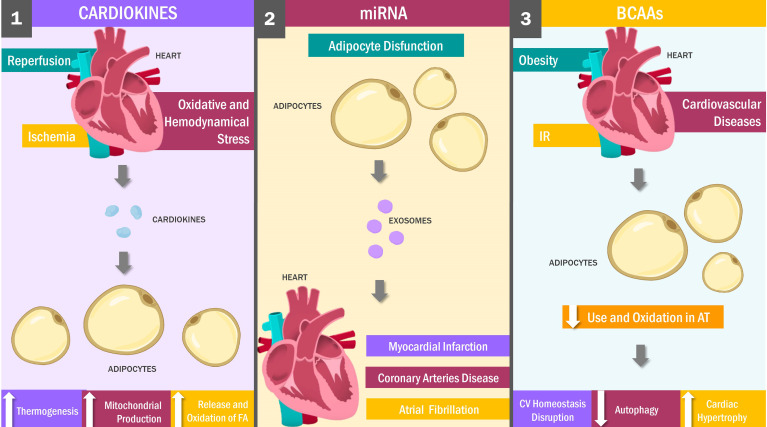
Adipose tissue (AT) biology is linked to cardiovascular health since obesity is associated with cardiovascular disease (CVD) and positively correlated with excessive visceral fat accumulation. AT signaling to myocardial cells through soluble factors known as adipokines, cardiokines, branched-chain amino acids and small molecules like microRNAs, undoubtedly influence myocardial cells and AT function via the endocrine-paracrine mechanisms of action. Unfortunately, abnormal total and visceral adiposity can alter this harmonious signaling network, resulting in tissue hypoxia and monocyte/macrophage adipose infiltration occurring alongside expanded intra-abdominal and epicardial fat depots seen in the human obese phenotype. These processes promote an abnormal adipocyte proteomic reprogramming, whereby these cells become a source of abnormal signals, affecting vascular and myocardial tissues, leading to meta-inflammation, atrial fibrillation, coronary artery disease, heart hypertrophy, heart failure and myocardial infarction. This review first discusses the pathophysiology and consequences of adipose tissue expansion, particularly their association with meta-inflammation and microbiota dysbiosis. We also explore the precise mechanisms involved in metabolic reprogramming in AT that represent plausible causative factors for CVD. Finally, we clarify how lifestyle changes could promote improvement in myocardiocyte function in the context of changes in AT proteomics and a better gut microbiome profile to develop effective, non-pharmacologic approaches to CVD.
Keywords: adipose tissue; inflammation; microbiota; myocardiocytes; obesity.
Copyright © 2021 Bermúdez, Durán, Rojas, Díaz, Rivas, Nava, Chacín, Cabrera de Bravo, Carrasquero, Ponce, Górriz and D´Marco.
Conflict of interest statement
The authors declare that the research was conducted in the absence of any commercial or financial relationships that could be construed as a potential conflict of interest.
Figures
References
-
- World Health Organization . Obesity and Overweight. Available at: https://www.who.int/news-room/fact-sheets/detail/obesity-and-overweight (Accessed cited 2021 May 6).
-
- World Health Organization . Cardiovascular Diseases (CVDs). Available at: https://www.who.int/news-room/fact-sheets/detail/cardiovascular-diseases... (Accessed cited 2021 May 6).
Publication types
MeSH terms
LinkOut - more resources
Full Text Sources
