Review
. 2021 Oct;15(5):757-781.
doi: 10.1007/s11571-021-09679-w. Epub 2021 May 7.

The glutamatergic synapse: a complex machinery for information processing

Affiliations
Review

The glutamatergic synapse: a complex machinery for information processing

Vito Di Maio. Cogn Neurodyn. 2021 Oct.

Abstract

Being the most abundant synaptic type, the glutamatergic synapse is responsible for the larger part of the brain's information processing. Despite the conceptual simplicity of the basic mechanism of synaptic transmission, the glutamatergic synapse shows a large variation in the response to the presynaptic release of the neurotransmitter. This variability is observed not only among different synapses but also in the same single synapse. The synaptic response variability is due to several mechanisms of control of the information transferred among the neurons and suggests that the glutamatergic synapse is not a simple bridge for the transfer of information but plays an important role in its elaboration and management. The control of the synaptic information is operated at pre, post, and extrasynaptic sites in a sort of cooperation between the pre and postsynaptic neurons which also involves the activity of other neurons. The interaction between the different mechanisms of control is extremely complicated and its complete functionality is far from being fully understood. The present review, although not exhaustively, is intended to outline the most important of these mechanisms and their complexity, the understanding of which will be among the most intriguing challenges of future neuroscience.

Keywords: AMPA; Brain information processing; EPSC; EPSP; Glutamatergic synapse; LTD; LTP; NMDA; Synaptic information processing; Synaptic modeling; Synaptic transmission; dendritic integration; dendritic spines.


Figures

Fig. 1
Fig. 1
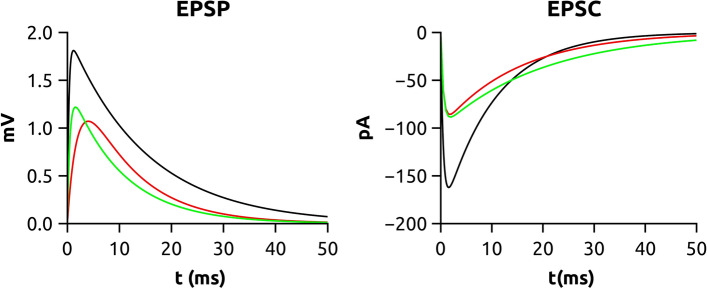
Examples of simulated EPSPs and EPSCs
Fig. 2
Fig. 2
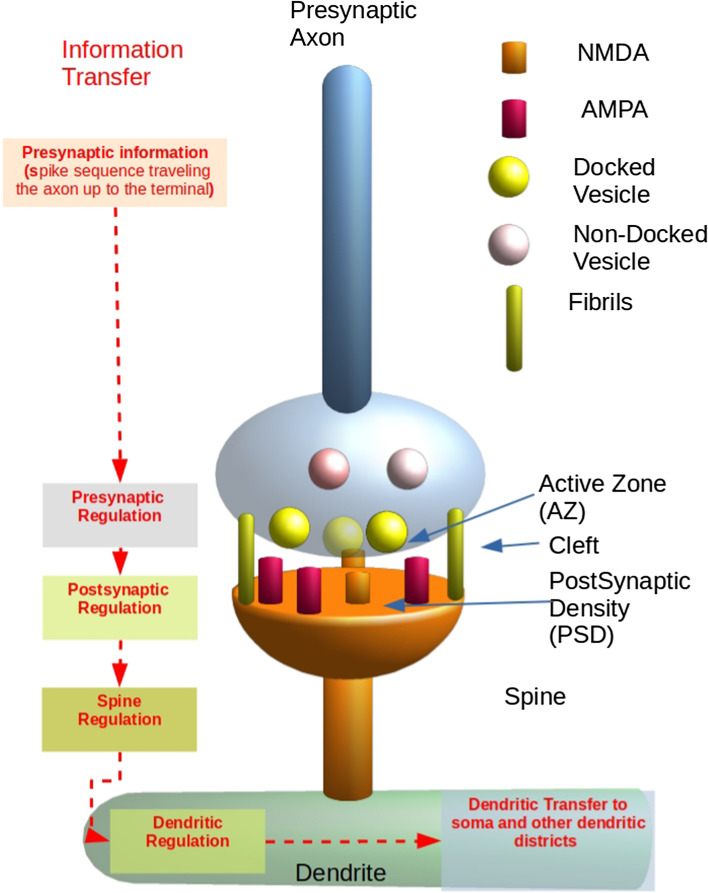
Schema of a typical Glu Synapse. The red pathway shows the information flow
Fig. 3
Fig. 3
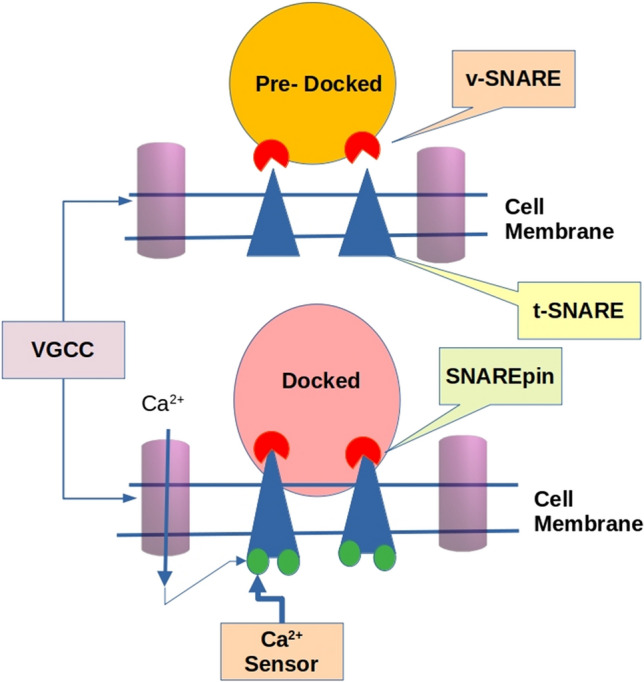
Simplified schematic representation of the SNARE complex configuration and vesicle docking
Fig. 4
Fig. 4
Simulated AMPA-EPSC (black line) and NMDA-EPSC (red line)
Fig. 5
Fig. 5
Simplified electrical circuit of the spine and its connection to the dendrite. VPSD is the difference of potential at the level of the PSD, Vd is the difference of potential at the level of the dendrite. RPSD is the input resistance at the PSD, Rd is the dendrite resistance and Rl is the longitudinal resistance of the intracellular liquid into the dendrite. Rn is the neck resistance and Cm the membrane capacitance
Fig. 6
Fig. 6
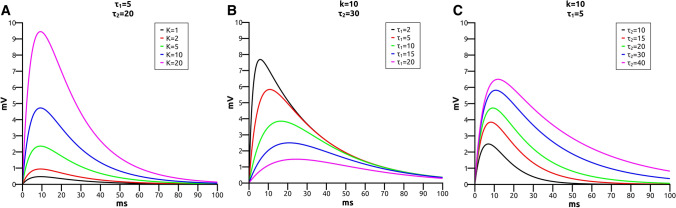
Variability of the EPSP depending on the parameters of Eq. (10). Panel A: τ1 and τ2 are kept constant while k is varied. Panel B: k and τ2 are kept constant and τ1 is varied. Panel C: k and τ1 are kept constant and τ2 is varied
Fig. 7
Fig. 7
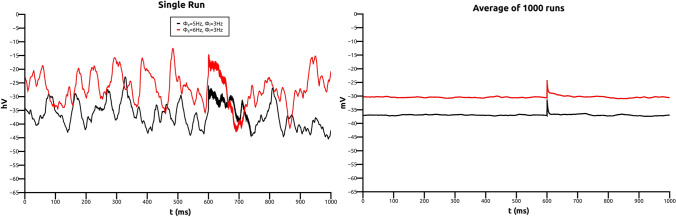
Left panel: Results of a single run simulation of an EPSP occurring after 600ms while a pool of 160 excitatory and 40 inhibitory synapses fires in neighbor dendrites with respectively a mean excitatory frequency of 5 Hz (black line) and 6 Hz red line and an inhibitory firing frequency of 3 Hz. The right panel is the same as the left panel but averaged over 1000 runs

References

    1. Abbott LF, Regehr WG. Synaptic computation. Nature. 2004;431:796–803. doi: 10.1038/nature03010. - DOI - PubMed
    1. Acker CD, Hoyos E, Loew LM (2016) EPSPs measured in proximal dendritic spines of cortical pyramidal neurons. eNeuro. 10.1523/ENEURO.0050-15.2016 - PMC - PubMed
    1. Ahmad M, Polepalli JS, Goswami D, Yang X, Kaeser-Woo YJ, Südhof TC, Malenka RC. Postsynaptic complexin controls AMPA receptor exocytosis during LTP. Neuron. 2012;73:260–267. doi: 10.1016/j.neuron.2011.11.020. - DOI - PMC - PubMed
    1. Allam S, Bouteiller JMC, Hu EY, Ambert N, Greget R, Bischoff S, Baudry M, Berger WT (2015) Synaptic efficacy as a function of ionotropic receptor distribution: a computational study. PLos ONE. 10.1371/journal.pone.0140333 - PMC - PubMed
    1. Allam SL, Ghaderi VS, Bouteiller JM, Legendre A, Ambert N, Greget R, Bischoff S, Baudry M, Berger TW (2012) A computational model to investigate astrocytic glutamate uptake influence on synaptic transmission and neuronal spiking. Front Comput Neurosci. 10.3389/fncom.2012.00070 - PMC - PubMed

LinkOut - more resources