Management of Coincident Pituitary Macroadenoma and Cavernous Carotid Aneurysm: A Systematic Literature Review
- PMID: 34603930
- PMCID: PMC8481005
- DOI: 10.1055/s-0041-1735904
Management of Coincident Pituitary Macroadenoma and Cavernous Carotid Aneurysm: A Systematic Literature Review
Abstract
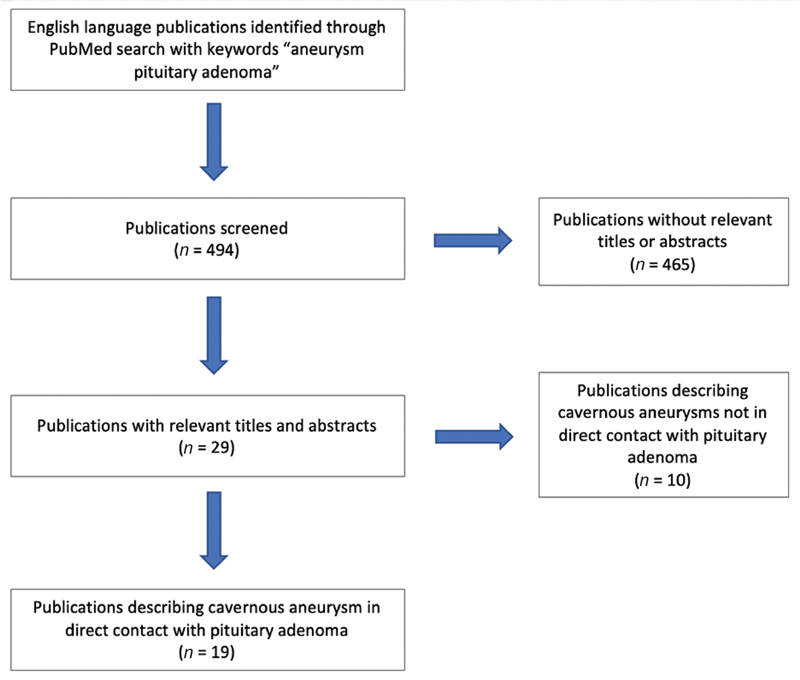
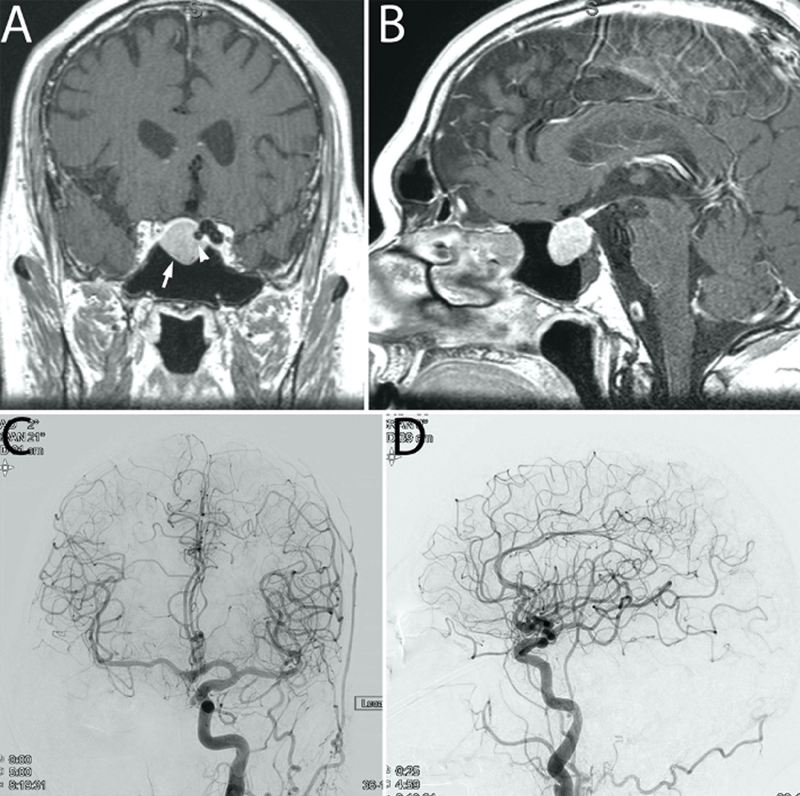
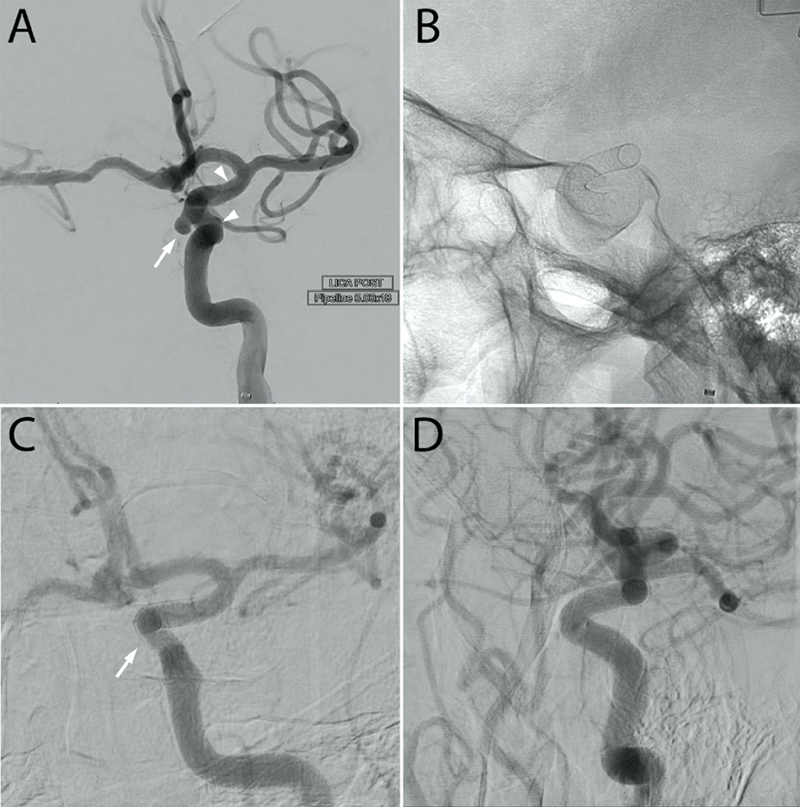
Introduction Pituitary adenomas are a common intracranial pathology with an incidence of 15 to 20% in the population while cerebral aneurysms are less common with a prevalence of 1:50 patients. The incidence of aneurysms in patients with pituitary adenoma has been estimated at 2.3 to 5.4% of patients; however, this remains unclear. Equally, the management of concomitant lesions lacks significant understanding. Methods A case report is presented of a concomitant cerebral aneurysm and pituitary adenoma managed by minimally invasive endovascular and endoscopic methods, respectively. A systematic review of the literature for terms "pituitary adenoma" and "aneurysm" yielded 494 studies that were narrowed to 19 relevant articles. Results We report a case of a 67-year-old patient with an enlarging pituitary macroadenoma, cavernous carotid aneurysm, and unilateral carotid occlusion. After successful treatment of the aneurysm by a pipeline flow diverter, the pituitary adenoma was surgically resected by an endoscopic transsphenoidal approach. Conclusion The use of a pipeline flow diverter and endonasal approach was feasible in the treatment of our patient. This is the first report to our knowledge of the use of pipeline flow diversion in the management of a cavernous carotid aneurysm prior to pituitary adenoma treatment.
Keywords: cavernous carotid aneurysm; endoscopic; intracranial aneurysm; macroadenoma; pipeline; pituitary adenoma; transphenoidal.
The Author(s). This is an open access article published by Thieme under the terms of the Creative Commons Attribution-NonDerivative-NonCommercial License, permitting copying and reproduction so long as the original work is given appropriate credit. Contents may not be used for commercial purposes, or adapted, remixed, transformed or built upon. ( https://creativecommons.org/licenses/by-nc-nd/4.0/ ).
Conflict of interest statement
Conflict of Interest None declared.
Figures
References
-
- Ezzat S, Asa S L, Couldwell W T. The prevalence of pituitary adenomas: a systematic review. Cancer. 2004;101(03):613–619. - PubMed
-
- Aghi M K, Chen C C, Fleseriu M. Congress of neurological surgeons systematic review and evidence-based guidelines on the management of patients with nonfunctioning pituitary adenomas: executive summary. Neurosurgery. 2016;79(04):521–523. - PubMed
-
- French Endocrinology Society non-functioning pituitary adenoma work-group . Chanson P, Raverot G, Castinetti F, Cortet-Rudelli C, Galland F, Salenave S. Management of clinically non-functioning pituitary adenoma. Ann Endocrinol (Paris) 2015;76(03):239–247. - PubMed
-
- Seinfeld J, Karim S. StatPearls Publishing; Treasure Island, FL: 2020. Cavernous sinus aneurysm. - PubMed