Review
. 2021 Sep 16:11:735394.
doi: 10.3389/fcimb.2021.735394. eCollection 2021.

COVID-19 Vaccination in Pregnancy and Lactation: Current Research and Gaps in Understanding

Affiliations
Review

COVID-19 Vaccination in Pregnancy and Lactation: Current Research and Gaps in Understanding

Lydia L Shook et al. Front Cell Infect Microbiol. .

Abstract

The COVID-19 pandemic has demonstrated the urgent need to develop vaccine strategies optimized for pregnant people and their newborns, as both populations are at risk of developing severe disease. Although not included in COVID-19 vaccine development trials, pregnant people have had access to these vaccines since their initial release in the US and abroad. The rapid development and distribution of novel COVID-19 vaccines to people at risk, including those who are pregnant and lactating, presents an unprecedented opportunity to further our understanding of vaccine-induced immunity in these populations. In this review, we aim to summarize the literature to date on COVID-19 vaccination in pregnancy and lactation and highlight opportunities for investigation that may inform future maternal vaccine development and implementation strategies.

Keywords: COVID-19; SARS-CoV-2; lactation; mRNA vaccine; maternal immunization; pregnancy; vaccination.


Conflict of interest statement

The authors declare that the research was conducted in the absence of any commercial or financial relationships that could be construed as a potential conflict of interest.

Figures
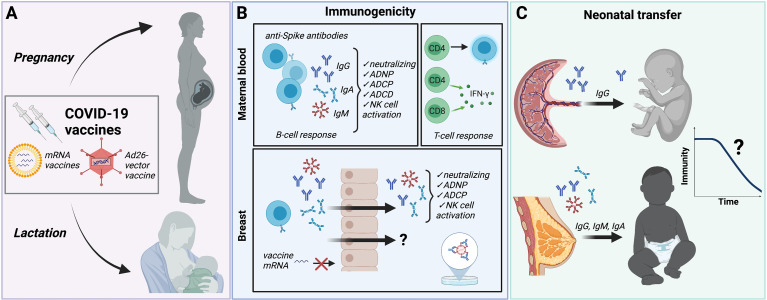
Figure 1
Figure 1
Summary of immune protection from COVID-19 vaccines in pregnancy and lactation. (A) Although excluded from initial vaccine trials, pregnant and lactating individuals have been eligible to receive Pfizer/BioNTech and Moderna mRNA vaccines and the Janssen/Johnson&Johnson Ad26-vector vaccine. Safety and reactogenicity profiles are similar to non-pregnant, non-lactating individuals. Immunization with the two-dose protocol for mRNA vaccines results in comparable IgG, IgA and IgM titers in fully-vaccinated pregnant and lactating individuals compared to non-pregnant controls. The longevity of immunity derived during pregnancy and the ability to confer protection against variants has not been directly studied in these populations. (B) COVID-19 vaccines generate anti-Spike antibodies in pregnant and lactating individuals with similar immunogenicity compared with non-pregnant controls. Vaccine-induced anti-Spike antibodies demonstrate neutralizing capacity, antibody-dependent neutrophil phagocytosis (ADNP), antibody-dependent cellular phagocytosis (ADCP), and antibody-dependent complement deposition (ADCD), and NK cell activation. Spike-specific CD4+ and CD8+ T-cell activity is similar to that observed in non-pregnant individuals. Anti-Spike IgG and IgA with binding, neutralizing and functional activity are also detectable in breastmilk. Whether breastmilk contains vaccine-induced cellular or other protective immune factors is not yet known. No vaccine mRNA has been detected in breastmilk immediately following vaccination. (C) Neutralizing anti-Spike IgG is transplacentally transferred from mother to fetus. Vaccine timing and maternal antibody titers impact cord titers. IgG, IgM and IgA are transferred through breastmilk. Neither the amount of maternally-derived antibodies required to confer neonatal protection from COVID-19 infection, nor the duration of this protection, is known. Created with BioRender.com. ADNP, antibody-dependent neutrophil phagocytosis; ADCP, antibody-dependent cellular phagocytosis; ADCD, antibody-dependent complement deposition.

References

    1. Adhikari E. H., Spong C. Y. (2021). COVID-19 Vaccination in Pregnant and Lactating Women. JAMA 325 (11), 1039–1040. doi: 10.1001/jama.2021.1658 - DOI - PubMed
    1. Alberca R. W., Pereira N. Z., Oliveira L. M. D. S., Gozzi-Silva S. C., Sato M. N. (2020). Pregnancy, Viral Infection, and COVID-19. Front. Immunol. 11, 1672. doi: 10.3389/fimmu.2020.01672 - DOI - PMC - PubMed
    1. Alberer M., Gnad-Vogt U., Hong H. S., Mehr K., Backert L., Finak G., et al. (2017). Safety and Immunogenicity of a mRNA Rabies Vaccine in Healthy Adults: An Open-Label, Non-Randomised, Prospective, First-in-Human Phase 1 Clinical Trial. Lancet 390 (10101), 1511–1520. doi: 10.1016/S0140-6736(17)31665-3 - DOI - PubMed
    1. Amenyogbe N., Levy O., Kollmann T. R. (2015). Systems Vaccinology: A Promise for the Young and the Poor. Philos. Trans. R Soc. Lond B Biol. Sci. 370, 1–5. doi: 10.1098/rstb.2014.0340 - DOI - PMC - PubMed
    1. Anichini G., Terrosi C., Gandolfo C., Gori S. G., Fabrizi S., Miceli G. B., et al. (2021). SARS-CoV-2 Antibody Response in Persons With Past Natural Infection. N. Engl. J. Med 385, 90–92. doi: 10.1056/NEJMc2103825 - DOI - PMC - PubMed

Publication types

Substances
