Review
. 2021 Sep 17:8:734550.
doi: 10.3389/fcvm.2021.734550. eCollection 2021.

Endothelial to Mesenchymal Transition: An Insight in Atherosclerosis

Affiliations
Review

Endothelial to Mesenchymal Transition: An Insight in Atherosclerosis

Qingyan Huang et al. Front Cardiovasc Med. .

Abstract

Atherosclerosis is a fundamental disease of the cardiovascular system that leads to high morbidity and mortality worldwide. The endothelium is the first protective barrier in atherosclerosis. Endothelial cells have the potential to be transformed into mesenchymal cells, in a process termed endothelial to mesenchymal transition (EndMT). On the one hand, EndMT is known to contribute to atherosclerosis by inducing a number of phenotypes ranging from endothelial cell dysfunction to plaque formation. On the other hand, risk factors for atherosclerosis can lead to EndMT. A substantial body of evidence has suggested that EndMT induces the development of atherosclerosis; therefore, a deeper understanding of the molecular mechanisms underlying EndMT in atherosclerosis might provide insights to reverse this condition.

Keywords: EndMT-associated marker; atherosclerosis; endothelial to mesenchymal transition; plasticity of endothelial cells; regulating mechanisms.


Conflict of interest statement

The authors declare that the research was conducted in the absence of any commercial or financial relationships that could be construed as a potential conflict of interest.

Figures
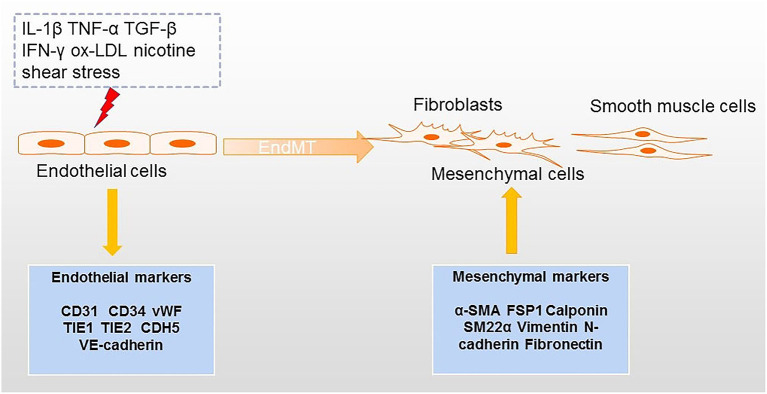
Figure 1
Figure 1
Processes inducing EndMT in atherosclerosis. Factors that can lead to EndMT include several inflammatory cytokines, ox-LDL, nicotine, and shear stress. The transition from endothelial cells to mesenchymal cells (e.g., fibroblasts and smooth muscle cells) is accompanied by downregulation of endothelial markers and upregulation of mesenchymal markers.
Figure 2
Figure 2
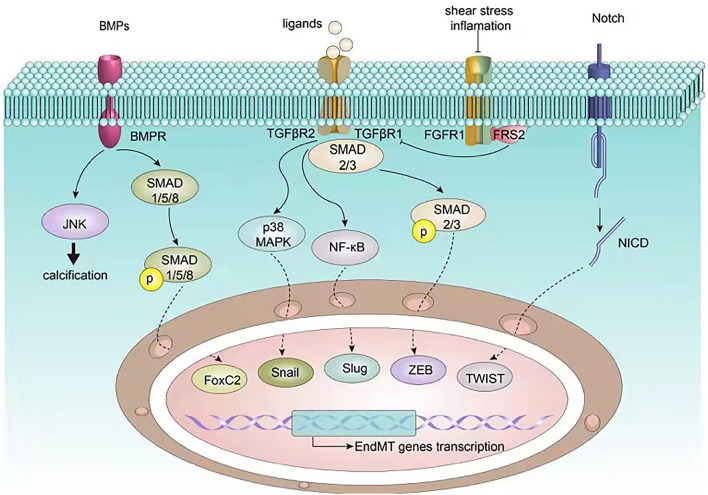
Signaling pathways involved in EndMT in atherosclerosis. EndMT related transcription factors such as Snail, Slug, ZEB, TWIST, and FoxC2 are governed by upstream signalings including BMP, TGF-β, FGF, and Notch, which in turn regulate endothelial and mesenchymal gene expression, ultimately inducing EndMT.

References

    1. Libby P, Buring JE, Badimon L, Hansson GK, Deanfield J, Bittencourt MS, et al. Atherosclerosis. Nat Rev Dis Primers. (2019) 5:56. 10.1038/s41572-019-0106-z - DOI - PubMed
    1. Zhu Y, Xian X, Wang Z, Bi Y, Chen Q, Han X, et al. Research progress on the relationship between atherosclerosis and inflammation. Biomolecules. (2018) 8:80. 10.3390/biom8030080 - DOI - PMC - PubMed
    1. Ahotupa M. Oxidized lipoprotein lipids and atherosclerosis. Free Radic Res. (2017) 51:439–47. 10.1080/10715762.2017.1319944 - DOI - PubMed
    1. Gistera A, Hansson GK. The immunology of atherosclerosis. Nat Rev Nephrol. (2017) 13:368–80. 10.1038/nrneph.2017.51 - DOI - PubMed
    1. Wesseling M, Sakkers TR, de Jager SCA, Pasterkamp G, Goumans MJ. The morphological and molecular mechanisms of epithelial/endothelial-to-mesenchymal transition and its involvement in atherosclerosis. Vascul Pharmacol. (2018) 106:1–8. 10.1016/j.vph.2018.02.006 - DOI - PubMed

LinkOut - more resources