


Organic Compound with Potential for X-ray Imaging Applications
- PMID: 34604664
- PMCID: PMC8482459
- DOI: 10.1021/acsomega.1c03671
Organic Compound with Potential for X-ray Imaging Applications
Abstract
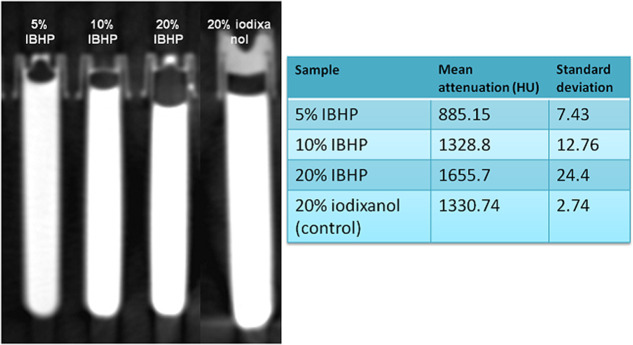
A radiopaque compound, namely, 4,4-bis(4-hydroxy-3,5-diiodophenyl)pentanoic acid, was synthesized by the electrophilic aromatic iodination of 4,4-bis(4-hydroxyphenyl)pentanoic acid using sodium iodide and sodium hypochlorite. The active iodines created by hypochlorite were selectively bound to the ortho positions of the diphenolic acid and obtained a tetraiodo compound. Characterization of this iodinated compound was accomplished by routine methods such as Fourier transform infrared (FTIR) spectroscopy, 1H nuclear magnetic resonance (NMR) spectroscopy, energy-dispersive X-ray spectroscopy, mass spectroscopy, UV-Vis spectroscopy, and thermogravimetry. The iodine content in the compound was as high as 64% by weight and therefore expected to possess substantial radiopacity. A 5% solution of the compound in dimethyl sulfoxide exhibited radiopacity of 885 ± 7 Hounsfield Units when tested with computed tomography (CT) scanner. In vitro cytotoxicity test performed using 3-(4,5-dimethylthiazol-2-yl)-2,5-diphenyltetrazolium bromide (MTT) assay demonstrated that the compound was noncytotoxic to L929 fibroblast cells up to the level of 0.8 mg/mL concentration. Overall results indicate that this highly radiopaque compound has the potential to be used for X-ray imaging in the clinical scenario.
© 2021 The Authors. Published by American Chemical Society.
Conflict of interest statement
The authors declare no competing financial interest.
Figures



References
-
- Torchilin V. P.The Use of Polychelating and Amphiphilic Polymers in Gamma, MR and CT Imaging. In Biomedical Polymers and Polymer Therapeutics, 1st ed.; Chiellini E.; Sunamoto J.; Migliaresi C.; Ottenbrite R. M.; Cohn D., Eds.; Springer: Boston, MA, 2002; pp 268–284.
LinkOut - more resources
Full Text Sources
Miscellaneous
