Review
. 2021 Jun 28;2(3):494-510.
doi: 10.1093/ehjdh/ztab047. eCollection 2021 Sep.

Ambulatory monitoring promises equitable personalized healthcare delivery in underrepresented patients

Affiliations
Review

Ambulatory monitoring promises equitable personalized healthcare delivery in underrepresented patients

Kanchan Kulkarni et al. Eur Heart J Digit Health. .

Abstract

The pandemic has brought to everybody's attention the apparent need of remote monitoring, highlighting hitherto unseen challenges in healthcare. Today, mobile monitoring and real-time data collection, processing and decision-making, can drastically improve the cardiorespiratory-haemodynamic health diagnosis and care, not only in the rural communities, but urban ones with limited healthcare access as well. Disparities in socioeconomic status and geographic variances resulting in regional inequity in access to healthcare delivery, and significant differences in mortality rates between rural and urban communities have been a growing concern. Evolution of wireless devices and smartphones has initiated a new era in medicine. Mobile health technologies have a promising role in equitable delivery of personalized medicine and are becoming essential components in the delivery of healthcare to patients with limited access to in-hospital services. Yet, the utility of portable health monitoring devices has been suboptimal due to the lack of user-friendly and computationally efficient physiological data collection and analysis platforms. We present a comprehensive review of the current cardiac, pulmonary, and haemodynamic telemonitoring technologies. We also propose a novel low-cost smartphone-based system capable of providing complete cardiorespiratory assessment using a single platform for arrhythmia prediction along with detection of underlying ischaemia and sleep apnoea; we believe this system holds significant potential in aiding the diagnosis and treatment of cardiorespiratory diseases, particularly in underserved populations.

Keywords: Cardiorespiratory; Haemodynamic; Monitoring; Personalized medicine; Smartphone; Telehealth.


Figures

None
Graphical abstract
Figure 1
Figure 1
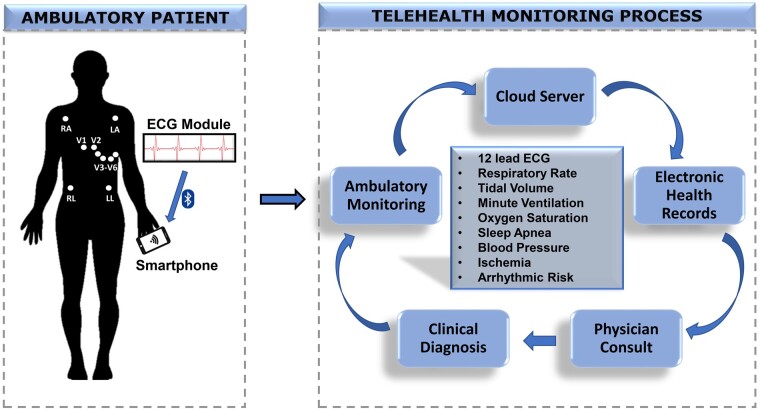
Schematic of a proposed telehealth monitoring system. Ambulatory monitoring of vital signals like the heart rate, blood pressure, oxygen saturation, respiratory rate, tidal volume, minute ventilation, sleep apnoea, and ischaemic or arrhythmic events is performed using a single platform telemonitoring device like the cvrPhone. Medical data are uploaded to cloud servers and transmitted to healthcare facilities as an electronic medical record. Healthcare professionals and physicians can access the data and provide clinical diagnosis along with necessary prescriptions for palliative care or recommendations for further treatments. The system provides a framework for remote monitoring and offers equitable personalized medical care for persons in rural communities and underrepresented areas. ECG, electrocardiograph; LA, left arm; LL, left leg; RA, right arm; RL, right leg.
Figure 2
Figure 2
Telehealth system for cardiac monitoring. (A) Representative electrocardioographic tracing acquired by the cvrPhone, using the precordial lead V2 depicting onset of ventricular tachycardia. (B) Summary results (n = 4) of minute wise change in alternans voltage and Kscore across all 12 body surface electrocardiographic leads, preceding the onset of spontaneous ventricular tachycardia or fibrillation. t = 0 corresponds to the induction of myocardial infarction by coronary artery occlusion. Significant rise in alternans voltage and Kscore is observed in all leads just after onset of ischaemia post-occlusion.
Figure 3
Figure 3
Detection of myocardial ischaemia. (A) Instantaneous beat-to-beat change in ischaemic index acquired by the cvrPhone using precordial lead V6, quantifying the changes in ST-segment elevation. t = 0 corresponds to the induction of myocardial infarction by coronary artery occlusion. (B) Summary results (n = 9 records, 6 swine) of minute wise change in ischaemic index across all 12 body surface electrocardiograph leads. t = 0 corresponds to the induction of myocardial ischaemia by coronary artery occlusion. Significant rise in ischaemic index is observed in all leads within a minute of myocardial ischaemia induction.
Figure 4
Figure 4
Telehealth system for respiratory monitoring. (A) Representative plot of respiration rate estimates acquired using cvrPhone, as true respiration rate was varied between 0 and 6 breaths/min. (B) Representative plot of tidal volume estimates acquired using cvrPhone, as true tidal volume was varied from 250 to 0 to 750 to 0 to 500 to 0 to 750 mL. (C) Representative plot of minute ventilation estimates as true minute ventilation was varied from 1500 to 0 to 4500 to 0 to 3000 to 0 to 4500 breaths/min. Red lines denote true respiration rate, tidal volume, or minute ventilation values.
Figure 5
Figure 5
Instantaneous blood oxygen saturation estimation. Representative photoplethysmography and oxygen saturation signals acquired by the cvrPhone. Quantification of oxygen saturation estimation error (n = 11), acquired using different fingers (index, middle, and ring fingers), demonstrating no significant difference among fingers/hands. P-value is calculated using Wilcoxon signed-rank test. Data are presented as bar graphs denoting 10, 25, 50, 75, and 90 percentiles of oxygen saturation estimation error. PPG, photoplethysmographic; RMSE, root mean square error (%); SpO2, oxygen saturation.
Figure 6
Figure 6
Beat-to-beat real-time blood pressure estimation. Representative, noise-free signals. A beat here corresponds to: (i) end of prior beat’s T-wave to the end of current beat’s T-wave, (ii) diastolic to diastolic, for blood pressure, and (iii) minimum to the next beat’s minimum value for oxygen saturation. ABP, arterial blood pressure; ECG, electrocardiogram; SpO2, oxygen saturation.

References

    1. Cosby AG, McDoom-Echebiri MM, James W, Khandekar H, Brown W, Hanna HL.. Growth and persistence of place-based mortality in the United States: the rural mortality penalty. Am J Public Health 2019;109:155–162. - PMC - PubMed
    1. Browne AJ, Varcoe CM, Wong ST, Smye VL, Lavoie J, Littlejohn D, Tu D, Godwin O, Krause M, Khan KB.. Closing the health equity gap: evidence-based strategies for primary health care organizations. Int J Equity Health 2012;11:1–15. - PMC - PubMed
    1. Dwyer-Lindgren L, Bertozzi-Villa A, Stubbs RW, Morozoff C, Mackenbach JP, van Lenthe FJ, Mokdad AH, Murray CJ.. Inequalities in life expectancy among us counties, 1980 to 2014: temporal trends and key drivers. JAMA Intern Med 2017;177:1003–1011. - PMC - PubMed
    1. Pew research internet project. Mobile technology fact sheet. 2014. http://www.Pewinternet.Org/fact-sheets/mobile-technology-fact-sheet (11 ....
    1. Nigam G, Pathak C, Riaz M.. A systematic review of central sleep apnea in adult patients with chronic kidney disease. Sleep Breath 2016;20:957–964. - PubMed

LinkOut - more resources