Review
. 2022 Jan;70(1):17-28.
doi: 10.1369/00221554211048951. Epub 2021 Oct 4.

Emerging Roles of DLK1 in the Stem Cell Niche and Cancer Stemness

Affiliations
Review

Emerging Roles of DLK1 in the Stem Cell Niche and Cancer Stemness

Elisa Stellaria Grassi et al. J Histochem Cytochem. 2022 Jan.

Abstract

DLK1 is a maternally imprinted, paternally expressed gene coding for the transmembrane protein Delta-like homologue 1 (DLK1), a non-canonical NOTCH ligand with well-described roles during development, and tumor-supportive functions in several aggressive cancer forms. Here, we review the many functions of DLK1 as a regulator of stem cell pools and tissue differentiation in tissues such as brain, muscle, and liver. Furthermore, we review recent evidence supporting roles for DLK1 in the maintenance of aggressive stem cell characteristics of tumor cells, specifically focusing on central nervous system tumors, neuroblastoma, and hepatocellular carcinoma. We discuss NOTCH -dependent as well as NOTCH-independent functions of DLK1, and focus particularly on the complex pattern of DLK1 expression and cleavage that is finely regulated from a spatial and temporal perspective. Progress in recent years suggest differential functions of extracellular, soluble DLK1 as a paracrine stem cell niche-secreted factor, and has revealed a role for the intracellular domain of DLK1 in cell signaling and tumor stemness. A better understanding of DLK1 regulation and signaling may enable therapeutic targeting of cancer stemness by interfering with DLK1 release and/or intracellular signaling.

Keywords: DLK1; angiogenesis; cancer; glioblastoma; stem cell; stemness; tissue differentiation; tumor heterogeneity; tumor immune infiltrate; tumor microenvironment.


Conflict of interest statement

Competing Interests: The author(s) declared no potential conflicts of interest with respect to the research, authorship, and/or publication of this article.

Figures

Figure 1.
Figure 1.
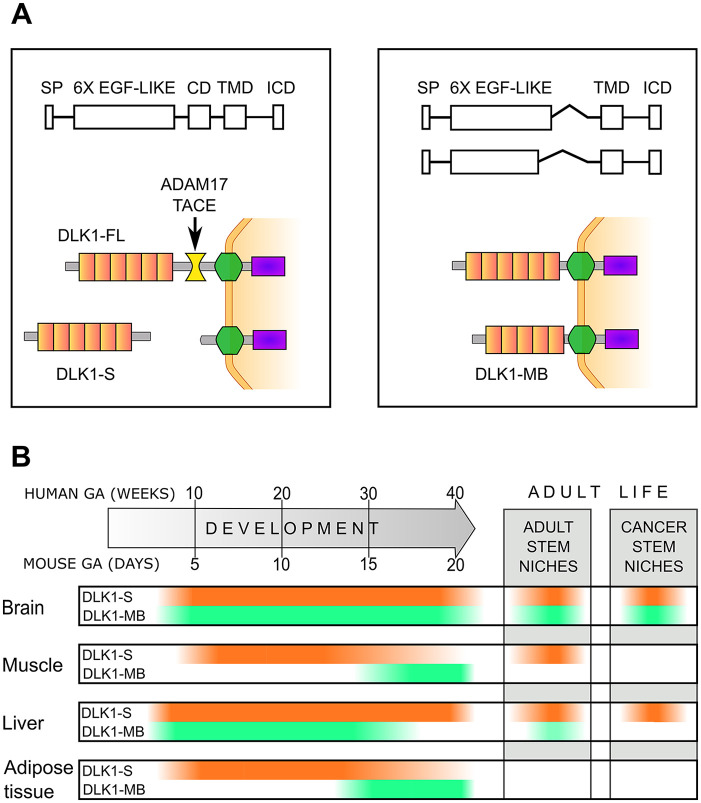
DLK1 isoforms play different roles in tissue development and stem cell pool maintenance. (A) DLK1 is composed of six epidermal growth factor (EGF)–like tandem repeats that constitute the major part of the extracellular domain (ECD), an ADAM17/TACE cleavage domain (CD), a transmembrane domain (TMD), and a short intracellular domain (ICD). Alternative splicing can generate different isoforms that lack the ADAM17/TACE cleavage site and part or all of the sixth EGF-like repeat and are thus membrane-bound (DLK1-MB). The cleavage of full-length DLK1 generates the secreted form of the protein (DLK1-S) that may act as a paracrine factor. (B) Variations in the levels of DLK1-S (orange) and DLK1-MB (green) during development and in stem cell pools and in cancer stem cell niches of adults. The DLK1 timelines represent an integration of the different data available in mouse and humans.
Figure 2.
Figure 2.
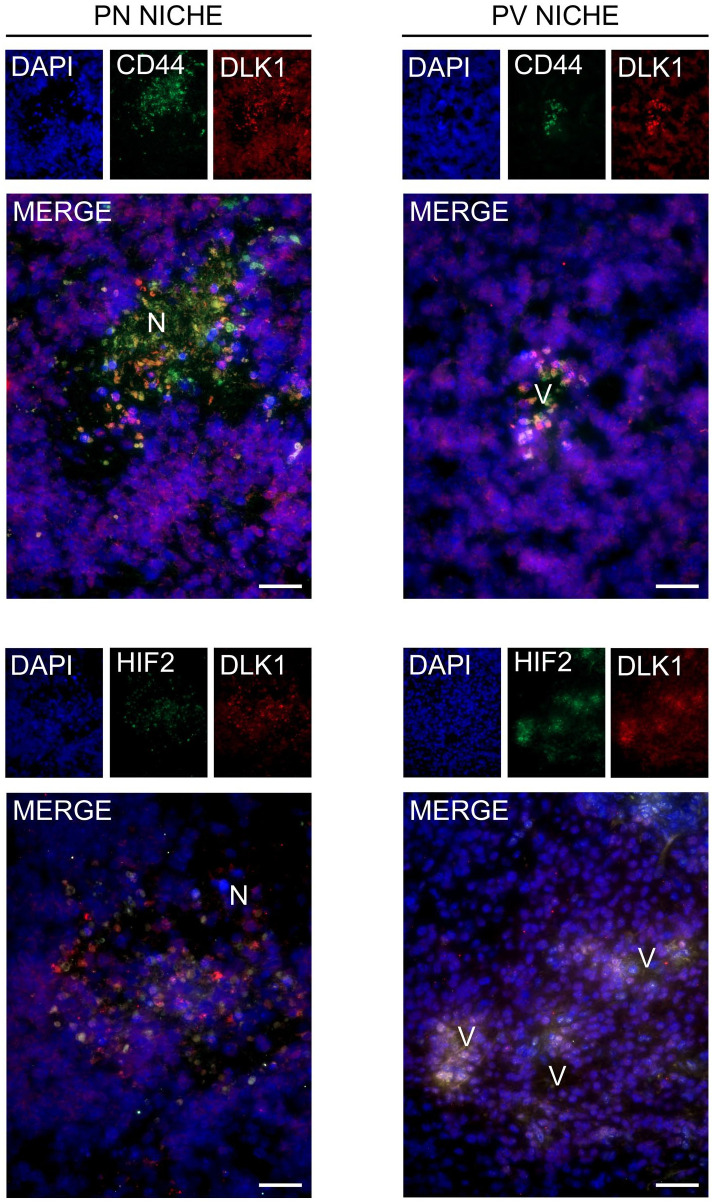
DLK1 expression in glioblastoma (GBM) perivascular and perinecrotic niches. DLK1 expression and colocalization with two markers of the perivascular (PV) and perinecrotic (PN) niches, CD44 and HIF-2alpha, in immunofluorescence performed on cryosections of Nestin/tv-a Ink4a/Arf−/−murine GBM induced through neonatal intracranial injection with DF1 cells expressing replication-competent avian sarcoma-leukosis virus long-terminal repeat with splice acceptor (RCAS) encoding human platelet-derived growth factor B (PDGFB) and RCAS-short hairpin p53 (RCAS-shp53). All images were batch processed for background and LUTs optimization. V, vessel; N, necrosis. Scalebars represent 40 µm.
Figure 3.
Figure 3.
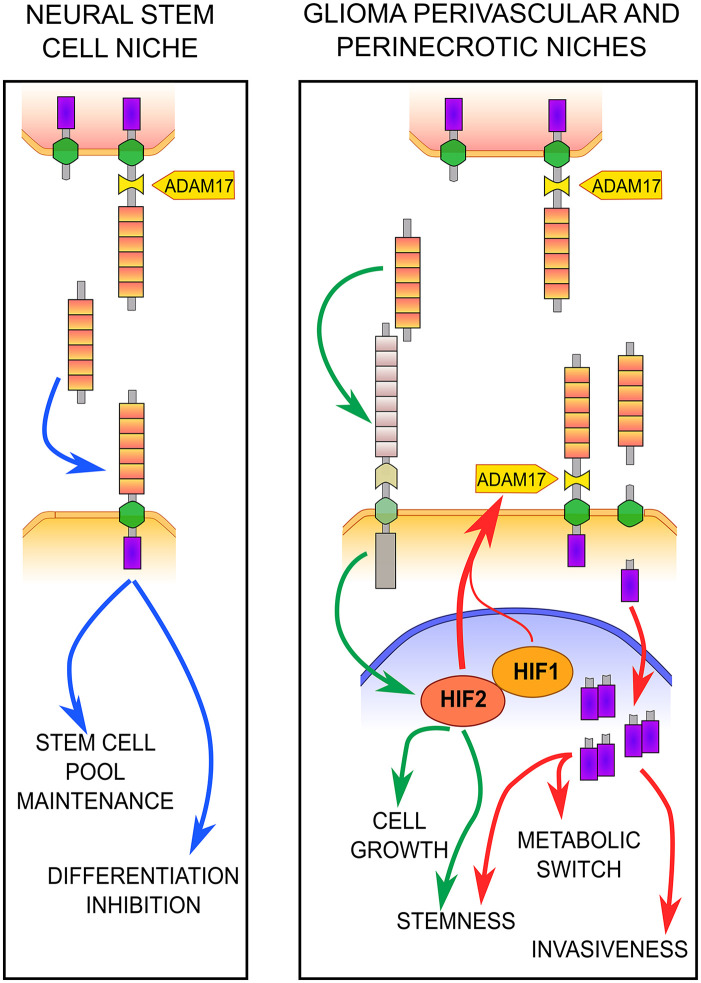
Role of secreted and membrane-bound DLK1 in adult neural stem cell niches and in glioma cancer stem cell niches. In the neural stem cell niches, astrocytes express the full-length, cleavable form of DLK1 (upper cells) while the neural stem cells express the membrane-bound form (bottom cells). The expression of both DLK1 forms in the different cell types is necessary for the inhibition of differentiation and the maintenance of the stem cell pool. In glioma stem cell niches, the reactive astrocyte-secreted DLK1 (upper cells) stimulates cancer cell stemness and growth mainly enhancing HIF-2 activity through a yet unidentified pathway. Moreover, in the cancer cells (bottom), the activation of HIFs induce an ADAM17-dependent cleavage of DLK1 and the release of the intracellular domain (ICD) that then translocates to the nucleus. Here, DLK1 ICD promotes cancer cell stemness and invasiveness mainly through the induction of a metabolic switch that allows a better adaptation to the hypoxic niche environment.

References

    1. da Rocha ST, Tevendale M, Knowles E, Takada S, Watkins M, Ferguson-Smith AC. Restricted co-expression of DLK1 and the reciprocally imprinted non-coding RNA, Gtl2: implications for cis-acting control. Dev Biol. 2007;306(2):810–23. doi:10.1016/j.ydbio.2007.02.043. - DOI - PubMed
    1. Laborda J. The role of the epidermal growth factor-like protein DLK in cell differentiation. Histol Histopathol. 2000;15(1):119–29. doi:10.14670/HH-15.119. - DOI - PubMed
    1. Ferrón SR, Charalambous M, Radford E, McEwen K, Wildner H, Hind E, Morante-Redolat JM, Laborda J, Guillemot F, Bauer SR, Fariñas I, Ferguson-Smith AC. Postnatal loss of DLK1 imprinting in stem cells and niche astrocytes regulates neurogenesis. Nature. 2011;475(7356):381–5. doi:10.1038/nature10229. - DOI - PMC - PubMed
    1. Falix FA, Aronson DC, Lamers WH, Gaemers IC. Possible roles of DLK1 in the Notch pathway during development and disease. Biochim Biophys Acta. 2012;1822(6):988–95. doi:10.1016/j.bbadis.2012.02.003. - DOI - PubMed
    1. Sakajiri S, O’Kelly J, Yin D, Miller CW, Hofmann WK, Oshimi K, Shih LY, Kim KH, Sul HS, Jensen CH, Teisner B, Kawamata N, Koeffler HP. DLK1 in normal and abnormal hematopoiesis. Leukemia. 2005;19(8):1404–10. doi:10.1038/sj.leu.2403832. - DOI - PubMed

Publication types

MeSH terms