. 2022 Jan;57(1):66-74.
doi: 10.1002/ppul.25695. Epub 2021 Oct 4.

Understanding the environmental factors related to the decrease in Pediatric Emergency Department referrals for acute asthma during the SARS-CoV-2 pandemic

Affiliations

Understanding the environmental factors related to the decrease in Pediatric Emergency Department referrals for acute asthma during the SARS-CoV-2 pandemic

Arianna Dondi et al. Pediatr Pulmonol. 2022 Jan.

Abstract

Background: Lockdown measures during the SARS-CoV-2 pandemic determined radical changes to behavioral and social habits, that were reflected by a reduction in the transmission of respiratory pathogens and in anthropogenic atmospheric emissions.

Objective: This ecological study aims to provide a descriptive evaluation on how restrictive measures during the SARS-CoV-2 pandemic impacted Pediatric Emergency Department (PED) referrals for asthma exacerbations, and their potentially associated environmental triggers in Bologna, a densely populated urban area in Northern Italy.

Methods: Files of children evaluated for acute asthma during 2015 to 2020 at the PED of Sant'Orsola University Hospital of Bologna were retrospectively reviewed. Historical daily concentration records of particulate (PM2.5 , PM10 ) and gaseous (NO2 , C6 H6 ) air pollutants, and pollen were concurrently evaluated, including specific PM chemical tracers for traffic-related air pollution (TRAP).

Results: In 2020, asthma-related PED referrals decreased compared to referral rates of the previous 5 years (p < 0.01). This effect was particularly marked during the first lockdown period (March to May), when the drastic drop in PED referrals was associated with a reduction of high-priority cases up to 85% and by 54%, on average. A concomitant reduction in the concentrations of traffic-related air pollutants was observed in the range of 40%-60% (p < 0.01).

Conclusions: The lower rate of asthma exacerbations in childhood was in this study paralleled with reduced TRAP levels during the pandemic. Synergic interactions of the multiple consequences of lockdowns likely contributed to the reduced exacerbations, including decreased exposure to ambient pollutants and fewer respiratory infections, identified as the most important factor in the literature.

Keywords: allergens; asthma exacerbations; oxidative stress; traffic-related air pollution.


Conflict of interest statement

The authors declare that there are no conflict of interests.

Figures
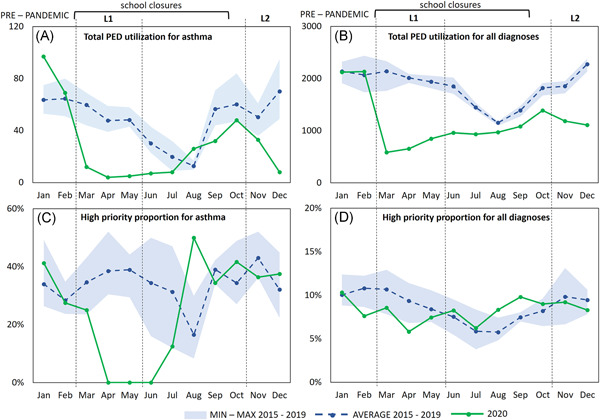
Figure 1
Figure 1
Monthly referrals to the Pediatric Emergency Department (PED) of Sant'Orsola University Hospital of Bologna, Italy, related to the time periods 2015–2019 and 2020. (A) Asthma‐related PED referrals during 2015–2019 versus 2020; (B) PED referrals for all diagnoses during 2015–2019 versus 2020; (C) high priority asthma visits (%) during 2015–2019 versus 2020; (D) high priority visits (%) for all diagnoses during 2015–2019 versus 2020 [Color figure can be viewed at wileyonlinelibrary.com]
Figure 2
Figure 2
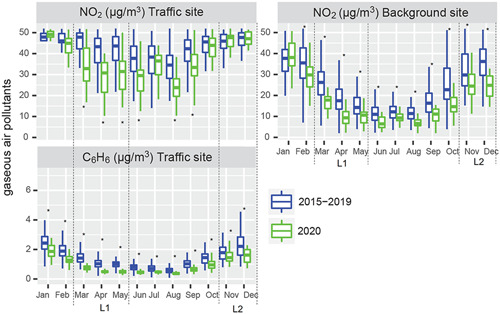
Gaseous pollutants levels at the urban background site (NO2) and the traffic site (NO2 and C6H6) of the Arpae air quality monitoring network in Bologna, Northern Italy. The comparison is related to the time period 2015–2019 versus 2020: monthly boxplots are extracted by daily concentrations for 2020 and average daily concentrations for 2015–2019. The March to May calendar period (severe lockdown‐1) is indicated as L1 and the October to December calendar period (moderate lockdown‐2) is indicated as L2. *Above or below the boxplot refer to the statistically significant differences based on the t test [Color figure can be viewed at wileyonlinelibrary.com]
Figure 3
Figure 3
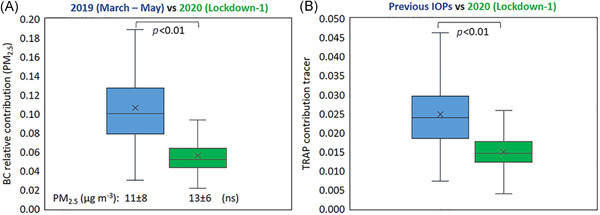
(A) Black carbon relative contribution to PM2.5 during the March to May calendar period (lockdown‐1) in 2019 (blue) and 2020 (red); PM2.5 average mass concentrations are also reported (ns indicates that differences in mass concentrations between 2019 versus 2020 resulted as not significant); (B): f57 signal in the organic mass spectra of NR‐PM1 (TRAP signal) as measured in intensive observation periods (IOPs) during lockdown‐1 and during previous experimental campaigns at the urban background supersite of Arpae in Bologna. Not significant (ns) and p refer to Student's t test [Color figure can be viewed at wileyonlinelibrary.com]

References

    1. Masetti R, Corsini I, Leardini D, Lanari M, Pession A. Presentations to the emergency department in Bologna, Italy, during COVID‐19 outbreak. BMJ Paediatr Open. 2020;4(1):1‐3. 10.1136/bmjpo-2020-000748 - DOI - PMC - PubMed
    1. Matera L, Nenna R, Rizzo V, et al. SARS‐CoV‐2 pandemic impact on pediatric emergency rooms: a multicenter study. Int J Environ Res Public Health. 2020;17(23):1‐12. 10.3390/ijerph17238753 - DOI - PMC - PubMed
    1. Taquechel K, Diwadkar AR, Sayed S, et al. Pediatric asthma health care utilization, viral testing, and air pollution changes during the COVID‐19 pandemic. J Allergy Clin Immunol Pract. 2020;8(10):3378‐3387.e11. 10.1016/j.jaip.2020.07.057 - DOI - PMC - PubMed
    1. Papadopoulos NG, Custovic A, Deschildre A, et al. Impact of COVID‐19 on pediatric asthma: practice adjustments and disease burden. J Allergy Clin Immunol Pract. 2020;8(8):2592‐2599.e3. 10.1016/j.jaip.2020.06.001 - DOI - PMC - PubMed
    1. Tregony S, Kimberly FG, Adam H, Kyle N, Jonathan MG. Impact of the COVID‐19 pandemic on pediatric emergency department utilization for asthma. Ann Am Thorac Soc. 2020;18:717‐719. 10.1513/AnnalsATS.202007-765RL - DOI - PMC - PubMed

Publication types