. 2021 Oct 4;12(1):5792.
doi: 10.1038/s41467-021-26020-5.

Unveiling unconventional magnetism at the surface of Sr2RuO4

Affiliations

Unveiling unconventional magnetism at the surface of Sr2RuO4

R Fittipaldi et al. Nat Commun. .

Abstract

Materials with strongly correlated electrons often exhibit interesting physical properties. An example of these materials is the layered oxide perovskite Sr2RuO4, which has been intensively investigated due to its unusual properties. Whilst the debate on the symmetry of the superconducting state in Sr2RuO4 is still ongoing, a deeper understanding of the Sr2RuO4 normal state appears crucial as this is the background in which electron pairing occurs. Here, by using low-energy muon spin spectroscopy we discover the existence of surface magnetism in Sr2RuO4 in its normal state. We detect static weak dipolar fields yet manifesting at an onset temperature higher than 50 K. We ascribe this unconventional magnetism to orbital loop currents forming at the reconstructed Sr2RuO4 surface. Our observations set a reference for the discovery of the same magnetic phase in other materials and unveil an electronic ordering mechanism that can influence electron pairing with broken time reversal symmetry.


Conflict of interest statement

The authors declare no competing interests.

Figures
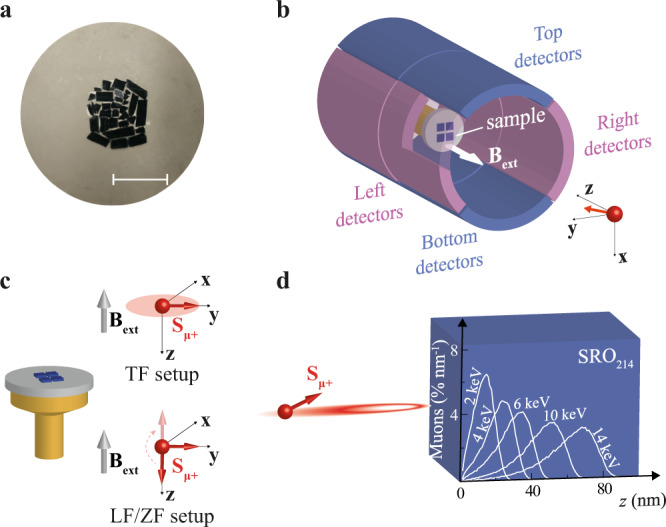
Fig. 1
Fig. 1. Low-energy μSR setup for measurements on SRO214 single crystals.
a SRO214 crystals cleaved and glued onto a Ni-coated aluminium plate to form a mosaic for the LE-μSR measurements. The scale bar corresponds to a length of 2 cm. b Experimental LE-μSR setup with applied field vector Bext perpendicular to the sample (i.e., along the c-axis of SRO214 coinciding with the axis z of our orthonormal reference-axes system) and arrays of positron detectors used to count muon decay events. The schematic cut-out allows viewing the sample inside the detectors. c LE-μSR measurement configurations for different orientations of the initial muon spin polarization vector Sμ+: Sμ+ perpendicular to the applied field vector Bext and precessing in the xy-plane of our reference-axes system as indicated by the shadowed red circle (transverse field, top) or Sμ+ collinear to Bext (longitudinal field or zero fields with Bext = 0, bottom). d Muon implantation profiles in SRO214 simulated for a few representative implantation energies.
Fig. 2
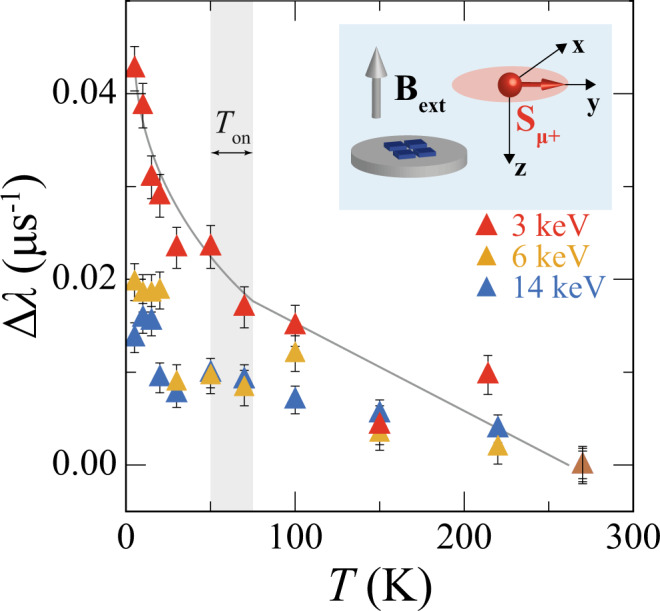
Fig. 2. Temperature dependence of magnetism in SRO214 at different implantation depths.
Shift in the muon depolarization rate, Δλ, from the λ value measured at T = 270 K as a function of temperature T measured in a TF setup (inset) with applied field amplitude Bext = 100 G at different implantation energy E values: E = 3 keV (red symbols with error bars), E = 6 keV (orange symbols with error bars) and E = 16 keV (blue symbols with error bars). The solid grey line serves as a guide to the eye and marks the T range (grey shaded region) where Δλ changes slope for = 3 keV, which we identify as the onset temperature Ton of the magnetism in SRO214. The inset shows the relative orientation of the applied field Bext with respect to the muon spin polarization Sμ+ in our orthonormal reference-axes system for the TF configuration.
Fig. 3
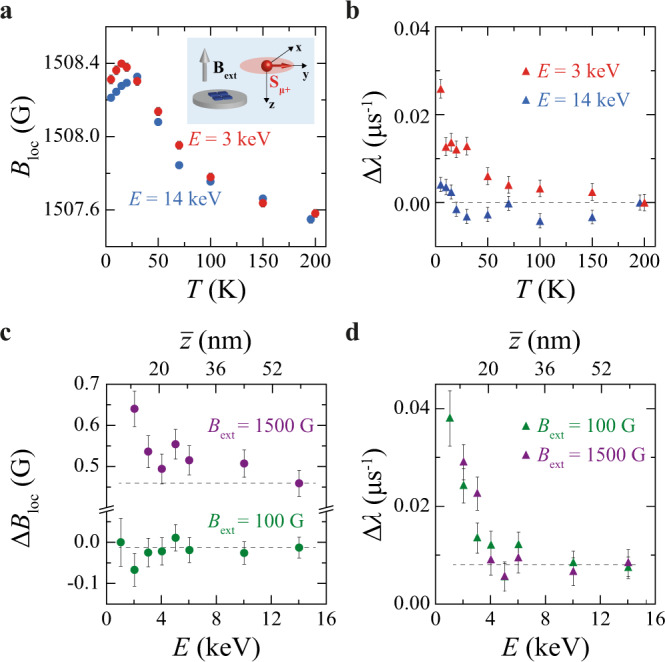
Fig. 3. Magnetic field response and depth profile of magnetism in SRO214.
a, b, Temperature dependence of the local field amplitude Bloc (a) and of the shift in the depolarization rate, Δλ, from the λ value measured at T = 200 K (b) measured in TF with amplitude of the external field Bext = 1500 G at E = 3 keV (red symbols with error bars) and E = 14 keV (blue symbols with error bars). Error bars in (a) are within the symbols. The inset schematic in (a) shows the relative orientation of the applied field Bext with respect to the muon spin polarization Sμ+ in our orthonormal reference-axes system for the TF configuration. The Δλ values in (b) are different from those shown in Fig. 2, as they are measured at a different stage of the experiment after warming the samples to room T, degaussing the magnet and zero-field cooling the samples again before applying Bext. c, d Shift in the local field amplitude ΔBloc (c) and in Δλ (d) between T = 100 K > Ton and T = 5 K < Ton measured in TF as a function of E for Bext = 100 G (green symbols with error bars) and Bext = 1500 G (purple symbols with error bars). The top axes are the corresponding muon average stopping depth z¯ values determined from the simulated muon stopping distributions in Fig. 1d. Dashed lines in (b) to (d) are guides to the eye.
Fig. 4
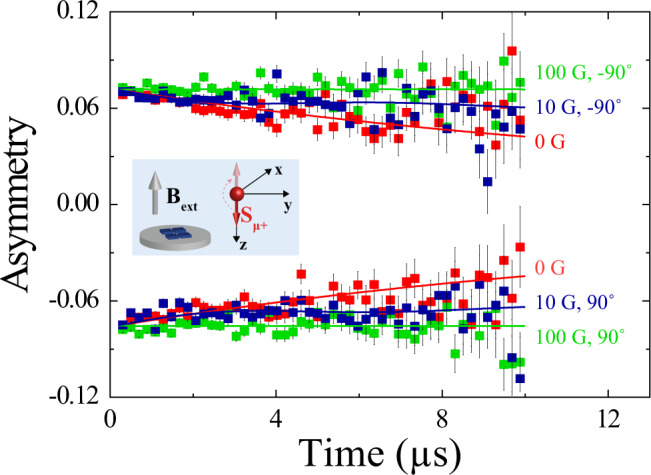
Fig. 4. Static nature of magnetism in SRO214.
Asymmetry signal measured at T =  5 K in ZF/LF for parallel (angle = 90°) and antiparallel (angle = −90°) alignments of the applied field Bext and the muon spin polarization Sμ+ with different Bext amplitude values: Bext = 0 G (red symbols with error bars), Bext = 10 G (blue symbols with error bars) and Bext = 100 G (green symbols with error bars). The inset schematic shows the relative orientation of Bext and Sμ+ in our orthonormal reference-axes system for the ZF/LF setup.
Fig. 5
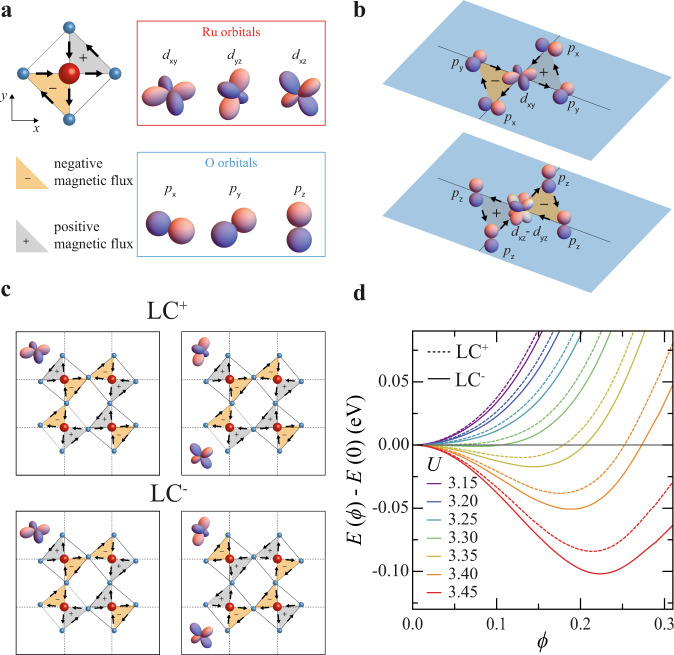
Fig. 5. Magnetism due to orbital loop currents in SRO214.
a Illustration of the RuO4 plaquette and of the corresponding d-orbitals for the Ru atoms (red box) and p-orbitals for the O atoms (light blue box) with asymmetric loop current distributions generating magnetic flux pointing inward (yellow triangle with ‘−’ symbol) or outward (grey triangle with ‘+’ symbol) the RuO4 plane. b Possible orbital loop currents for a given RuO4 plaquette associated with the Ru–O hybridization of the dxy orbitals (top) and of the (dxz, dyz) orbitals (bottom). c Loop current states with equal (LC+ state) and opposite sign (LC state) of the magnetic flux associated with the xy- and z-orbital sectors of the RuO plaquettes in the SRO214 supercell. d, Free energy E(ϕ)−E(0) of the LC+ (dashed lines) and LC states (solid lines) calculated at T = 50 K for different values of the d–p Coulomb interaction U (U values given in eV units are specified in the figure legend) as a function of the order parameter ϕ which sets the amplitude of the bond current.

References

    1. Illing B, et al. Mermin–Wagner fluctuations in 2D amorphous solids. Proc. Natl. Acad. Sci. USA. 2017;114:1856–1861. doi: 10.1073/pnas.1612964114. - DOI - PMC - PubMed
    1. Kosterlitz JM, Thouless DJ. Ordering, metastability and phase transitions in 2 dimensional systems. J. Phys. C. 1973;6:1181–1203. doi: 10.1088/0022-3719/6/7/010. - DOI - PubMed
    1. Ji D, et al. Freestanding crystalline oxide perovskites down to the monolayer limit. Nature. 2019;570:87–90. doi: 10.1038/s41586-019-1255-7. - DOI - PubMed
    1. Bednorz JG, Müller KA. Possible high Tc superconductivity in the Ba–La–Cu–O system. Z. Phys. B. 1986;64:189–193. doi: 10.1007/BF01303701. - DOI
    1. Imada M, Fujimori A, Tokura Y. Metal–insulator transitions. Rev. Mod. Phys. 1998;70:1039–1263. doi: 10.1103/RevModPhys.70.1039. - DOI