


Nonprofits: A Public Policy Tool for the Promotion of Community Subjective Well-being
- PMID: 34608375
- PMCID: PMC8482971
- DOI: 10.1093/jopart/muab010
Nonprofits: A Public Policy Tool for the Promotion of Community Subjective Well-being
Abstract
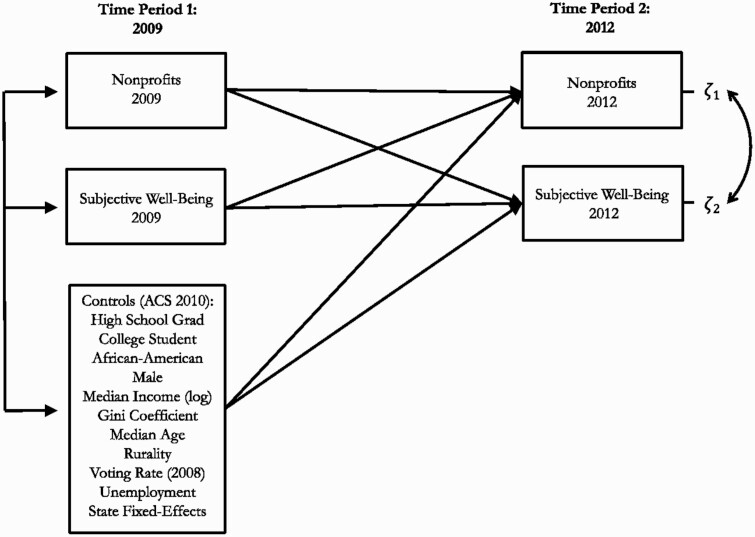
Looking to supplement common economic indicators, politicians and policymakers are increasingly interested in how to measure and improve the subjective well-being of communities. Theories about nonprofit organizations suggest that they represent a potential policy-amenable lever to increase community subjective well-being. Using longitudinal cross-lagged panel models with IRS and Twitter data, this study explores whether communities with higher numbers of nonprofits per capita exhibit greater subjective well-being in the form of more expressions of positive emotion, engagement, and relationships. We find associations, robust to sample bias concerns, between most types of nonprofit organizations and decreases in negative emotions, negative sentiments about relationships, and disengagement. We also find an association between nonprofit presence and the proportion of words tweeted in a county that indicate engagement. These findings contribute to our theoretical understanding of why nonprofit organizations matter for community-level outcomes and how they should be considered an important public policy lever.
© The Author(s) 2021. Published by Oxford University Press on behalf of the Public Management Research Association. All rights reserved. For permissions, please e-mail: journals.permissions@oup.com.
Figures
References
-
- Aggarwal, Charu C., and Zhai Cheng Xiang. 2012. Mining text data. Medford, MA: Springer Science & Business Media.
-
- Ahern, Melissa, Brown Cheryl, and Dukas Stephen. 2011. A national study of the association between food environments and county-level health outcomes. The Journal of Rural Health 27 (4): 367–79. - PubMed
-
- Allard, Scott W. 2008. Out of reach: Place, poverty, and the new American welfare state. London, UK: Yale Univ. Press.
-
- Allison, Paul D. 2005. Fixed effects regression methods for longitudinal data using SAS. Cary, NC: Sas Institute.
-
- Almog-Bar, Michal, and Schmid Hillel. 2014. Advocacy activities of nonprofit human service organizations: A critical review. Nonprofit and Voluntary Sector Quarterly 43 (1): 11–35.
Grants and funding
LinkOut - more resources
Full Text Sources