European expert consensus on improving patient selection for the management of disabling spasticity with intrathecal baclofen and/or botulinum toxin type A
- PMID: 34608495
- PMCID: PMC8862646
- DOI: 10.2340/16501977-2877
European expert consensus on improving patient selection for the management of disabling spasticity with intrathecal baclofen and/or botulinum toxin type A
Abstract
Objective: To develop an algorithm for the selection of adults with disabling spasticity for treatment with intrathecal baclofen (ITB) and/or botulinum toxin type A (BoNT A).
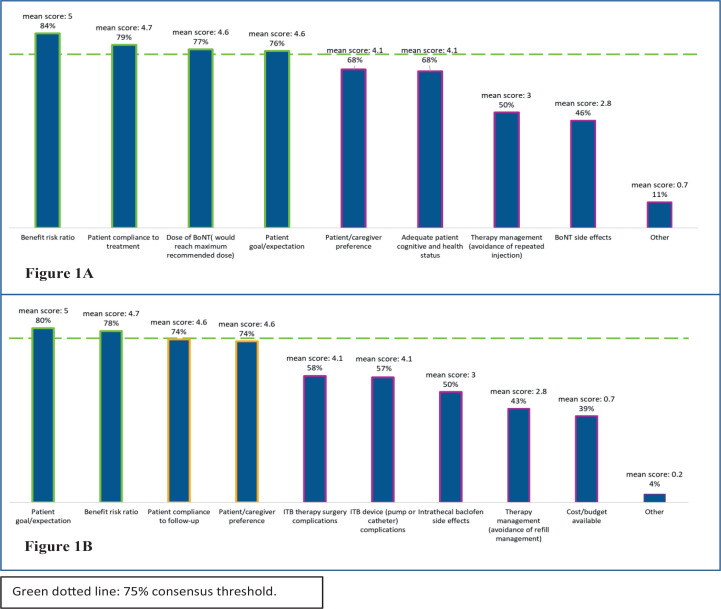
Methods: A European Advisory Board of 4 neurologists and 4 rehabilitation specialists performed a literature review on ITB and BoNT A treatment for disabling spasticity. An online survey was sent to 125 physicians and 13 non-physician spasticity experts. Information on their current clinical practice and level of agreement on proposed selection criteria was used to inform algorithm design. Consensus was considered reached when ≥75% of respondents agreed or were neutral.
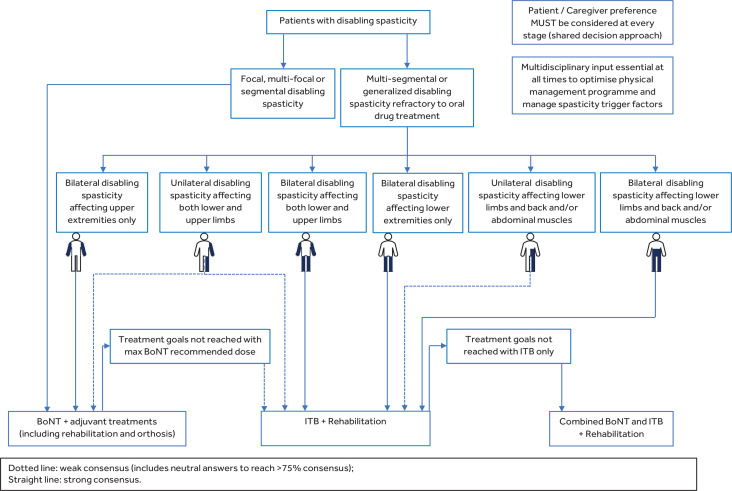
Results: A total of 79 experts from 17 countries completed the on-line survey (57%). Agreement was reached that patients with multi-segmental or generalized disabling spasticity refractory to oral drugs are the best candidates for ITB (96.1% consensus), while those with focal/segmental disabling spasticity are ideal candidates for BoNT A (98.7% consensus). In addition the following are good candidates for ITB (% consensus): bilateral disabling spasticity affecting lower limbs only (97.4%), bilateral (100%) or unilateral (90.9%) disabling spasticity affecting lower limbs and trunk, and unilateral or bilateral disabling spasticity affecting upper and lower extremities (96.1%).
Conclusion: This algorithm will support the management of adult patients with disabling spasticity by aiding patient selection for ITB and/or BoNT A treatments.
Conflict of interest statement
The Advisory Board and the publication fees were supported by Medtronic.
Figures
References
-
- Pandyan AD, Gregoric M, Barnes MP, Wood D, Van Wijck F, Burridge J, et al. Spasticity: clinical perceptions, neurological realities and meaningful measurement. Disabil Rehabil 2005; 27: 2–6. - PubMed
-
- Opheim A, Danielsson A, Alt Murphy M, Persson H, Sunnerhagen K. Upper-limb spasticity during the first year after stroke: stroke arm longitudinal study at the University of Gothenburg. Am J Phys Med Rehabil 2014; 93: 884–896. - PubMed
-
- Natale M, Mirone G, Rotondo M, Moraci A. Intrathecal baclofen therapy for severe spasticity: Analysis on a series of 112 consecutive patients and future prospectives. Clin Neurol Neurosurg 2012; 114: 321–325. - PubMed
-
- Draulans N, Vermeersch K, Degraeuwe B, Meurrens T, Peers K, Nuttin B, et al. Intrathecal baclofen in multiple sclerosis and spinal cord injury: complications and long-term dosage evolution. Clin Rehabil 2013; 27: 1137–1143. - PubMed
SUPPLEMENTARY REFERENCES
-
- Borowski A, Littleton AG, Borkhuu B, Presedo A, Shah S, Dabney KW, et al. Complications of intrathecal baclofen pump therapy in pediatric patients. J Pediatr Orthop 2010; 30: 76–81. - PubMed
-
- Borrini L, Bensmail D, Thiebaut JB, Hugeron C, Rech C, Jourdan C. Occurrence of adverse events in long-term intrathecal baclofen infusion: a 1-year follow-up study of 158 adults. Arch Phys Med Rehabil 2014; 95: 1032–1038. - PubMed
-
- Dvorak EM, McGuire JR, Nelson MES. Incidence and identification of intrathecal baclofen catheter malfunction. PM R 2010; 2: 751–756. - PubMed
-
- Khan AA, Birks-Agnew I, Bullock P, Rushton D. Clinical outcome and complications of intrathecal baclofen pump in multiple sclerosis patients: a retrospective study. NeuroRehabilitation 2010; 27: 117–120. - PubMed
Publication types
MeSH terms
Substances
LinkOut - more resources
Full Text Sources
Medical