Functional imaging improves patient selection for mandibular advancement device treatment outcome in sleep-disordered breathing: a prospective study
- PMID: 34608859
- PMCID: PMC8883076
- DOI: 10.5664/jcsm.9694
Functional imaging improves patient selection for mandibular advancement device treatment outcome in sleep-disordered breathing: a prospective study
Abstract
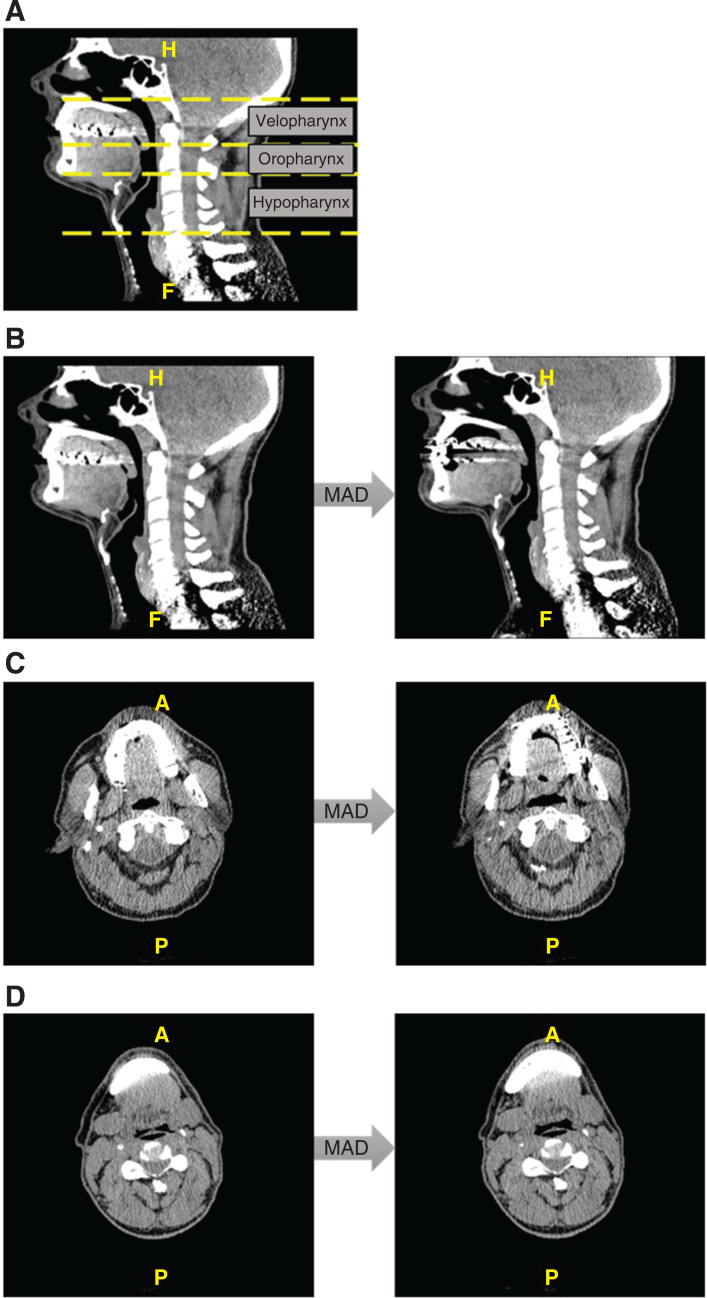
Study objectives: Mandibular advancement devices (MADs) are a noninvasive treatment option for patients with obstructive sleep apnea (OSA) and act by increasing the upper airway volume. However, the exact therapeutic mechanism of action remains unclear. The aim of this study was to assess MAD mechanisms using functional imaging that combines imaging techniques and computational fluid dynamics and assess associations with treatment outcome.
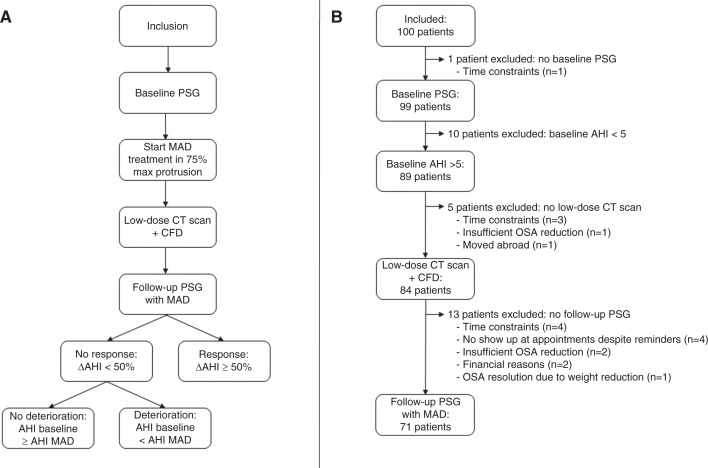
Methods: One hundred patients with OSA were prospectively included and treated with a custom-made MAD at a fixed 75% protrusion. A low-dose computed tomography scan was made with and without MADs for computational fluid dynamics analysis. Patients underwent a baseline and 3-month follow-up polysomnography to evaluate treatment efficacy. A reduction in apnea-hypopnea index ≥ 50% defined treatment response.
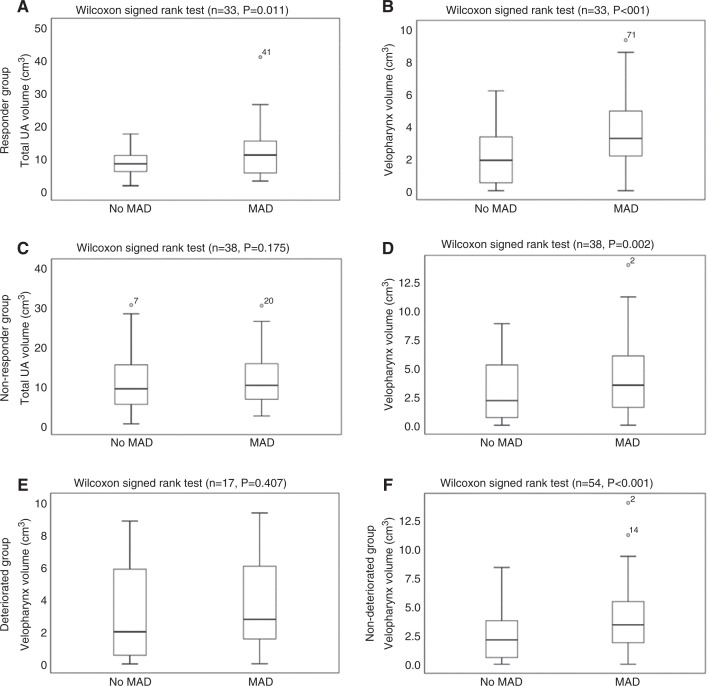
Results: Overall, 71 patients completed both 3-month follow-up polysomnography and low-dose computed tomography scan with computational fluid dynamics analysis. MAD treatment significantly reduced the apnea-hypopnea index (16.5 [10.4-23.6] events/h to 9.1 [3.9-16.4] events/h; P < .001, median [quartile 1-quartile 3]) and significantly increased the total upper airway volume (8.6 [5.4-12.8] cm3 vs 10.7 [6.4-15.4] cm3; P = .003), especially the velopharyngeal volume (2.1 [0.5-4.1] cm3 vs 3.3 [1.8-6.0] cm3; P < .001). However, subanalyses in responders and nonresponders only showed a significant increase in the total upper airway volume in responders, not in nonresponders.
Conclusions: MAD acts by increasing the total upper airway volume, predominantly due to an increase in the velopharyngeal volume. Responders showed a significant increase in the total upper airway volume with MAD treatment, while there was no significant increase in nonresponders. Findings add evidence to implement functional imaging using computational fluid dynamics in routine MAD outcome prediction.
Clinical trial registration: Registry: ClinicalTrials.gov; Name: Predicting Therapeutic Outcome of Mandibular Advancement Device Treatment in Obstructive Sleep Apnea; URL: https://clinicaltrials.gov/ct2/show/NCT01532050; Identifier: NCT01532050.
Citation: Van Gaver H, Op de Beeck S, Dieltjens M, et al. Functional imaging improves patient selection for mandibular advancement device treatment outcome in sleep-disordered breathing: a prospective study. J Clin Sleep Med. 2022;18(3):739-750.
Keywords: CFD; MAD; OSA; obstructive sleep apnea; oral appliances.
© 2022 American Academy of Sleep Medicine.
Conflict of interest statement
All authors have seen and approved the manuscript. Work for this study was performed at Antwerp University Hospital (UZA), University of Antwerp. This study was funded by a 3-year grant of the Flemish Government Agency for Innovation by Science and Technology (IWT-090864). M.D. holds a postdoctoral fellowship at Research Foundation Flanders (FWO)—12H4516N. J.V. reports grants from SomnoMed outside the submitted work and sits on the advisory board of ResMed Narval. M.J.B. reports grants from SomnoMed outside the submitted work and sits on the advisory boards of ResMed and SomnoMed. O.M.V. reports grants from Philips, grants from SomnoMed, personal fees from SomnoMed, other support from Inspire Medical Systems, personal fees from Inspire Medical Systems, other support from Zephyr, other support from NightBalance, and other support from Galvani, outside the submitted work. O.M.V. holds a Senior Clinical Investigator Fellowship from Research Foundation Flanders (FWO)—2016-2021. The other authors report no conflicts of interest.
Figures
References
-
- Vanderveken OM , Boudewyns A , Ni Q , et al. . Cardiovascular implications in the treatment of obstructive sleep apnea . J Cardiovasc Transl Res. 2011. ; 4 ( 1 ): 53 – 60 . - PubMed
-
- Bradley TD , Floras JS . Obstructive sleep apnoea and its cardiovascular consequences . Lancet. 2009. ; 373 ( 9657 ): 82 – 93 . - PubMed
-
- Kushida CA , Morgenthaler TI , Littner MR , et al. . Practice parameters for the treatment of snoring and obstructive sleep apnea with oral appliances: an update for 2005 . Sleep. 2006. ; 29 ( 2 ): 240 – 243 . - PubMed
Publication types
MeSH terms
Associated data
LinkOut - more resources
Full Text Sources
Medical
Miscellaneous