


The impact of hospital accreditation on the quality of healthcare: a systematic literature review
- PMID: 34610823
- PMCID: PMC8493726
- DOI: 10.1186/s12913-021-07097-6
The impact of hospital accreditation on the quality of healthcare: a systematic literature review
Abstract
Background: Accreditation is viewed as a reputable tool to evaluate and enhance the quality of health care. However, its effect on performance and outcomes remains unclear. This review aimed to identify and analyze the evidence on the impact of hospital accreditation.
Methods: We systematically searched electronic databases (PubMed, CINAHL, PsycINFO, EMBASE, MEDLINE (OvidSP), CDSR, CENTRAL, ScienceDirect, SSCI, RSCI, SciELO, and KCI) and other sources using relevant subject headings. We included peer-reviewed quantitative studies published over the last two decades, irrespective of its design or language. Following the Preferred Reporting Items for Systematic Reviews and Meta-Analyses guidelines, two reviewers independently screened initially identified articles, reviewed the full-text of potentially relevant studies, extracted necessary data, and assessed the methodological quality of the included studies using a validated tool. The accreditation effects were synthesized and categorized thematically into six impact themes.
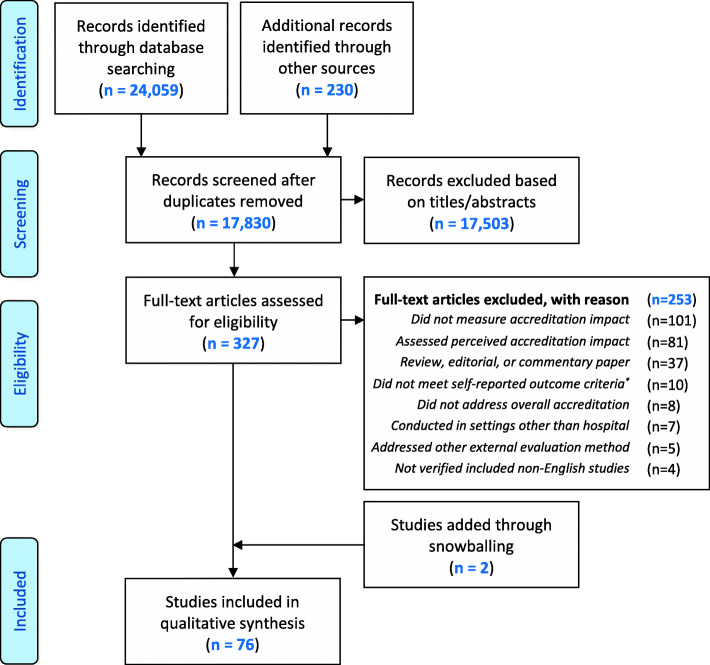
Results: We screened a total of 17,830 studies, of which 76 empirical studies that examined the impact of accreditation met our inclusion criteria. These studies were methodologically heterogeneous. Apart from the effect of accreditation on healthcare workers and particularly on job stress, our results indicate a consistent positive effect of hospital accreditation on safety culture, process-related performance measures, efficiency, and the patient length of stay, whereas employee satisfaction, patient satisfaction and experience, and 30-day hospital readmission rate were found to be unrelated to accreditation. Paradoxical results regarding the impact of accreditation on mortality rate and healthcare-associated infections hampered drawing firm conclusions on these outcome measures.
Conclusion: There is reasonable evidence to support the notion that compliance with accreditation standards has multiple plausible benefits in improving the performance in the hospital setting. Despite inconclusive evidence on causality, introducing hospital accreditation schemes stimulates performance improvement and patient safety. Efforts to incentivize and modernize accreditation are recommended to move towards institutionalization and sustaining the performance gains. PROSPERO registration number CRD42020167863.
Keywords: Accreditation; Health services; Hospitals; Quality of health care.
© 2021. The Author(s).
Conflict of interest statement
The authors declare that they have no competing interests.
Figures
References
-
- Institute of Medicine Committee on Quality of Health Care in America. In: Kohn LT, Corrigan JM, Donaldson MS, editors. To Err is Human: Building a Safer Health System. Washington (DC): National Academies Press (US); 2000. 10.17226/9728. - PubMed
-
- Devers KJ, Pham HH, Liu G. What is driving hospitals' patient-safety efforts? A study of twelve communities suggests that a regulatory body, not market forces, is having the strongest impact on hospitals' efforts to improve patient safety. Health Aff (Millwood) 2004;23(2):103–115. doi: 10.1377/hlthaff.23.2.103. - DOI - PubMed
-
- Moffett M, Bohara A. Hospital quality oversight by the joint commission on the accreditation of healthcare organizations. East Econ J. 2005;31:629–647.
-
- Greenfield D, Hinchcliff R, Hogden A, Mumford V, Debono D, Pawsey M, Westbrook J, Braithwaite J. A hybrid health service accreditation program model incorporating mandated standards and continuous improvement: interview study of multiple stakeholders in Australian health care. Int J Health Plann Manag. 2016;31(3):e116–e130. doi: 10.1002/hpm.2301. - DOI - PubMed
Publication types
MeSH terms
LinkOut - more resources
Full Text Sources
Medical
Miscellaneous
