


Dispositional hope as a potential outcome parameter among patients with advanced malignancy: An analysis of the ENABLE database
- PMID: 34613617
- PMCID: PMC10008020
- DOI: 10.1002/cncr.33907
Dispositional hope as a potential outcome parameter among patients with advanced malignancy: An analysis of the ENABLE database
Abstract
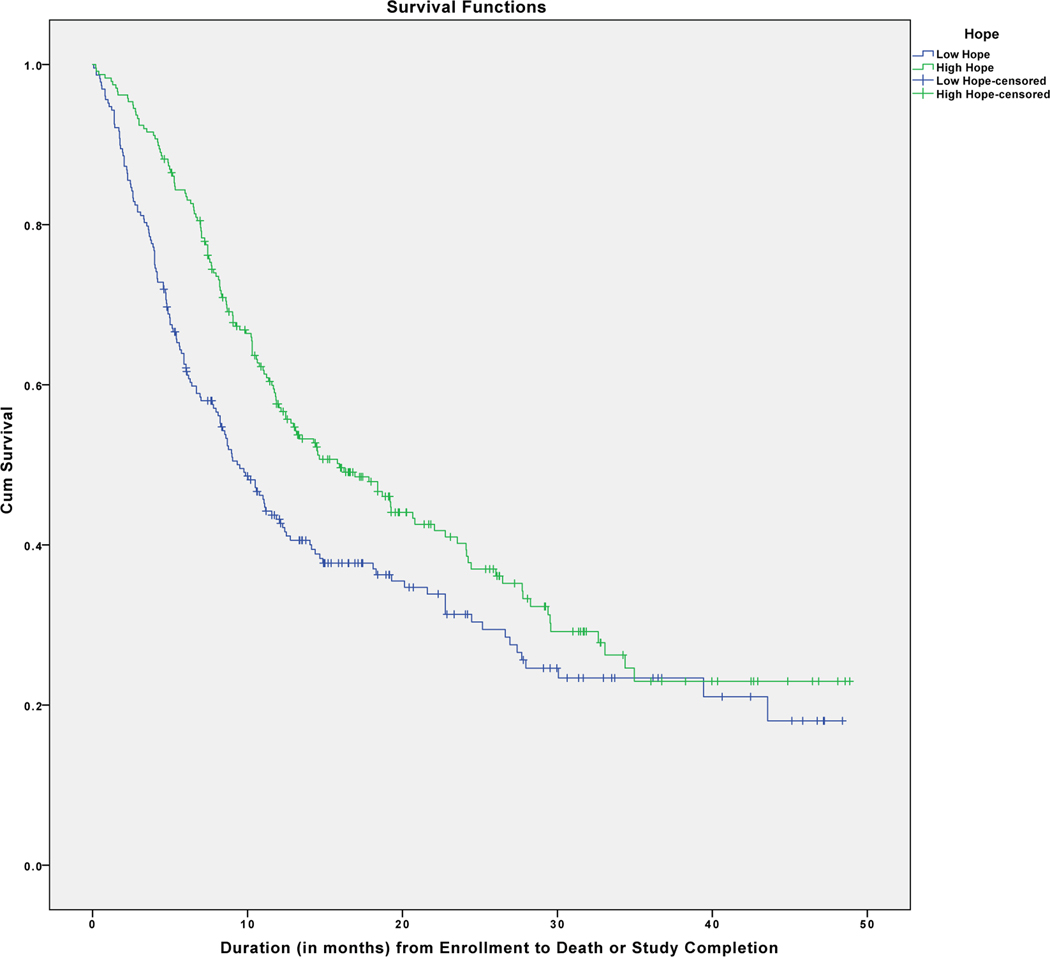
Background: Hopefulness, whether inherently present (dispositional hope) or augmented (by enhancement techniques), may affect outcomes. This study was performed to determine the association of dispositional hope with survival among patients diagnosed with advanced cancer.
Methods: Data from ENABLE (Educate, Nurture, Advise, Before Life Ends), a palliative care intervention, were reanalyzed to determine the association of higher dispositional hope and patient survival. This was a secondary analysis of data combined from the ENABLE II and ENABLE III randomized controlled trials (RCTs) with respect to dispositional hope and survival. A dispositional hope index was created from 3 hope items from 2 validated baseline questionnaires. Dispositional hope and survival data were collected during the 2 RCTs. In ENABLE II, participants were randomly assigned to the ENABLE intervention or to usual care. In ENABLE III, participants were randomly assigned to receive the intervention immediately or 12 weeks after enrollment.
Results: In all, 529 persons were included in Cox proportional hazards regression analyses to model the effects of dispositional hope on survival. An initial analysis without covariates yielded a significant effect of hope (Wald statistic, 8.649; hazard ratio, 0.941; confidence interval, 0.904-0.980; P = .003), such that higher dispositional hope was associated with longer survival. In a subsequent analysis that included all covariates, the effect of dispositional hope approached statistical significance (Wald statistic, 2.96; hazard ratio, 0.933; confidence interval, 0.863-1.010; P = .085).
Conclusions: Higher levels of dispositional hope were associated with longer survival in patients with advanced cancer. Prospective trials are needed to determine the effects of dispositional and augmented hope on the outcomes of patients with advanced cancer.
Trial registration: ClinicalTrials.gov NCT00253383 NCT01245621.
Keywords: Educate, Nurture, Advise, Before Life Ends (ENABLE); advanced cancer; hope; palliation; survival.
© 2021 American Cancer Society.
Conflict of interest statement
Conflicts of Interest: None.
Figures
References
-
- Siegel RL, Miller KD, Jemal A. Cancer statistics, 2020. CA Cancer J Clin 2020; 70: 7–30. - PubMed
-
- Corn BW, Feldman DB, Wexler ID: The science of hope. Lancet Oncol 2020; 21: e452–e459. - PubMed
-
- Feldman DB, Dreher DE: Can hope be changed in 90 minutes? Testing the efficacy of a single-session goal-pursuit intervention for college students. J Happiness Stud 2012; 13: 745–759.
-
- Snyder CR. Hope theory: Rainbows in the mind. Psychol Inq 2002; 13: 249–275.
-
- Snyder CR, Harris C, Anderson JR, et al. The will and the ways: Development and validation of an individual differences measure of hope. J Pers Soc Psychol 1991; 60: 570–585. - PubMed
Publication types
MeSH terms
Associated data
Grants and funding
LinkOut - more resources
Full Text Sources
Medical
