


Removal of Toxic Volatile Compounds in Batch Culture Prolongs Stationary Phase and Delays Death of Escherichia coli
- PMID: 34613759
- PMCID: PMC8612265
- DOI: 10.1128/AEM.01860-21
Removal of Toxic Volatile Compounds in Batch Culture Prolongs Stationary Phase and Delays Death of Escherichia coli
Abstract
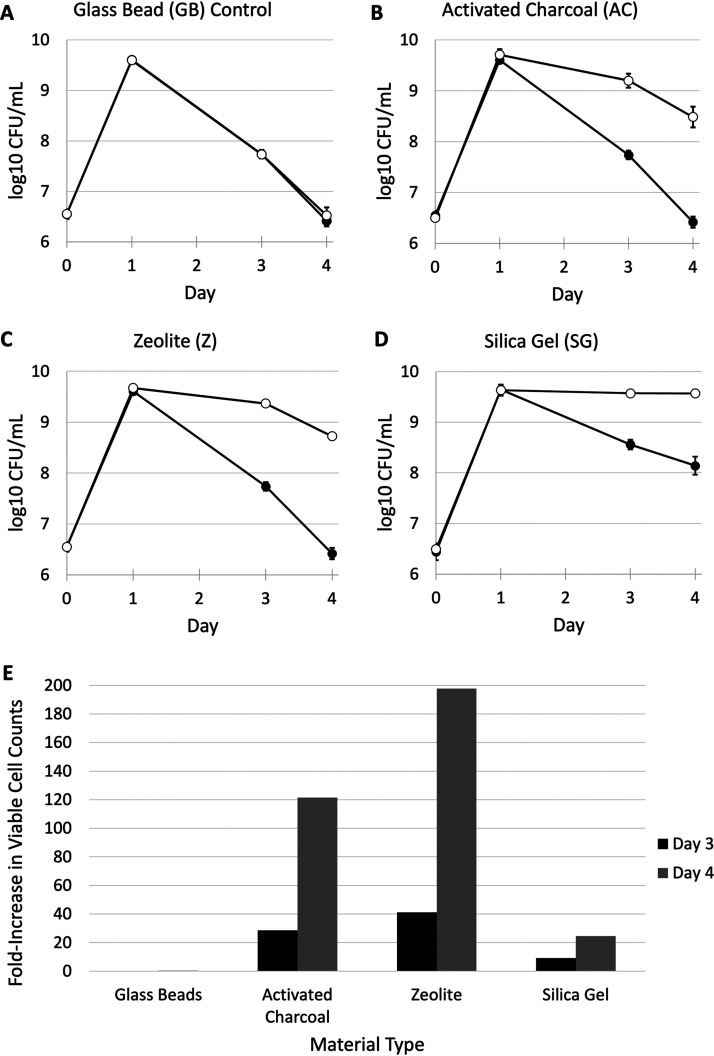
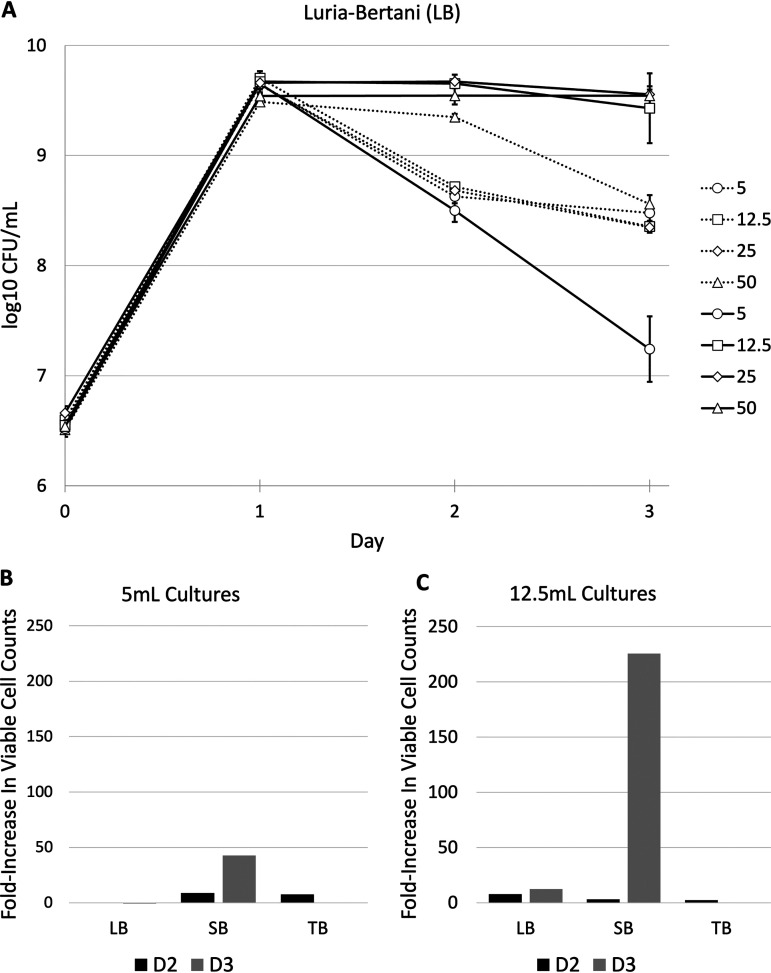
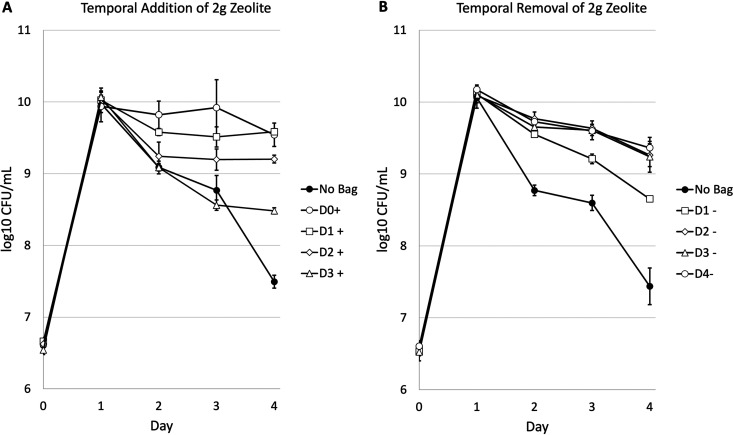
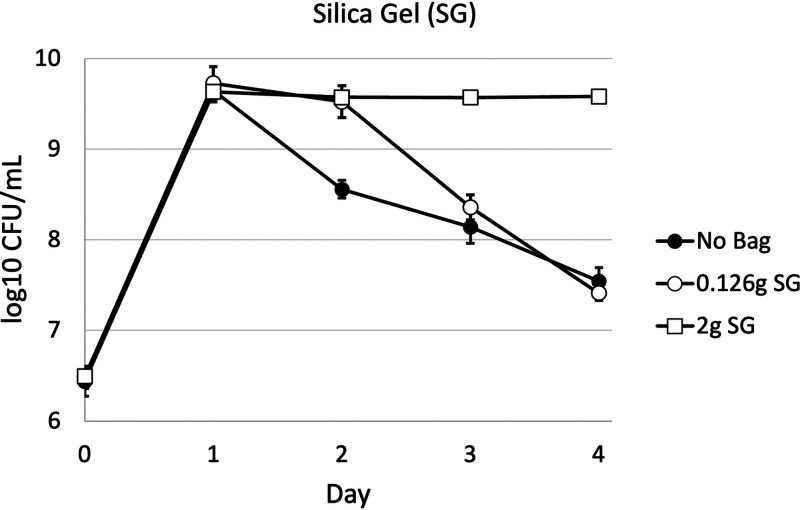
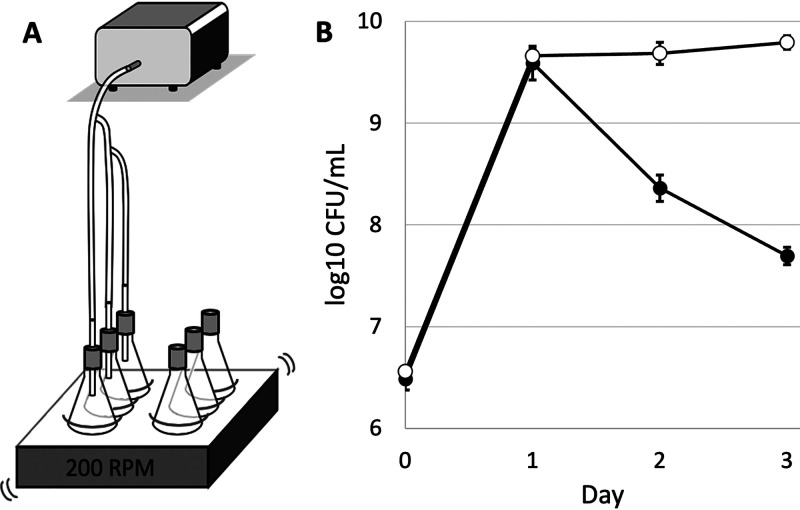
The mechanisms controlling entry into and exit from the death phase in the bacterial life cycle remain unclear. Although bacterial growth studies in batch cultures traditionally focus on the first three phases during incubation, two additional phases, the death phase and the long-term stationary phase, are less understood. Although there are a number of stressors that arise during long-term batch culture, including nutrient depletion and the accumulation of metabolic toxins such as reactive oxidative species, their roles in cell death are not well-defined. By manipulating the environmental conditions of Escherichia coli incubated in long-term batch culture through chemical and mechanical means, we investigated the role of volatile metabolic toxins in modulating the onset of the death phase. Here, we demonstrate that with the introduction of substrates with high binding affinities for volatile compounds, toxic by-products of normal cell metabolism, into the headspace of batch cultures, cells display a prolonged stationary phase and delayed entry into the death phase. The addition of these substrates allows cultures to maintain a high cell density for hours to days longer than cultures incubated under standard growth conditions. A similar effect is observed when the gaseous headspace in culture flasks is continuously replaced with sterile air, mechanically preventing the accumulation of metabolic by-products in batch cultures. We establish that toxic compound(s) are produced during the exponential phase, demonstrate that buildup of toxic by-products influence entry into the death phase, and present a novel tool for improving high-density growth in batch culture that may be used in future research or industrial or biotechnology applications. IMPORTANCE Bacteria, such as Escherichia coli, are routinely used in the production of biomaterials because of their efficient and sustainable capacity for synthesis of bioproducts. Industrial applications of microbial synthesis typically utilize cells in the stationary phase, when cultures have the greatest density of viable cells. By manipulating culture conditions to delay the transition from the stationary phase to the death phase, we can prolong the stationary phase on a scale of hours to days, thereby maintaining the maximum density of cells that would otherwise quickly decline. Characterization of the mechanisms that control entry into the death phase for the model organism E. coli not only deepens our understanding of the bacterial life cycle but also presents an opportunity to enhance current protocols for batch culture growth and explore similar effects in a variety of widely used bacterial strains.
Keywords: culture viability; long-term survival; stationary phase.
Figures
References
-
- Sambrook J. 2001. Molecular cloning: a laboratory manual, 3rd ed. Cold Spring Harbor Laboratory Press, Cold Spring Harbor, NY.
-
- Miller JH. 1972. Experiments in molecular genetics. Cold Spring Harbor Laboratory Press, Cold Spring Harbor, NY.
Publication types
MeSH terms
Substances
Grants and funding
LinkOut - more resources
Full Text Sources
